


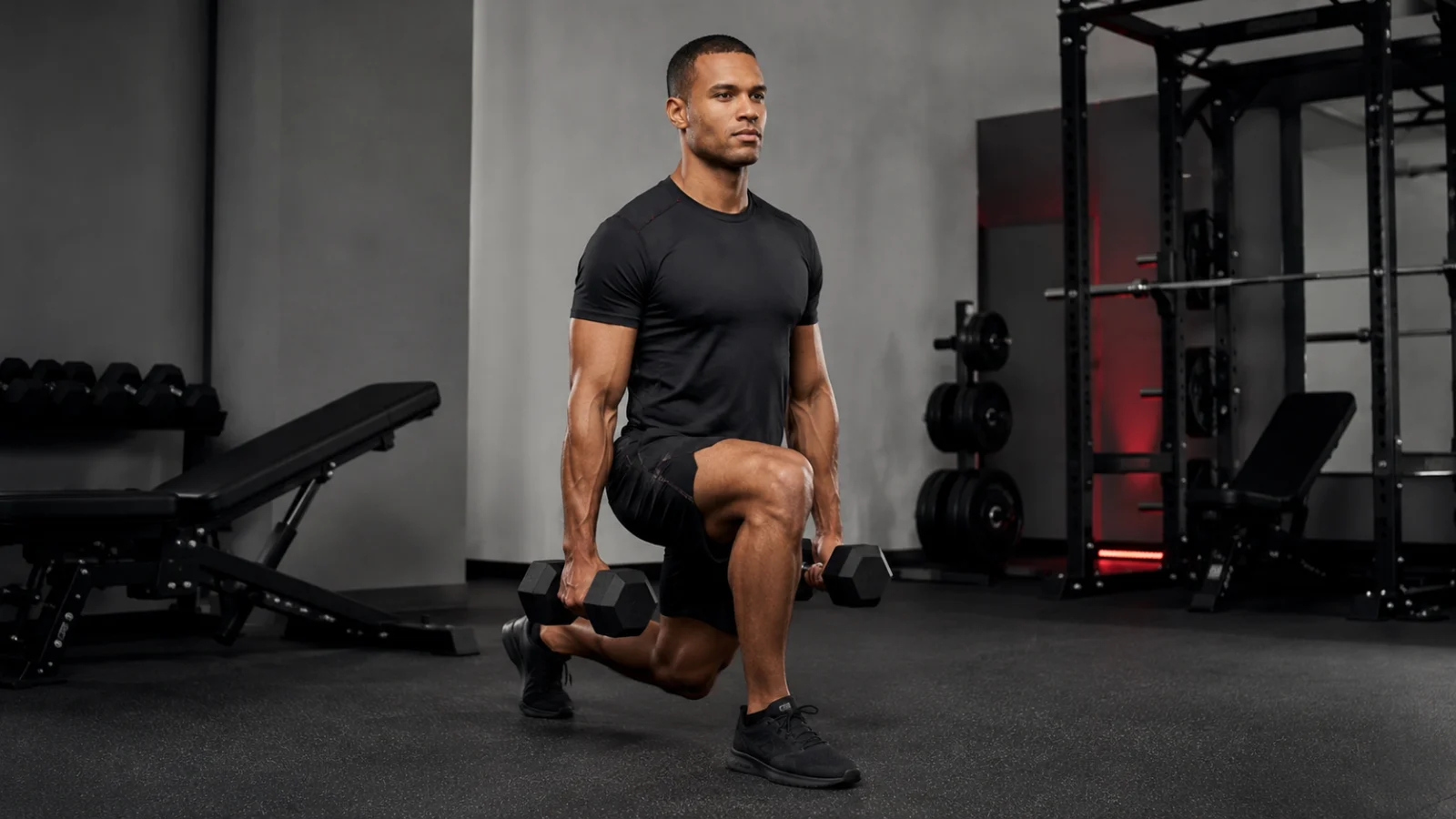
The dumbbell split squat is a stationary, unilateral-dominant leg exercise that trains the quadriceps and glutes while challenging balance and lower-body control.
Unlike a lunge, your feet remain planted throughout the set. This removes the repeated stepping action and lets you focus more closely on stance, depth and front-leg strength. You only need a pair of dumbbells and a small area of clear floor, making it practical for busy gyms and compact home gym setups.
Dumbbell Split Squat at a Glance
Exercise detail | Information |
|---|---|
Exercise type | Unilateral-dominant compound exercise |
Equipment needed | One or two dumbbells |
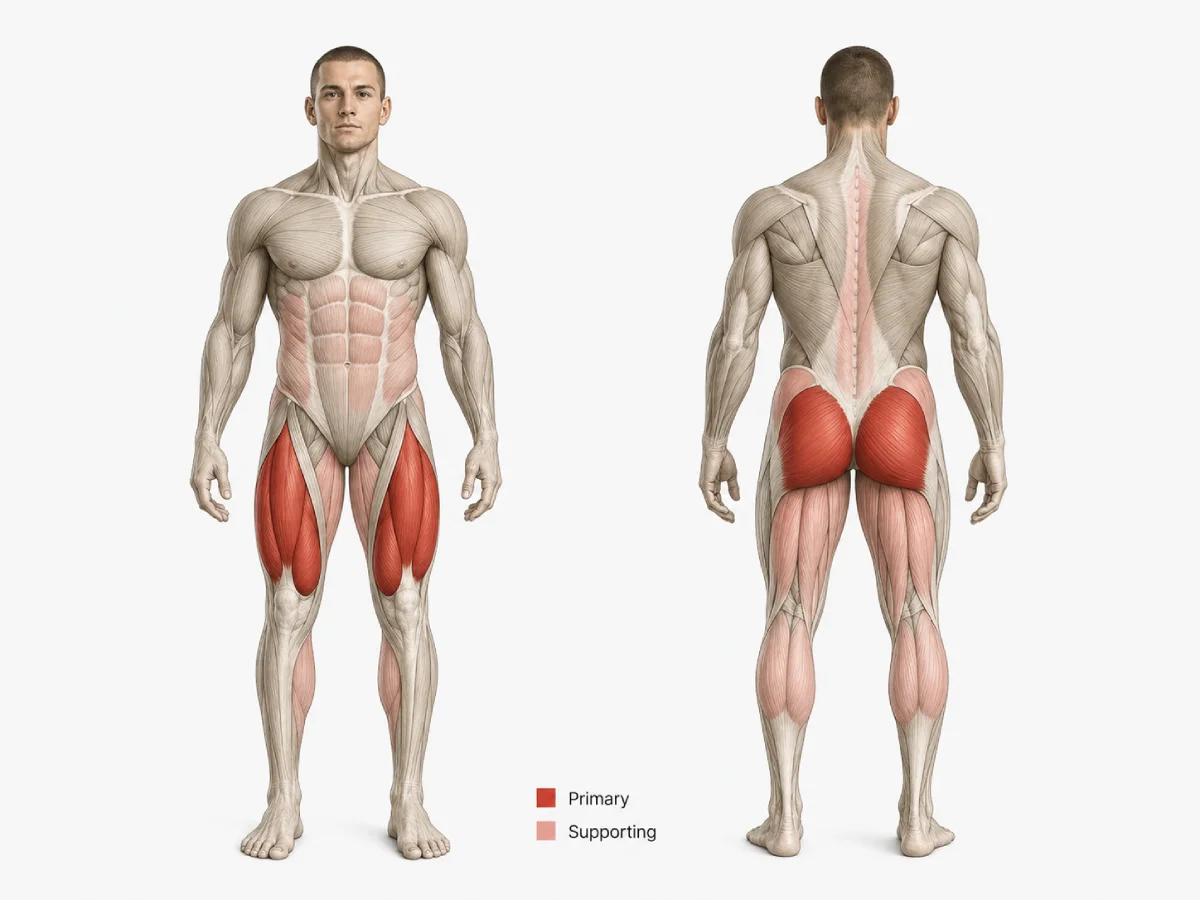
Primary muscles | Quadriceps and gluteus maximus |
Supporting muscles | Adductors, hamstrings, calves and core |
Movement pattern | Stationary split stance |
Difficulty | Beginner to intermediate |
Best for | Leg strength, muscle growth, balance and side-to-side control |
Beginner starting point | Learn the bodyweight version before adding load |
Safety note: Muscle fatigue and effort are expected, but sharp joint pain is not. Stop the exercise if it causes pain, numbness or loss of control. Anyone returning from an injury should seek guidance from a qualified healthcare or exercise professional.
What Is a Dumbbell Split Squat?
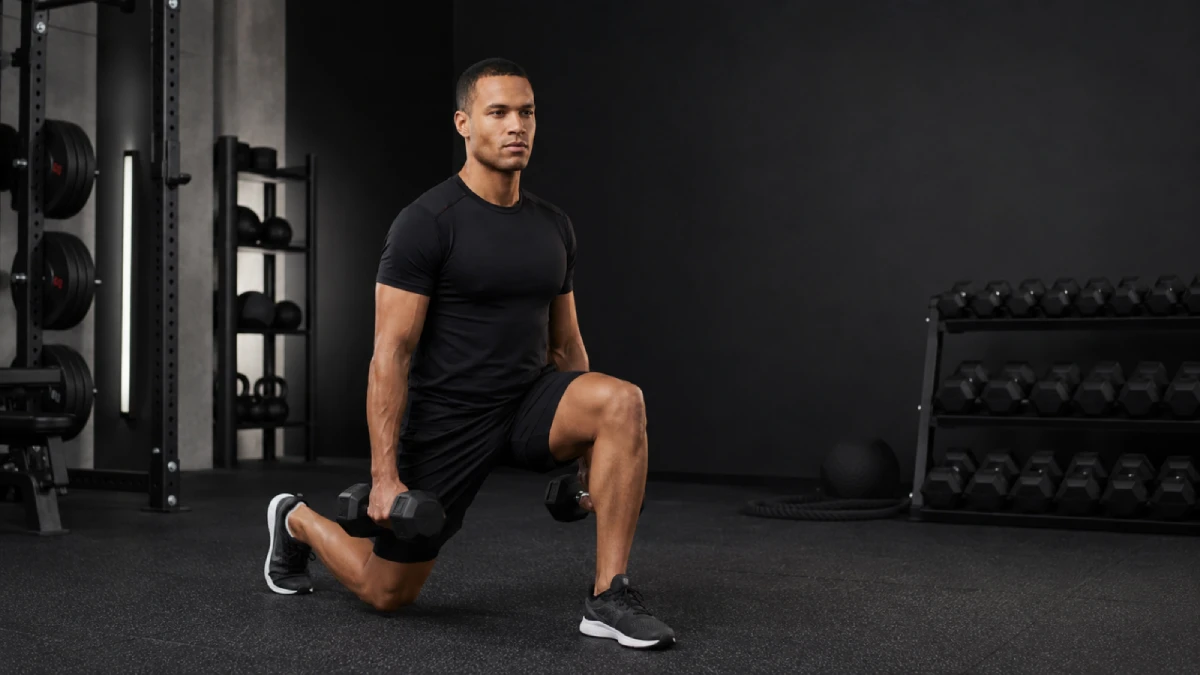
A dumbbell split squat is performed with one foot in front of the other while holding a dumbbell in each hand. Once you establish the stance, both feet remain in position until you complete the set on that side.
You bend both knees to lower the body, then push through the front foot to stand back up. The front leg performs most of the work, while the rear leg supports your balance and contributes naturally to the movement.
This differs from a dumbbell lunge, where you step into or out of the working position during every repetition. Removing the repeated step usually makes the split squat easier to practise under control.
Is a Split Squat the Same as a Static Lunge?
“Split squat” and “static lunge” are often used to describe the same general exercise. In both, the feet stay in a split position while the body moves down and up.
Forward, reverse and walking lunges are dynamic variations because one foot moves during each repetition. That stepping action introduces a different balance and coordination challenge.
How to Do a Dumbbell Split Squat
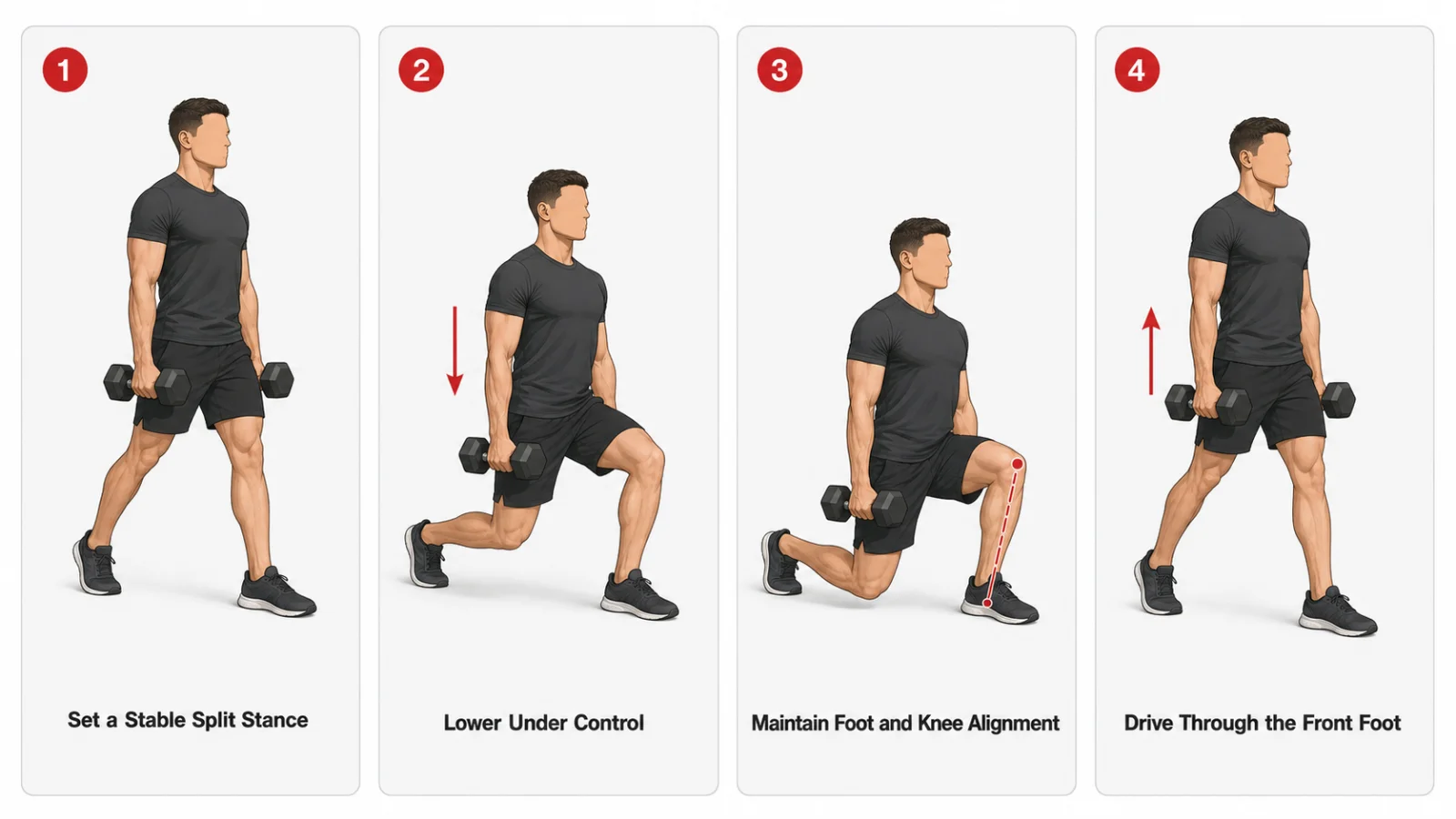
Learn the stance with bodyweight first. Once you can control the movement on both sides, add dumbbells without changing your depth or alignment.
1. Set Your Stance
Stand tall with a dumbbell in each hand and your arms relaxed by your sides.
Step one foot forward and the other behind you. Keep your feet approximately hip-width apart from side to side rather than placing them on one narrow line.
Plant the whole front foot on the floor. Keep the ball of the rear foot down and lift the rear heel.
2. Brace Your Trunk
Face your hips and chest forward. Gently brace your abdomen before beginning the repetition.
Your torso can remain upright or incline slightly forward depending on your proportions and training goal. It should not collapse or change position suddenly.
3. Lower Under Control
Bend both knees and lower your pelvis toward the floor.
Think about moving mainly down rather than lunging forward. Let the rear knee travel toward the floor while keeping your front foot planted.
4. Keep the Front Knee Aligned
Allow the front knee to move naturally as you descend. It should generally travel in the same direction as the middle toes.
The knee does not have to remain directly above the ankle, and it may travel past the toes when you have sufficient ankle mobility and maintain full-foot contact.1
5. Use a Controlled Depth
Lower until the rear knee approaches the floor or until you reach the deepest position you can control.
Stop before your front heel lifts, your pelvis rotates or your lower back changes position.
6. Push Through the Whole Front Foot
Press through the heel, base of the big toe and base of the little toe.
Extend the front knee and hip to rise. Avoid bouncing out of the bottom or driving aggressively from the rear foot.
7. Complete One Side
Return to the starting split stance without bringing your feet together.
Complete all planned repetitions on one side, then carefully switch your stance and repeat with the other leg forward.
Quick Form Checklist
Keep the feet hip-width apart from side to side.
Maintain full contact through the front foot.
Point the front knee in the same direction as the toes.
Keep the pelvis level and facing forward.
Lower the rear knee toward the floor.
Let the front leg produce most of the effort.
Use a steady, controlled tempo.
Stop the set when balance or alignment begins to break down.
Dumbbell Split Squat Muscles Worked
The dumbbell split squat trains several lower-body muscles simultaneously. Their relative contribution changes with your stance, range of motion, torso angle and loading position.
Quadriceps
The quadriceps are the four muscles at the front of the thigh:
Rectus femoris
Vastus lateralis
Vastus medialis
Vastus intermedius
Their primary role during the split squat is to extend the front knee as you rise. They generally work harder when the front knee bends deeply and travels forward under control.
That makes the split squat a useful addition to a programme containing other quadriceps exercises, such as the front squat, goblet squat or leg press.
Gluteus Maximus
The gluteus maximus helps extend the front hip as you stand from the bottom position.
A small musculoskeletal-modelling study by Schellenberg and colleagues found high gluteus maximus loading in the front leg during the split squat. It also found that muscle forces changed with step length, front-shin position and range of motion.2 This supports using stance adjustments strategically rather than assuming every split squat trains the muscles identically.
For more direct hip-extension work, see the hip thrust exercise guide.
Adductors and Hamstrings
The adductors help control the thigh and pelvis, while the hamstrings assist with hip control and stabilise the knee.
They are not passive stabilisers. Their involvement can increase as the stance becomes longer and the exercise requires more hip flexion.
Gluteus Medius, Calves and Core
The gluteus medius helps control the pelvis and resist unwanted inward movement of the front knee.
The calves stabilise the ankle and rear foot. The abdominals, obliques and erector spinae keep the trunk from rotating, arching or bending excessively.
Does the Back Leg Work?
Yes. The front leg should be the main driver, but the rear leg is not merely a passive “kickstand.”
Its contribution depends on your stance, depth, load and individual technique. Rather than trying to maintain an exact front-to-back weight percentage, focus on whether the front leg controls the descent and produces most of the upward force.
How Stance Length and Torso Position Change the Exercise
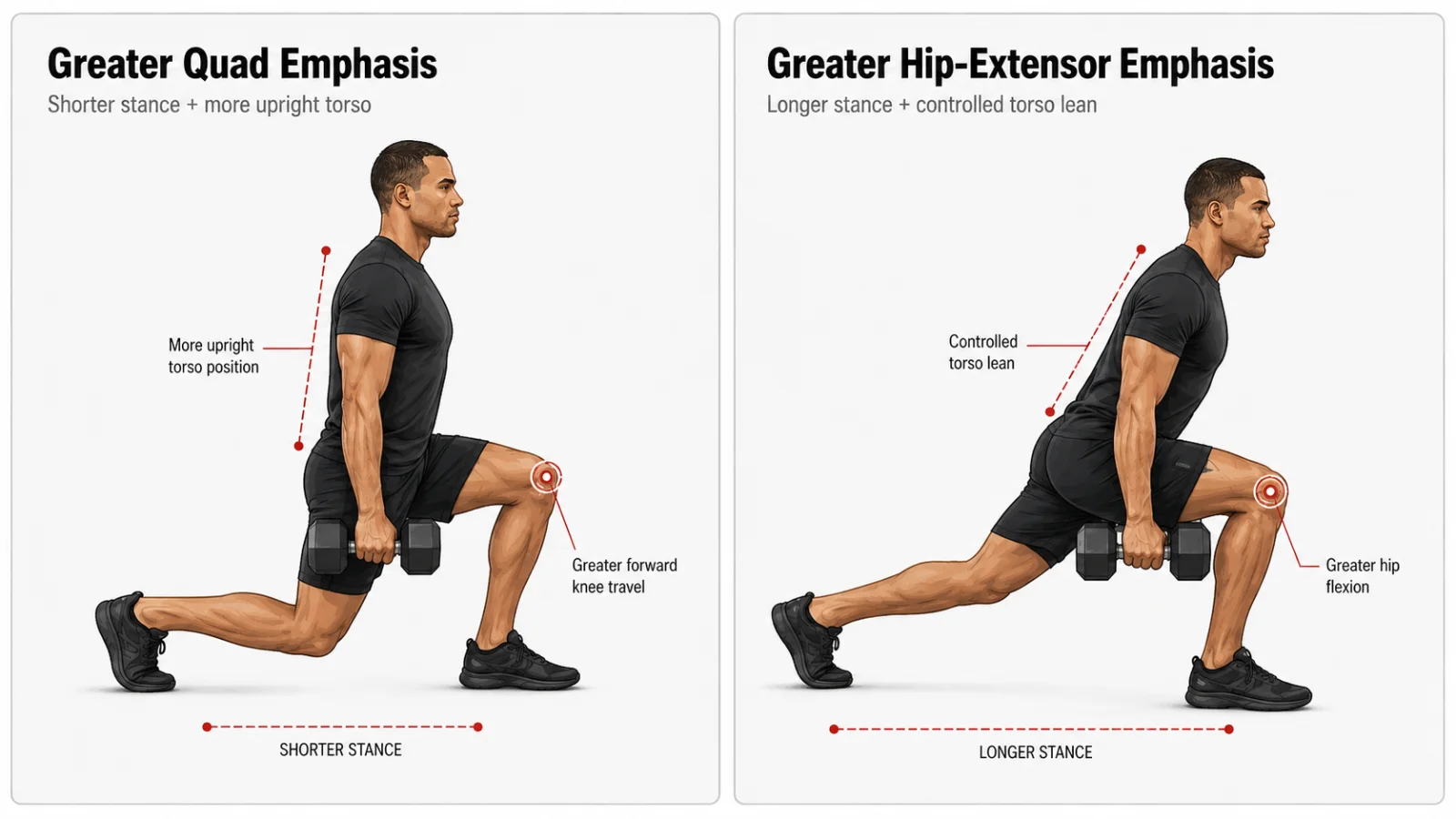
Small technique adjustments can shift the relative demand between the front knee and hip. They cannot completely isolate the quadriceps or glutes, but they can make the movement more knee- or hip-dominant.
In a 2023 study, Song and colleagues tested four split-squat step lengths in 20 physically active male college students. Longer steps altered hip, knee and ankle mechanics and generally increased hip-extensor activation while having a more limited effect on knee-extensor activation.3 Because the sample was small and specific, the findings are best used as practical guidance rather than a universal stance formula.
How to Find a Comfortable Starting Stance
Start with roughly one natural walking stride. Perform a few bodyweight repetitions and ask:
Can both knees bend comfortably?
Does the entire front foot remain planted?
Can the rear knee descend without your pelvis twisting?
Do you feel stable from side to side?
Can you stand without pushing strongly from the rear foot?
Your stance is probably too short if the position feels cramped, your front heel lifts or the rear knee cannot lower comfortably.
It may be too long if your pelvis rotates, your lower back arches or you cannot produce force smoothly through the front leg.
How to Increase Relative Quad Demand
To place relatively more demand on the quadriceps:
Use a slightly shorter stance.
Keep the torso more upright.
Allow controlled forward movement of the front knee.
Maintain pressure through the whole front foot.
Use as much knee flexion as you can control.
Greater front-knee flexion usually increases the knee-extension demand. However, do not force additional knee travel if the heel lifts or discomfort appears.
The objective is not to keep the shin perfectly vertical. It is to achieve controlled knee movement while preserving foot pressure and alignment.
How to Increase Relative Glute and Hip-Extensor Demand
To shift relatively more demand toward the hip extensors:
Lengthen the stance slightly.
Incline the torso modestly from the hips.
Maintain a neutral spine.
Allow greater hip flexion at the bottom.
Keep the front foot fully planted.
The torso should move as one controlled unit. Do not round the back or collapse the chest toward the thigh.
A longer stance can increase hip-extensor demand, but an excessively long position often reduces stability and usable range of motion.
Quad-Biased vs Hip-Biased Split Squat
Technique variable | More quad emphasis | More hip-extensor emphasis |
|---|---|---|
Stance length | Slightly shorter | Slightly longer |
Torso position | More upright | Modest forward inclination |
Front knee | Travels forward under control | Usually less forward travel |
Hip flexion | Moderate | Greater |
Main coaching cue | Lower straight down while bending the knee | Sit down and slightly back through the hip |
Non-negotiable | Front foot remains planted | Spine and pelvis remain controlled |
Benefits of the Dumbbell Split Squat
1. Trains Each Leg Separately
A stronger leg can compensate during bilateral exercises without you noticing. Split squats make differences in strength, balance and range of motion easier to identify.
Small differences between sides are normal. The objective is not perfect symmetry, but improving each leg without allowing the stronger side to perform the weaker side’s work.
2. Builds the Quadriceps and Glutes
The exercise combines knee extension and hip extension, allowing the quadriceps and glutes to work through a meaningful range of motion.
Because one leg is emphasised at a time, many lifters can challenge it without using the same total external load required for a heavy bilateral squat.
3. Complements Bilateral Squats
Unilateral and bilateral training are not interchangeable, and neither is automatically superior.
A meta-analysis of 28 studies found that training adaptations showed a strong specificity effect: unilateral training transferred better to unilateral strength and power patterns, while bilateral training transferred better to bilateral patterns.4 The authors did not identify one method as best for every performance measure.
In practice, dumbbell split squats work well alongside bilateral movements such as the barbell back squat or front squat.
4. Develops Balance and Lower-Body Control
The split stance requires you to control the ankle, knee, hip and trunk together.
Balance should challenge you without becoming the only factor limiting the set. When instability prevents the target muscles from working effectively, reduce the load, widen your stance or lightly hold a stable support.
5. Requires Minimal Space and Equipment
A standard split squat does not require a rack, barbell or bench. You only need a clear patch of floor and suitable dumbbells.
This makes it practical for compact Indian homes, crowded commercial gyms and sessions built around a dumbbell workout.
6. Fits Several Training Goals
Depending on the load, tempo and repetitions, dumbbell split squats can support:
Beginner movement practice
Lower-body hypertrophy
Strength accessory work
Muscular endurance
Athletic preparation
Home-gym training
The exercise should complement your wider programme rather than automatically replace every squat, lunge or leg machine.
Common Dumbbell Split Squat Mistakes
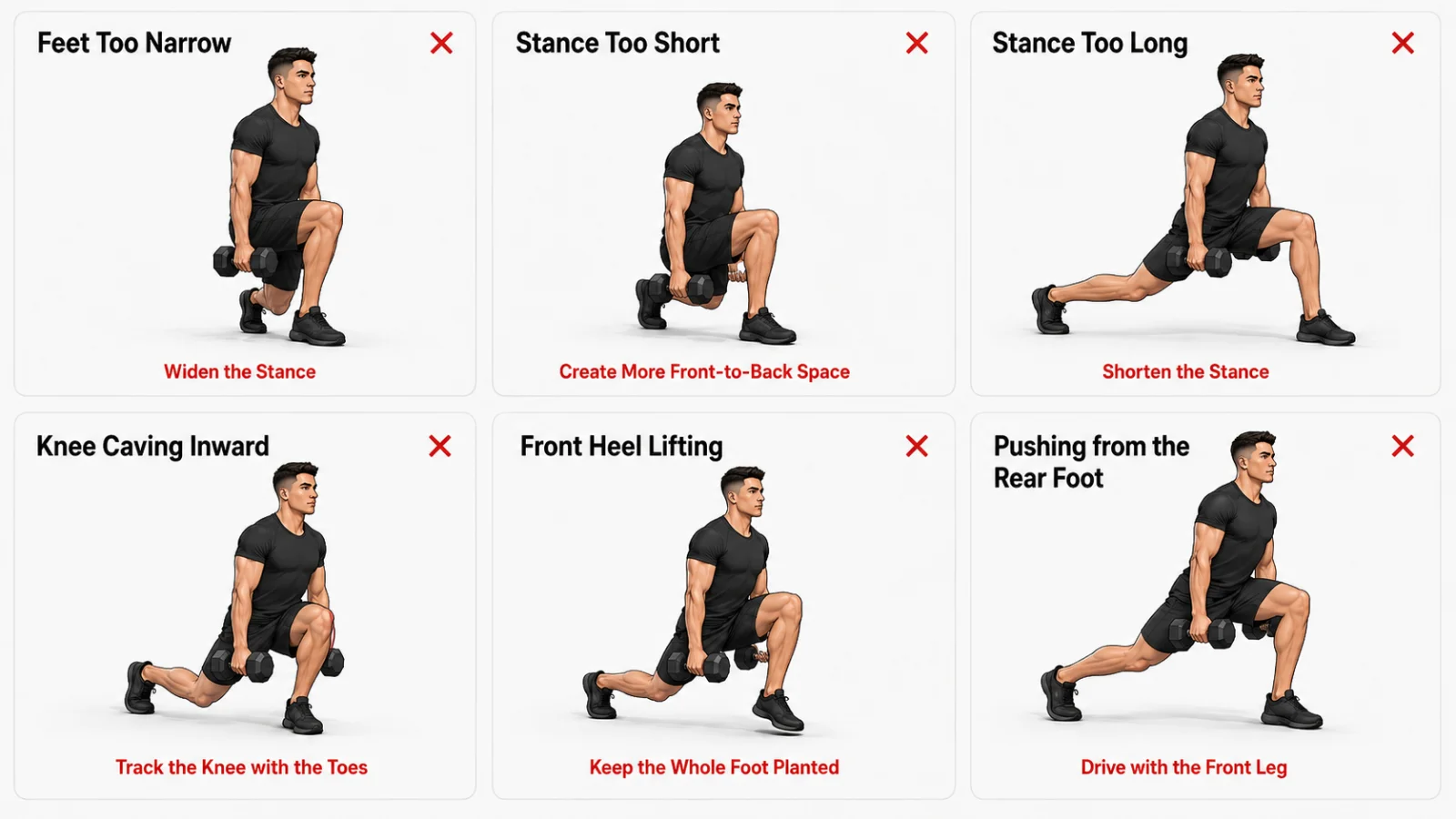
1. Standing on a Tightrope
The problem: Both feet are positioned on one narrow line, creating unnecessary side-to-side instability.
The correction: Keep the feet approximately hip-width apart laterally. Imagine standing on two parallel railway tracks rather than one rope.
2. Using a Stance That Is Too Short
The problem: The movement feels cramped, the rear knee cannot descend comfortably or the front heel starts to lift.
The correction: Increase the front-to-back distance slightly. Retest your depth after each small adjustment rather than taking one very large step.
3. Overstretching the Stance
The problem: The feet are so far apart that the pelvis rotates, the lower back arches or you cannot rise smoothly.
The correction: Shorten the stance until both knees can bend and your pelvis can lower without changing position.
A longer stance is not automatically better for the glutes. You still need stability and usable range of motion.
4. Letting the Front Knee Collapse Inward
The problem: The front knee moves noticeably inside the line of the foot, especially while you stand.
The correction: Keep the knee moving in the same general direction as the middle toes. Reduce the load or range of motion if you cannot maintain that relationship.
Do not force the knee excessively outward. Aim for controlled alignment rather than an exaggerated position.
5. Allowing the Front Heel to Lift
The problem: Pressure shifts onto the toes and the heel separates from the floor.
The correction: Reduce the depth, adjust the stance and slow the descent. Maintain contact through the heel and both sides of the forefoot.
Limited ankle mobility can contribute, but an unsuitable stance or uncontrolled descent may produce the same error.
6. Pushing Too Much Through the Rear Foot
The problem: The back leg becomes the main source of upward force, reducing the challenge on the working front leg.
The correction: Use the rear foot for support while consciously pressing the floor away with the front leg. If necessary, reduce the load and use a slower tempo.
7. Collapsing the Torso or Overarching the Back
The problem: The chest drops suddenly, or you force an upright position by excessively arching the lower back.
The correction: Brace before descending. Use an upright or modestly inclined torso according to your goal, but maintain a stable relationship between the ribcage and pelvis.
A slight forward torso angle is not automatically poor form. Uncontrolled spinal movement is the concern.
8. Dropping Too Quickly
The problem: You fall into the bottom position and use momentum to reverse the movement.
The correction: Lower for approximately two to three seconds. Pause briefly if needed, then rise without bouncing.
A controlled descent also makes stance and mobility problems easier to identify.
Dumbbell Split Squat vs Lunge vs Bulgarian Split Squat
These three exercises use a split-legged position, but they have different movement and stability demands.
Feature | Dumbbell split squat | Dumbbell lunge | Bulgarian split squat |
|---|---|---|---|
Foot movement | Both feet remain stationary | One foot steps during each repetition | Front foot stays planted; rear foot is elevated |
Stability demand | Moderate | Moderate to high | Generally higher |
Range of motion | Moderate | Depends on the variation | Usually greater |
Setup complexity | Low | Low to moderate | Moderate |
Beginner suitability | Often the easiest starting point | Depends on stepping control | Better after basic split-squat control |
Primary use | Controlled unilateral strength | Dynamic unilateral movement | Greater front-leg challenge |
Equipment | Dumbbells | Dumbbells | Dumbbells and a stable bench or platform |
Start with the standard split squat when you want to develop stance and control.
Choose a dumbbell rear lunge when you want a dynamic stepping pattern. Progress to the Bulgarian split squat after you can maintain balance, depth and front-foot pressure consistently.
Dumbbell Split Squat Sets and Reps
Your working range should reflect your goal and ability to maintain technique.
Training goal | Suggested starting range | Programming guidance |
|---|---|---|
Learning the movement | 2–3 sets of 6–8 per leg | Use bodyweight or light dumbbells |
Muscle growth | 3–4 sets of 8–12 per leg | Finish with approximately 1–3 controlled reps in reserve |
Strength accessory | 3–4 sets of 5–8 per leg | Use a stable stance and progressively heavier load |
Muscular endurance | 2–3 sets of 12–15 per leg | Preserve control instead of rushing |
These are starting ranges rather than fixed rules. End the set when you reach the target repetitions or when balance, depth or alignment begins to deteriorate.
How Heavy Should the Dumbbells Be?
There is no universal beginner weight. Body size, balance, mobility and training history can make the same dumbbells appropriate for one person and unsuitable for another.
Choose a load that allows you to:
Keep the front foot planted.
Use a consistent range of motion.
Control the descent.
Avoid bouncing or excessive rear-leg push-off.
Maintain similar technique on both sides.
Finish with approximately one to three clean repetitions remaining.
If you cannot complete six controlled bodyweight repetitions per side, continue practising without dumbbells.
How to Progress the Exercise
Use the following progression:
Establish a stable stance.
Improve control and depth.
Reach the top of your target rep range.
Add a small amount of weight.
Rebuild your repetitions with the new load.
Later introduce pauses, slower descents or elevation.
Do not increase the weight and range of motion simultaneously. Change one variable at a time so you can assess its effect on your form.
Explore LIFE FIT’s range of dumbbells for progressive lower-body training at home or in a commercial gym. Access to several weight increments makes it easier to progress without taking unnecessarily large jumps.
Best Dumbbell Split Squat Variations
Bodyweight Split Squat
The bodyweight version is the best place to learn stance, depth and knee tracking.
Lightly hold a wall or stable upright when balance prevents you from practising the movement correctly. Reduce the assistance as your control improves.
Goblet Split Squat
Hold one dumbbell vertically in front of your chest.
The centred loading position can be easier to balance than two dumbbells held at the sides. It may also encourage a more upright torso, making it a useful progression from the dumbbell goblet squat.
Front-Foot-Elevated Dumbbell Split Squat
Place the front foot on a low, stable platform.
The elevation creates additional space for the rear knee to descend and can increase the available range of motion. Start with a small elevation and increase it only when you can keep the front foot planted.
Pause Dumbbell Split Squat
Pause for one or two seconds near the bottom before standing.
This removes momentum and increases the difficulty without immediately adding heavier dumbbells. It also helps reveal whether you are relying on a bounce or rear-leg push-off.
Tempo Dumbbell Split Squat
Lower for three or four seconds, pause briefly and rise under control.
A slower eccentric phase increases time under tension and is useful when the available dumbbells are too light for conventional repetitions.
Single-Dumbbell Split Squat
Holding one dumbbell increases the anti-rotation demand on your trunk.
Contralateral loading: Hold the dumbbell opposite the front leg.
Ipsilateral loading: Hold it on the same side as the front leg.
Neither position is universally better. Choose the version that fits your training goal while allowing good pelvic and trunk control.
Bulgarian Split Squat
Place the rear foot on a stable bench or platform while keeping the front foot planted.
This usually increases the balance requirement and available range of motion. It should be treated as a progression—not as a mandatory replacement for the standard split squat.
Dumbbell Step-Up
The dumbbell step-up is another unilateral-dominant exercise, but it involves raising the body onto an elevated surface.
Use split squats for controlled tension in a stationary stance. Use step-ups when you want to practise single-leg elevation and upward drive.
Frequently Asked Questions
Both feet remain planted during a dumbbell split squat. During a lunge, one foot steps forward, backward or across the floor during each repetition. The lunge therefore adds a dynamic balance and coordination requirement.
The front leg should produce most of the effort. The rear leg supports balance and contributes naturally, but it should not become the primary driver. Adjust your stance or reduce the load if you consistently feel the movement only in the back leg.
It trains both. A shorter stance, more upright torso and greater front-knee flexion can increase relative quadriceps demand. A slightly longer stance with controlled forward torso inclination can shift relatively more demand toward the glutes and other hip extensors.
Start with roughly one comfortable walking stride from front to back and keep the feet approximately hip-width apart laterally. Adjust the stance until both knees can bend, the front foot remains planted and the pelvis can lower without twisting.
Yes, provided the movement is controlled, the front heel remains planted and the knee tracks in the same direction as the toes. Limb proportions, ankle mobility, stance length and training goals all influence how far the knee travels.
Use a weight that lets you maintain stable feet, controlled depth and consistent knee alignment. Beginners may need to start with bodyweight. Increase the load only after reaching the top of the planned repetition range without losing technique.
Begin with two or three sets of six to eight controlled repetitions per leg. Start with bodyweight or light dumbbells. Increase repetitions gradually before adding more weight.
No. A standard split squat keeps both feet on the floor. A Bulgarian split squat elevates the rear foot on a bench or platform, usually increasing the range of motion and balance requirement.
Final Takeaway
The dumbbell split squat becomes more effective when control comes before load.
Keep the feet stationary, maintain pressure through the whole front foot and let the front leg perform most of the work. Use a slightly shorter, more upright stance for greater quad emphasis or a somewhat longer stance with a controlled forward inclination for greater hip-extensor emphasis.
Master those fundamentals before adding heavier dumbbells or progressing to more demanding variations.
Planning a Complete Gym Setup?
LIFE FIT provides equipment-selection, layout and installation support for home and commercial fitness spaces. Explore our home gym equipment or request a customised quotation.
References & Footnotes
- Song Q, Ma M, Liu H, Wei X, and Chen X (2023) found that changing split-squat step length significantly altered hip, knee, and ankle angles, as well as hip and knee extension moments. This supports treating front-knee and shin position as individual technique variables rather than enforcing one fixed shin angle. The study did not establish one universally safe or pain-free knee position for every person. Source ↩
- Schellenberg F, Taylor WR, and Lorenzetti S (2017) used individualised musculoskeletal models to examine muscle forces across 10 split-squat variations in 11 participants. The front limb showed high gluteus maximus loading, while muscle forces changed with hip flexion, step length, and tibial angle. These findings describe the tested conditions and should not be treated as universal muscle-activation percentages. Source ↩
- Song et al. (2023) tested 20 physically active male college students at split-squat step lengths equal to 50%, 70%, 100%, and 120% of individual leg length. Increasing step length changed lower-limb joint angles and hip and knee extension moments. The authors reported greater activation of the hip extensors with comparatively limited effects on the knee extensors. Source ↩
- Zhang W, Chen X, Xu K, and colleagues (2023) included 28 papers comparing unilateral and bilateral training interventions. The results showed a task-specific pattern: unilateral training tended to produce greater improvements in unilateral performance measures, while bilateral training was more specific to bilateral performance. The authors recommended unilateral training as a complement or alternative to bilateral training rather than declaring one method universally superior. Source ↩
0 Comments
Loading comment form…
Loading comments…