


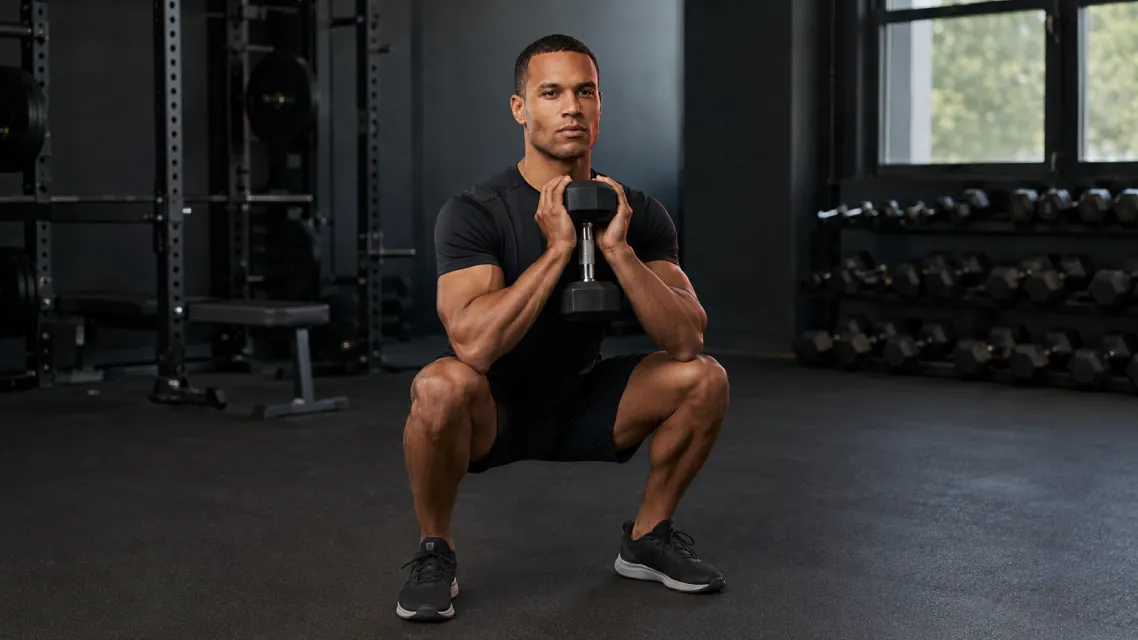
The dumbbell goblet squat exercise is one of the simplest and most effective squat variations for building lower-body strength, improving squat form, and training your legs at home or in the gym.
Unlike a barbell back squat, the goblet squat uses a single dumbbell held close to your chest. This front-loaded position encourages a more upright torso, helps many beginners learn better squat mechanics, and still challenges the quads, glutes, hamstrings, core, and upper back. NASM describes the goblet squat as a compound lower-body exercise using a dumbbell or kettlebell held in front of the body to build strength and establish proper squat mechanics.
For anyone building a home gym, this is also a practical exercise because it does not require a full rack setup. A pair of quality dumbbells or even one fixed-weight dumbbell is enough to get started.
What Is a Dumbbell Goblet Squat?
A dumbbell goblet squat is a squat variation where you hold one dumbbell vertically in front of your chest while performing a squat.
The name “goblet” comes from the way you hold the weight, similar to holding a cup or goblet. Your elbows point down, the dumbbell stays close to your body, and your torso remains upright as you lower into the squat.
This makes the movement useful for:
Beginners learning proper squat depth
Home gym users with limited equipment
Lifters who want a quad-focused squat variation
People who struggle to stay upright in bodyweight squats
Warm-ups before heavier leg training
High-rep leg finishers
The goblet squat is not a full replacement for heavy barbell squats if your goal is maximum strength. But it is one of the best exercises for learning the squat pattern and building strong legs with minimal equipment.
For a more advanced barbell-based squat setup, you can also read the barbell back squat guide.
Dumbbell Goblet Squat Muscles Worked
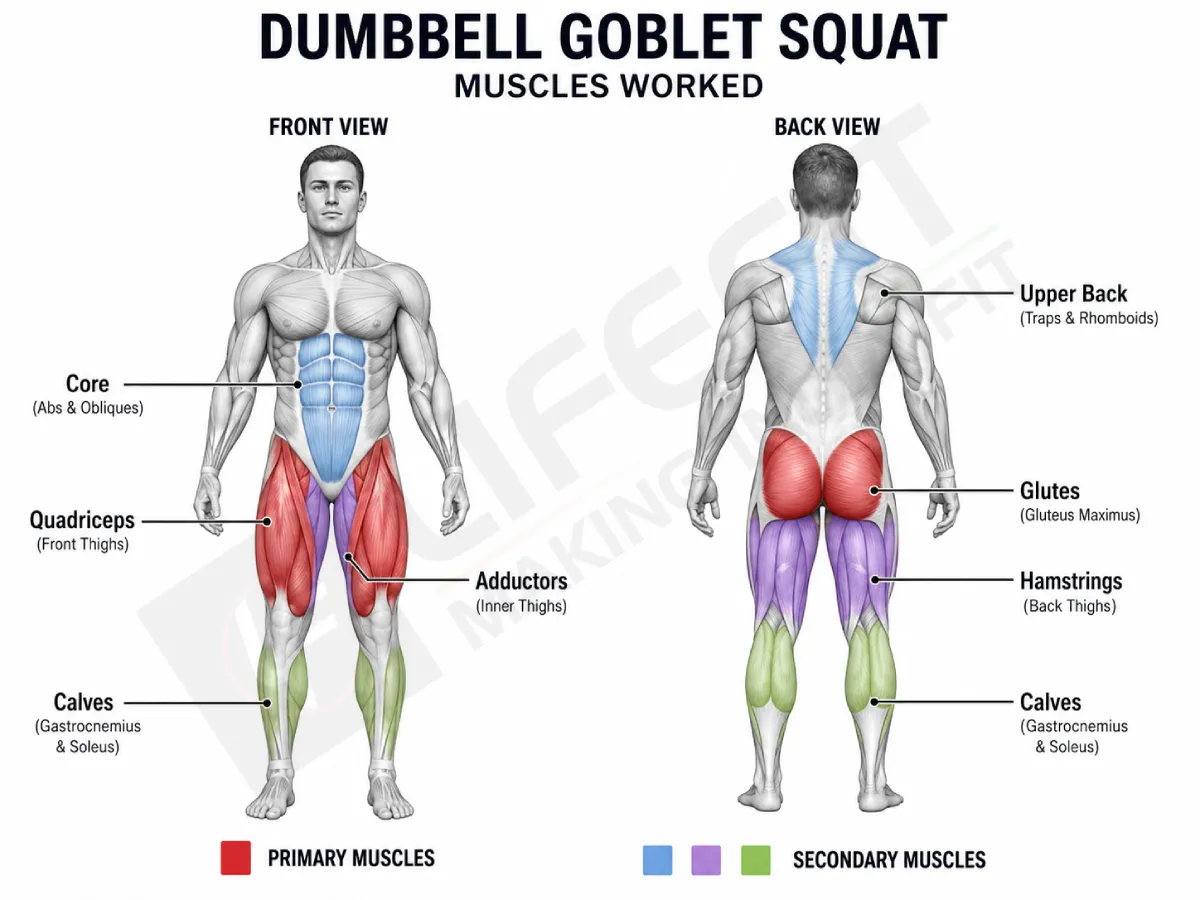
The dumbbell goblet squat mainly works the lower body, but because the weight is held in front of the chest, your core and upper body also help stabilize the movement.
Primary Muscles
Quadriceps: Your quads work hard as you bend and straighten your knees. If you stay upright and use a controlled squat depth, the goblet squat can feel very quad-focused.
Glutes: Your glutes help extend the hips as you stand up from the bottom position. Deeper squats generally increase hip involvement, as long as you can maintain control.
Secondary Muscles
Hamstrings: The hamstrings assist during hip control and help stabilize the movement.
Adductors: The inner thigh muscles help stabilize the hips and knees, especially when using a slightly wider stance.
Calves: Your calves assist with ankle stability and balance.
Core: Your abs and obliques help keep your torso stable while the dumbbell pulls your body forward.
Upper back and forearms: Your upper back supports posture, while your hands and forearms hold the dumbbell in position.
Research on squat variations shows that load position can influence trunk and lower-body muscle activity, which is why front-loaded squat variations like goblet squats often feel different from back squats.
How to Do a Dumbbell Goblet Squat Correctly
Start with a light dumbbell until your form feels stable and repeatable.
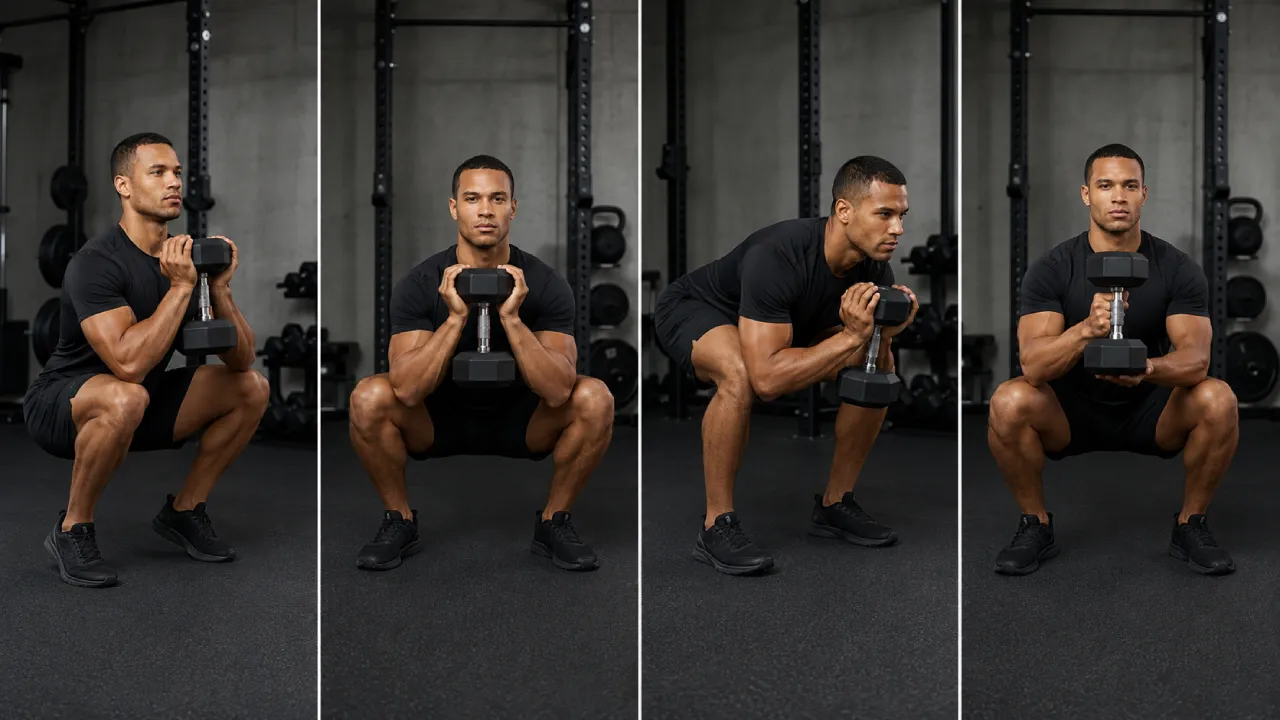
Hold the Dumbbell at Chest Height: Hold one dumbbell vertically with both hands. Your palms can support the top end of the dumbbell, or you can hold the sides of the top plate. Keep the dumbbell close to your chest. Do not let it drift forward.
Set Your Feet: Stand with your feet around shoulder-width apart. Turn your toes slightly outward if that feels natural for your hips. Your stance should allow your knees to track in the same direction as your toes.
Brace Your Core: Before you squat, take a breath and gently brace your midsection. Think of keeping your ribs stacked over your hips. Avoid arching your lower back or letting your chest collapse.
Lower Under Control: Push your hips slightly back and bend your knees. Lower until your thighs are at least close to parallel with the floor, or as low as you can go without your heels lifting or your back rounding. Keep your elbows pointing down. They may travel inside your knees at the bottom.
Drive Back Up: Push through your mid-foot and heel to stand up. Keep your chest tall, knees tracking over your toes, and dumbbell close to your body.
Reset Before the Next Rep: At the top, squeeze your glutes lightly, re-brace, and repeat.
Do not rush the reps. The goal is clean control, not just moving the dumbbell up and down.
Key Form Cues
Use these simple cues while training:
Problem | Coaching Cue |
|---|---|
Chest falling forward | Show your chest to the wall ahead. |
Knees collapsing inward | Push knees in line with toes. |
Heels lifting | Keep pressure through mid-foot and heel. |
Dumbbell drifting forward | Keep the weight glued to your chest. |
Back rounding | Brace before you descend. |
Shallow depth | Lower only as far as you can control. |
A study on squat techniques found that lower-extremity muscle activation can change based on knee alignment, which supports the importance of keeping the knees controlled instead of letting them cave inward.
Benefits of the Dumbbell Goblet Squat Exercise
Helps Beginners Learn Proper Squat Form: The front-loaded position naturally encourages many people to keep the chest more upright. That makes the dumbbell goblet squat a strong teaching exercise before progressing to heavier squat variations. It is especially useful if your bodyweight squat feels unstable or if you struggle to find depth.
Builds Stronger Quads and Glutes: The goblet squat trains the major lower-body muscles used in squatting: quads, glutes, hamstrings, and adductors. For more complete leg development, you can pair it with machine-based exercises like the leg press or leg extension.
Trains Core Stability: Because the dumbbell sits in front of your body, your core has to resist the forward pull of the weight. Research comparing front and back-loaded squat variations suggests that bracing and load placement can affect trunk and lower-extremity mechanics during squatting.
Works Well for Home Workouts: You do not need a barbell, bench, or squat rack to perform goblet squats. This makes it a smart choice for people setting up a compact home gym with dumbbells, kettlebells, floor mats, and basic strength equipment.
Improves Squat Depth and Control: The goblet position can act as a counterbalance, helping some lifters sit deeper into the squat while staying balanced. This does not mean everyone should force a deep squat. Your depth should depend on your ankle mobility, hip comfort, knee control, and ability to keep your spine neutral.
Easier to Learn Than Barbell Squats: Barbell squats require more setup, shoulder mobility, rack safety, and load management. Goblet squats are easier to set up and easier to stop safely if a rep feels wrong. That is why they are often used as a bridge between bodyweight squats and barbell squats.
For heavier strength work, you can eventually progress to a squat rack or adjustable squat stand.
Common Dumbbell Goblet Squat Mistakes and How to Fix Them
Holding the Dumbbell Too Far Away: If the dumbbell moves away from your chest, your lower back and shoulders may fatigue before your legs. Fix: Keep the dumbbell close to your sternum throughout the full rep.
Letting the Knees Cave In: Knees collapsing inward usually means you are losing control through the hips, feet, or ankles. Fix: Keep your knees tracking in the same direction as your toes. Reduce the weight if needed.
Lifting the Heels: If your heels rise at the bottom, you may be shifting too far forward or lacking ankle mobility. Fix: Slow down, reduce depth slightly, and keep pressure through your mid-foot. You can also try a slightly wider stance.
Rounding the Back: A rounded back usually happens when the lifter loses core tension or tries to squat deeper than they can control. Fix: Brace before each rep and stop the descent before your pelvis tucks under aggressively.
Using Too Much Weight Too Soon: A heavy dumbbell may look impressive, but poor form reduces the value of the exercise. Fix: Start lighter and progress gradually. Perfect reps matter more than heavy, messy reps.
Turning It Into a Deadlift: Some lifters push the hips too far back and lean forward, turning the movement into a hinge. Fix: Let your knees bend naturally and keep your torso upright.
How Heavy Should a Dumbbell Goblet Squat Be?
Choose a dumbbell that lets you complete all reps with control.
A good beginner rule:
New to training: Start with bodyweight, then 5–10 kg
Beginner lifter: Try 10–15 kg
Intermediate lifter: Try 15–30 kg
Advanced lifter: Use heavier dumbbells or progress to barbell squats
The right weight should feel challenging in the last few reps, but your posture should not break down.
If your gym has limited dumbbell options, a fixed-weight dumbbell set or hex dumbbells can make progression easier.
Dumbbell Goblet Squat Sets and Reps
Your sets and reps should match your goal.
Goal | Sets | Reps | Rest |
|---|---|---|---|
Learn form | 2–3 | 8–10 | 60–90 sec |
Build muscle | 3–4 | 8–15 | 60–120 sec |
Strength foundation | 4–5 | 5–8 | 2–3 min |
Conditioning | 3–5 | 15–25 | 30–60 sec |
Warm-up | 2 | 8–12 | Short rest |
For muscle growth, use slow controlled reps and increase load over time.
For conditioning, use lighter weight and higher reps, but never sacrifice form just to move faster.
Dumbbell Goblet Squat Variations
Bodyweight Squat: Best for complete beginners. Learn the movement before adding weight.
Heel-Elevated Goblet Squat: Place your heels on a small wedge or plate. This can help people with limited ankle mobility squat deeper while keeping the torso upright.
Pause Goblet Squat: Pause for 1–3 seconds at the bottom of each rep. This builds control and removes momentum.
Tempo Goblet Squat: Lower for 3–4 seconds, pause briefly, then stand up. This increases time under tension.
Kettlebell Goblet Squat: Use a kettlebell instead of a dumbbell. The grip may feel more natural for some lifters.
Goblet Squat to Box: Squat down until your hips lightly touch a box or bench. This helps beginners learn consistent depth.
Double Dumbbell Front Squat: Hold two dumbbells at shoulder height. This is a harder progression and allows more loading than a single goblet squat.
Dumbbell Goblet Squat vs Back Squat vs Front Squat
Exercise | Best For | Main Advantage | Limitation |
|---|---|---|---|
Dumbbell goblet squat | Beginners, home workouts, form practice | Easy setup and upright posture | Limited by how heavy a dumbbell you can hold |
Barbell back squat | Max strength and heavy loading | Highest loading potential | Requires rack, technique, and shoulder comfort |
Front squat | Quad strength and upright torso | Strong front-loaded squat pattern | Requires wrist, shoulder, and upper-back mobility |
The goblet squat is usually the easiest to learn. The back squat is better for heavy strength progression. The front squat is more advanced but shares the front-loaded nature of the goblet squat.
Research on front squat variations shows meaningful trunk and lower-body muscle involvement, which helps explain why front-loaded squat patterns feel demanding even when the load is lighter than a back squat.
Sample Dumbbell Goblet Squat Workouts
Beginner Leg Workout
Dumbbell goblet squat: 3 sets of 10 reps
Glute bridge: 3 sets of 12 reps
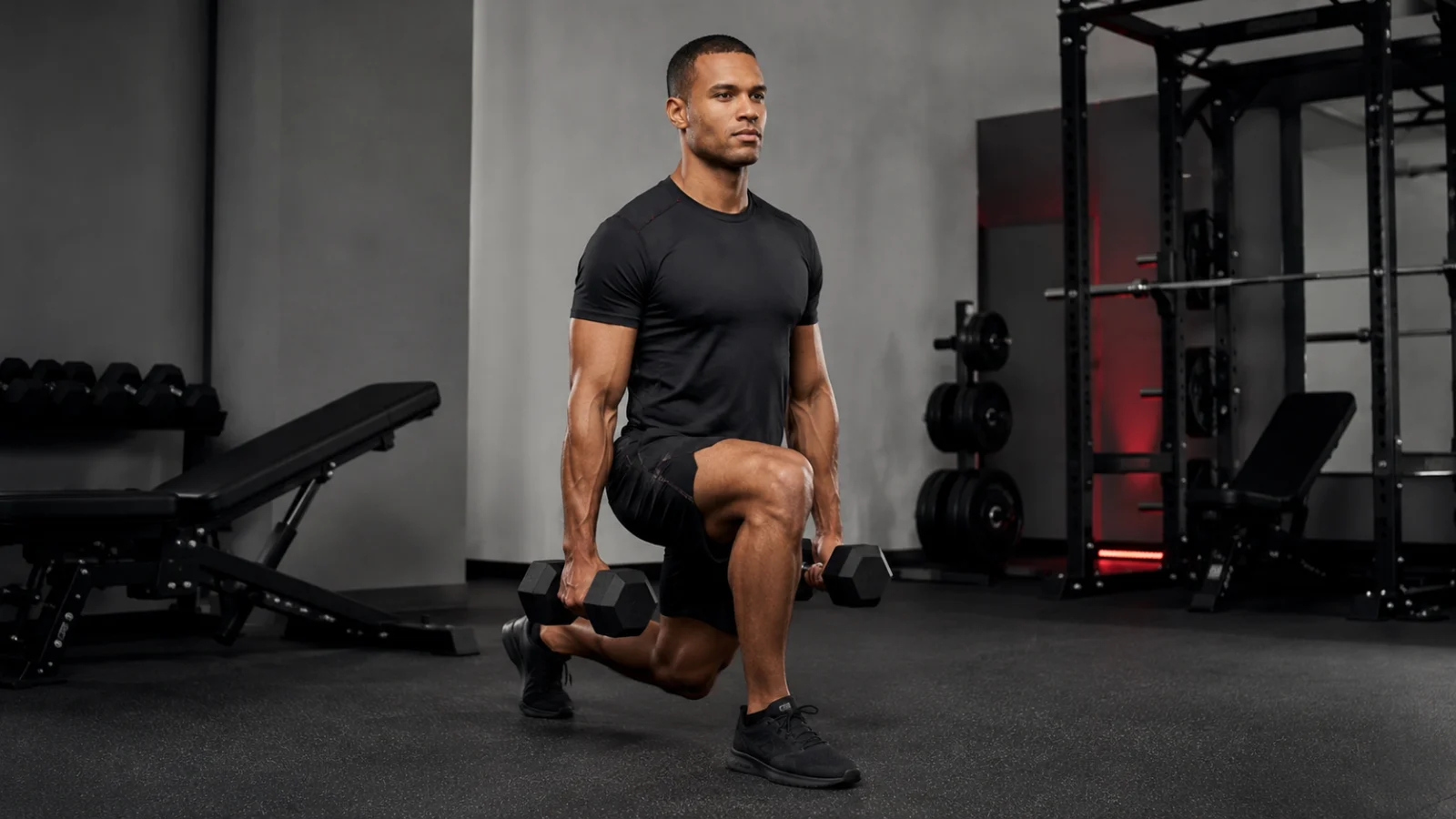
Reverse lunge: 2 sets of 10 reps each leg
Standing calf raise: 3 sets of 15 reps
Home Gym Lower-Body Workout
Goblet squat: 4 sets of 12 reps
Romanian deadlift with dumbbells: 3 sets of 10 reps
Step-up: 3 sets of 10 reps each leg
Plank: 3 rounds of 30–45 seconds
Gym-Based Leg Day
Barbell back squat or leg press: 4 sets of 6–10 reps
Dumbbell goblet squat: 3 sets of 12 reps
Leg extension: 3 sets of 12–15 reps
Leg curl: 3 sets of 10–15 reps
Calf raise: 4 sets of 12–20 reps
For machine-based lower-body training, explore leg machines.
Safety Tips Before You Start
The dumbbell goblet squat is beginner-friendly, but it still needs proper control.
Follow these safety tips:
Warm up before lifting.
Start light and build gradually.
Stop if you feel sharp knee, hip, or back pain.
Keep your spine neutral.
Do not bounce aggressively at the bottom.
Use a stable surface and proper footwear.
Avoid max-effort attempts if you are new to squats.
If you have an existing knee, hip, or back condition, speak with a qualified fitness professional or healthcare provider before adding loaded squats.
FAQs About Dumbbell Goblet Squats
Yes. Dumbbell goblet squats are one of the best squat variations for beginners because they are easy to set up, easier to control than barbell squats, and help teach upright squat posture.
Yes, goblet squats can help build muscle in the quads, glutes, and legs when you use enough resistance, proper form, and progressive overload.
They are not better in every way. Goblet squats are better for learning form, home workouts, and controlled reps. Barbell squats are better for heavy strength progression.
You can practice light goblet squats often, but hard weighted sets need recovery. For strength or muscle growth, 2–3 times per week is usually more practical.
Your heels may lift because of limited ankle mobility, poor balance, stance issues, or shifting too far forward. Try a slightly wider stance, reduce depth, or use heel elevation temporarily.
Yes. Goblet squats work the glutes, especially when you squat to a controlled depth and drive up through the floor. They also target the quads strongly.
Both work well. Dumbbells are common and easy to load. Kettlebells may feel more comfortable to hold because of the handle shape.
Not completely. Goblet squats are free-weight, balance-based, and core-demanding. The leg press allows heavier lower-body loading with more external support. Using both can be effective.
Final Takeaway
The dumbbell goblet squat exercise is a practical, beginner-friendly, and highly effective way to train your legs with minimal equipment. It teaches better squat mechanics, strengthens the quads and glutes, improves core stability, and fits easily into home or gym workouts.
Start light, focus on clean form, and progress slowly. Once your technique is strong, you can increase the dumbbell weight, add tempo or pause reps, or move toward barbell squat variations for heavier strength training.
For a complete setup, explore dumbbells, kettlebells, racks and home gym equipment from LIFE FIT.
0 Comments
Loading comment form…
Loading comments…