


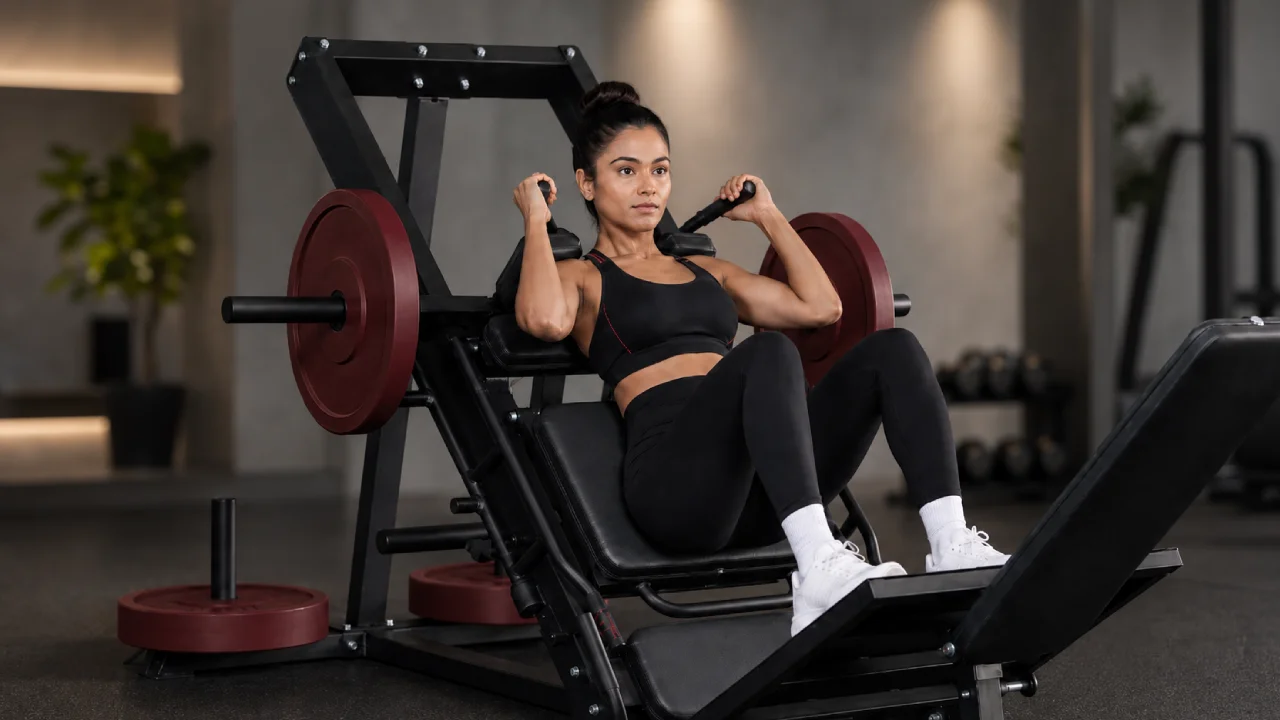
The machine hack squat exercise is a guided lower-body movement performed on a hack squat machine, usually with your back supported against a pad and your feet placed on an angled platform. It is popular for building the quadriceps, glutes, and overall leg strength because the machine path gives more stability than a free-weight squat.
For beginners, it can be easier to learn than the barbell back squat. For advanced lifters, it is a powerful way to add more quad-focused volume without relying heavily on balance or trunk stability.
Safety note: This article is for general fitness education. If you have knee, hip, ankle, or back pain, consult a qualified fitness professional or healthcare provider before adding heavy hack squats.
What Is a Machine Hack Squat?
A machine hack squat is a squat variation where your body moves along a fixed machine track. Instead of holding a barbell on your back, you stand on a platform, place your shoulders under the pads, keep your back against the support pad, and squat by bending your knees and hips.
The biggest advantage is stability. The machine guides the movement, so you can focus more on leg drive, depth, tempo, and muscle tension.
Compared with a free-weight squat, the hack squat usually requires less balance and less trunk stabilization. Research comparing back squats and hack squats suggests the hack squat may allow heavier relative loading because the trunk is supported, though this support can reduce trunk muscle activation compared with the back squat.
That makes the hack squat useful when your goal is to train the legs hard without making your lower back the limiting factor.
Machine Hack Squat Muscles Worked
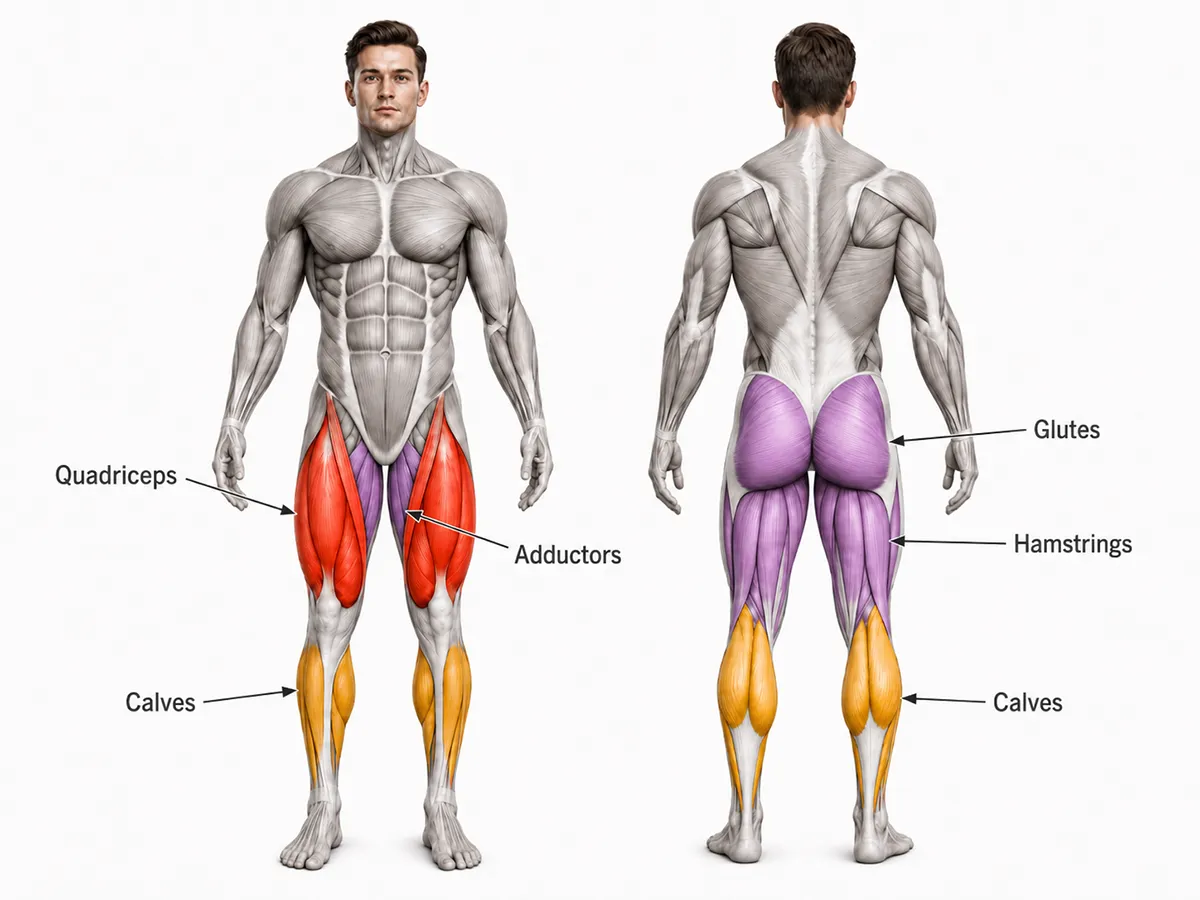
The hack squat is mainly a quad-focused leg exercise, but it still involves several lower-body muscles.
Muscle group | Role during hack squat |
|---|---|
Quadriceps | Main driver; extends the knees as you push up |
Glutes | Assist hip extension, especially at deeper ranges |
Hamstrings | Help stabilize the knee and assist hip control |
Adductors | Support thigh control and stability |
Calves | Help maintain foot pressure and ankle stability |
Core and lower back | Provide support, but usually less than free-weight squats |
For more quad-focused exercise ideas, you can also explore LIFE FIT’s quad exercises and broader leg exercises sections.
How to Do the Machine Hack Squat Properly
Step-by-Step Instructions
Set the machine and load carefully: Add a weight you can control for the full range of motion. Start lighter if you are new to the movement.
Step onto the platform: Place your feet about shoulder-width apart. Keep your feet flat on the platform.
Position your body: Rest your back firmly against the pad and place your shoulders under the shoulder pads. Keep your head neutral.
Unlock the safety handles: Hold the handles firmly and unlock the sled only when your body is stable.
Lower with control: Bend your knees and hips together. Keep your knees tracking in the same direction as your toes.
Reach a comfortable depth: Lower until your thighs are around parallel or slightly below, depending on mobility and comfort. Do not force depth if your heels lift or your lower back rounds.
Push through your full foot: Drive through your midfoot and heel to return to the starting position. Avoid locking your knees aggressively at the top.
Repeat with steady tempo: Keep each rep controlled. Do not bounce out of the bottom.
Key Form Cues
Keep your back pressed into the pad.
Keep your knees aligned with your toes.
Keep your heels down.
Control the lowering phase.
Do not let the sled crash into the bottom.
Stop the set if knee pain or sharp discomfort appears.
Hack Squat Foot Placement Guide
Foot placement changes how the hack squat feels. It does not completely isolate one muscle, but it can shift emphasis.
Foot placement | Main emphasis | Best for | Caution |
|---|---|---|---|
Mid-platform, shoulder-width | Balanced quads and glutes | Most lifters | Best starting point |
Lower on platform | More quad emphasis | Quad-focused training | May increase knee demand |
Higher on platform | More glute/hamstring involvement | Lifters who feel too much knee stress | Avoid turning it into a leg press |
Narrow stance | Outer quad feel, strong knee flexion | Quad pump work | Requires good knee tracking |
Wider stance | Glutes, adductors, inner thigh | Deeper, more stable reps | Do not force excessive toe-out |
A simple rule: start with a neutral stance, then adjust only if your knees, hips, and ankles feel stable.
If you want to compare the movement with a machine that allows more foot-placement freedom, read LIFE FIT’s leg press guide.
Benefits of the Machine Hack Squat
Strong Quad Development: The hack squat keeps the movement focused on knee extension, which makes it excellent for targeting the quadriceps. If your goal is bigger, stronger thighs, this exercise deserves a place in your leg-day plan.
More Stability Than Free-Weight Squats: Because the machine guides the movement, you do not need to balance a barbell. This can help beginners learn a squat pattern and help advanced lifters push hard sets with more control.
Lower Back-Friendly for Many Lifters: The back pad supports your torso, so the hack squat may feel easier on the lower back than a barbell squat. That does not mean it is risk-free, but it can be a useful option when your goal is leg training without heavy spinal loading.
Easy to Progress: The machine setup makes it simple to track load, reps, and depth. You can progress by adding weight, increasing reps, improving range of motion, or slowing down the eccentric phase.
Useful for Hypertrophy Training: The hack squat works well in moderate-to-high rep ranges. For muscle growth, many lifters use it after a main squat or as the main quad exercise of the day.
Exercise variation can also be useful in strength programs. One resistance-training study found that changing exercises may improve strength adaptations more effectively than only changing loading schemes.
Common Machine Hack Squat Mistakes
Mistake | Why it matters | Fix |
|---|---|---|
Heels lifting | Reduces stability and may stress knees | Move feet slightly higher and keep full-foot pressure |
Knees caving inward | Poor knee tracking | Push knees in line with toes |
Going too heavy too soon | Reduces depth and control | Use a weight you can control for clean reps |
Bouncing at the bottom | Increases joint stress | Pause briefly or slow the lowering phase |
Locking knees hard at the top | Can irritate the knees | Finish tall but keep a soft knee |
Letting hips lift from the pad | Breaks body position | Keep back and hips connected to the pad |
How Deep Should You Go?
Go as deep as you can while maintaining control, heel contact, and knee alignment. For many lifters, that means around parallel or slightly below parallel.
Depth should be earned, not forced. Research on squat depth and knee kinetics shows that load and depth both influence knee-joint demands, so the right depth depends on your mobility, training goal, and tolerance.
A practical approach:
Beginners: Start with controlled reps to a comfortable depth.
Hypertrophy-focused lifters: Use the deepest pain-free range you can control.
Strength-focused lifters: Prioritize consistent depth across sets.
Knee-sensitive lifters: Use a slightly higher foot placement and avoid sudden depth changes.
Hack Squat vs Leg Press vs Back Squat
Exercise | Best for | Main advantage | Limitation |
|---|---|---|---|
Machine hack squat | Quad-focused squat pattern | Strong leg stimulus with guided path | Fixed path may not suit everyone |
Leg press | Heavy lower-body volume | Stable and beginner-friendly | Less squat-specific movement |
Barbell back squat | Full-body strength | High carryover to strength and athletic training | Requires more skill and trunk control |
Dumbbell goblet squat | Learning squat mechanics | Simple, accessible, beginner-friendly | Load is limited by grip and dumbbell size |
The hack squat is not “better” than all other squat variations. It is better for certain goals.
Use the machine hack squat when you want a stable, quad-focused leg exercise. Use the barbell back squat when your goal is total-body strength and free-weight skill. Use the dumbbell goblet squat when you want a beginner-friendly squat variation for learning form.
Best Sets, Reps, and Programming
For Beginners:
Goal | Sets | Reps | Rest |
|---|---|---|---|
Learn form | 2–3 | 10–12 | 90 sec |
Build confidence | 3 | 8–10 | 90–120 sec |
Start light and focus on smooth reps. Do not chase maximum depth or heavy weight in the first few sessions.
For Muscle Growth:
Goal | Sets | Reps | Rest |
|---|---|---|---|
Quad hypertrophy | 3–5 | 8–15 | 90–150 sec |
High-volume finisher | 2–3 | 15–20 | 60–90 sec |
Use a controlled lowering phase of 2–3 seconds. Stop 1–2 reps before failure on most sets.
For Strength
Goal | Sets | Reps | Rest |
|---|---|---|---|
Heavy strength work | 3–5 | 5–8 | 2–3 min |
Secondary strength lift | 3–4 | 6–10 | 2 min |
Use the hack squat as your main lower-body machine lift or after your primary squat movement.
Where to Place Hack Squats in a Leg Workout
Option 1: Quad-Focused Leg Day
Machine hack squat: 4 sets of 8–12
Leg press: 3 sets of 10–15
Leg extension: 3 sets of 12–15
Seated or lying leg curl: 3 sets of 10–15
Standing calf raise: 3 sets of 12–20
Option 2: Strength + Hypertrophy Leg Day
Barbell back squat: 3–5 sets of 3–6
Machine hack squat: 3 sets of 8–10
Romanian deadlift: 3 sets of 8–10
Leg curl: 3 sets of 10–12
Calf raise: 3 sets of 12–20
Option 3: Machine-Based Leg Day
Hack squat: 4 sets of 8–12
Leg press: 3 sets of 10–15
Leg curl/extension machine: 3 sets each
Hip thrust machine: 3 sets of 8–12
Calf raise: 3 sets of 12–20
For gym owners or home-gym planning, you can explore LIFE FIT’s leg machines collection and gym machines buying guide to understand equipment options.
Who Should Modify or Avoid the Hack Squat?
The hack squat can be useful, but it is not ideal for everyone.
Modify the exercise if:
Your heels lift at the bottom.
Your knees cave inward.
You feel knee discomfort with low foot placement.
Your hips come off the pad.
You cannot control the bottom position.
Avoid or get professional guidance if:
You have current knee pain.
You have recent knee, hip, or back injury.
You feel sharp pain during the movement.
You cannot keep your feet flat.
You are unsure how to set the machine safely.
A good exercise should feel challenging in the muscles, not painful in the joints.
Machine Hack Squat Alternatives
Leg Press: The leg press is the closest machine-based alternative. It is stable, easy to load, and useful for high-volume leg training.
Barbell Back Squat: The barbell back squat builds total-body strength and coordination. It requires more skill but gives excellent carryover to strength training.
Dumbbell Goblet Squat: The dumbbell goblet squat is a great beginner-friendly alternative. It helps teach squat posture, bracing, and depth.
Smith Machine Squat: A Smith machine squat offers a fixed bar path, making it more stable than a free-weight squat. It can be useful when no hack squat machine is available.
Leg Extension: The leg extension isolates the quadriceps more directly. It is best used as an accessory, not a complete replacement for compound leg training.
FAQs About the Machine Hack Squat Exercise
Yes, the machine hack squat can be beginner-friendly because the machine guides the movement. Beginners should start light, learn proper foot placement, and avoid going too heavy too soon.
The machine hack squat mainly works the quadriceps. It also trains the glutes, hamstrings, adductors, calves, and supporting core muscles.
It depends on your goal. The hack squat feels more like a squat and is often more quad-focused. The leg press is usually easier to learn and allows more foot-position flexibility.
Not automatically. Poor form, excessive load, sudden depth changes, or unsuitable foot placement can irritate the knees. Keep your knees tracking with your toes and use a pain-free range of motion.
Start with your feet shoulder-width apart in the middle of the platform. Move your feet slightly higher if you feel too much knee stress, or slightly lower if you want more quad emphasis and can control it comfortably.
For muscle growth, try 3–5 sets of 8–15 reps. For beginners, start with 2–3 sets of 10–12 controlled reps.
They can replace barbell squats in some programs, especially if your goal is machine-based hypertrophy training. But if your goal is full-body strength and free-weight skill, keep some form of squat pattern in your plan.
Final Takeaway
he machine hack squat exercise is one of the best machine-based movements for building strong, muscular legs - especially the quadriceps. It gives you a stable squat pattern, allows controlled loading, and fits well into beginner, hypertrophy, and strength-focused programs.
Use it with good form: keep your feet flat, knees aligned, back supported, and reps controlled. Start with a neutral foot position, adjust based on comfort, and progress slowly.
For a complete lower-body training setup, combine hack squats with smart accessories like the leg press, leg curl, leg extension, and glute-focused movements. You can also browse LIFE FIT’s commercial gym equipment buying guide or home gym setup guide if you are planning equipment for a gym, studio, or home training space.
0 Comments
Loading comment form…
Loading comments…