


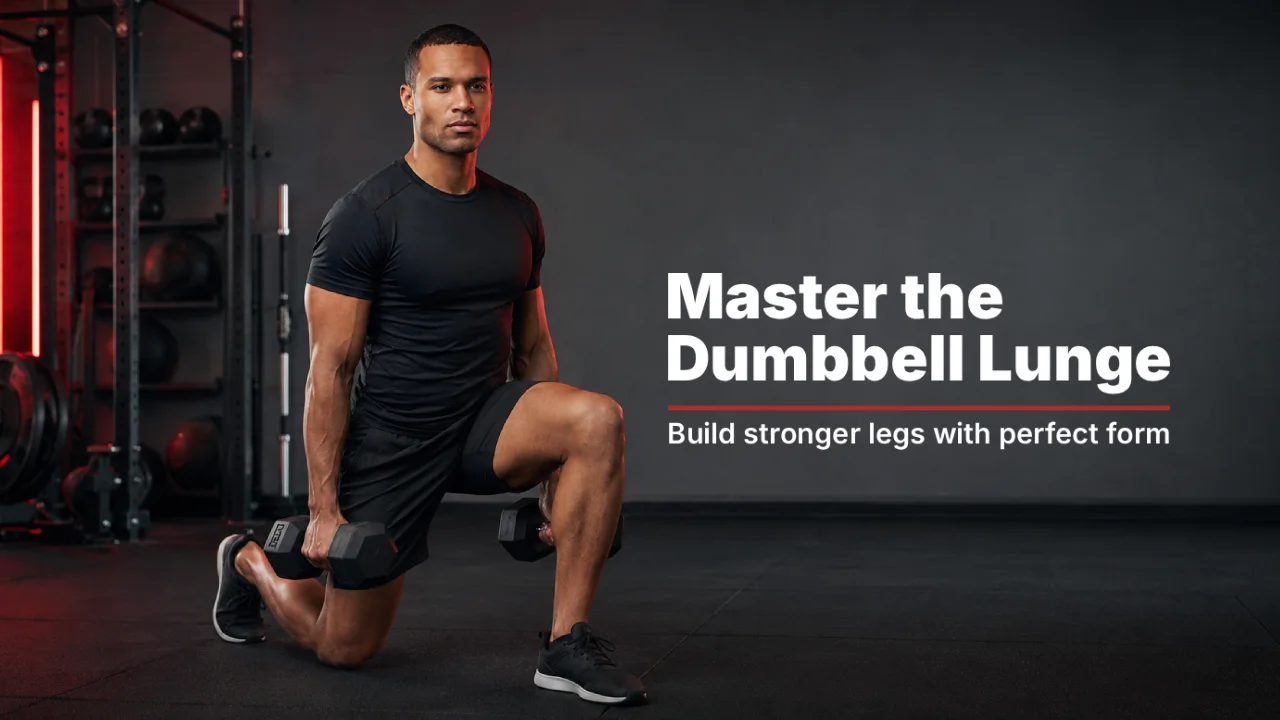
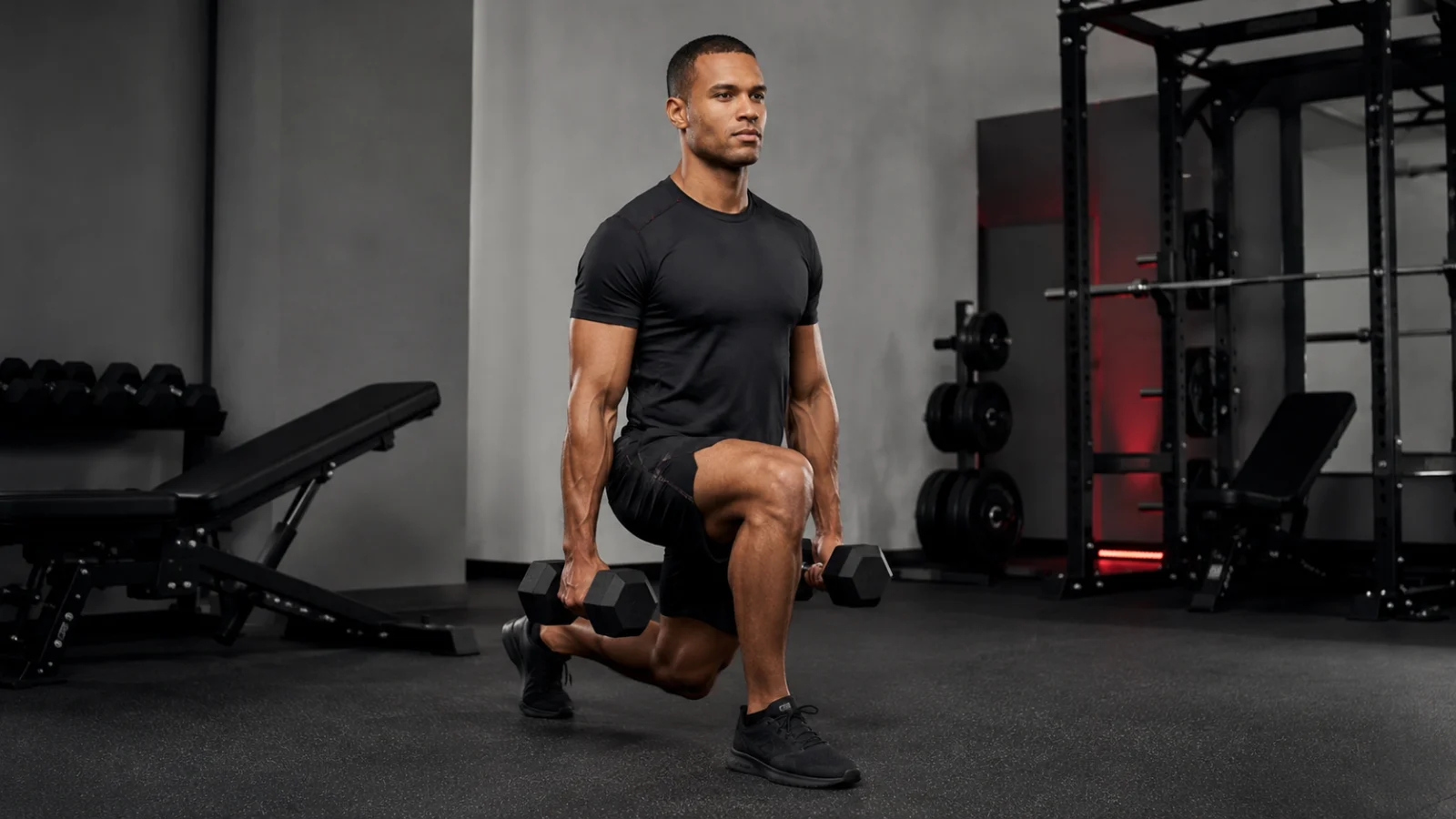
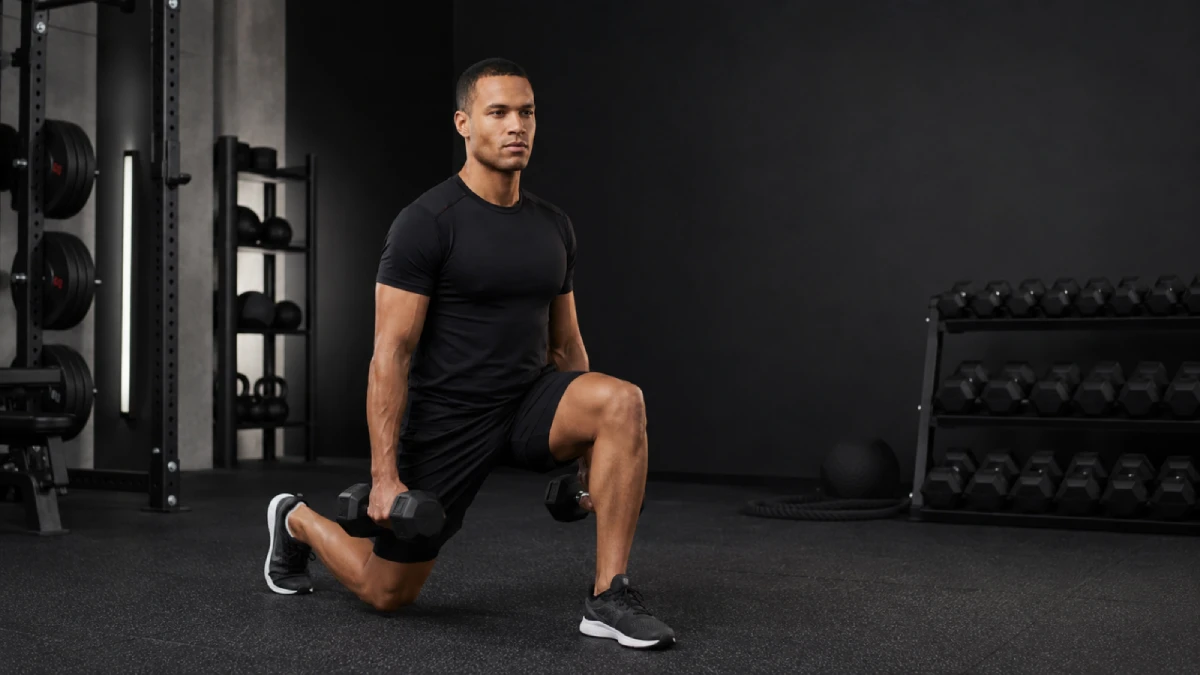
The dumbbell lunge exercise is a lower-body strength movement where you hold dumbbells while stepping one leg forward, lowering your body, and pushing back to the starting position. It trains one side of the body at a time, making it useful for building leg strength, improving balance, and reducing strength differences between the left and right leg.
Unlike machine-based leg exercises, dumbbell lunges require control from your hips, knees, ankles, and core at the same time. That makes them a practical exercise for athletes, gym-goers, and anyone building a stronger lower body.
You only need a pair of dumbbells and enough space to step safely. For a full lower-body routine, you can also pair this exercise with movements like the dumbbell goblet squat, barbell back squat, or machine hack squat.
How to Do Dumbbell Lunges Properly
To perform the dumbbell lunge correctly, focus on control, balance, and knee alignment. Do not rush the movement. A slow, stable lunge is more useful than a heavy but unstable one.
Step-by-Step Instructions
Stand tall with a dumbbell in each hand: Keep your feet hip-width apart. Let the dumbbells hang naturally at your sides with your palms facing inward.
Brace your core: Keep your chest lifted, shoulders relaxed, and spine neutral.
Step forward with one leg: Take a controlled step forward. Your stride should be long enough that both knees can bend comfortably.
Lower your body: Bend both knees until your front thigh is close to parallel with the floor. Your back knee should move toward the floor without slamming into it.
Keep the front knee controlled: Your front knee should track in the same direction as your toes. Avoid letting it collapse inward.
Push through the front foot: Drive through your front foot to return to the starting position.
Repeat on the other side: Alternate legs or complete all reps on one side before switching.
Key Form Checklist
Keep your torso tall or slightly forward, but not rounded.
Keep the front foot flat on the floor.
Let the back heel lift naturally.
Control the lowering phase.
Do not bounce at the bottom.
Keep the dumbbells close to your sides.
Move with balance before increasing weight.
Research on forward lunges shows that step length and stride style can influence lower-body muscle activity, including the quadriceps, glutes, hamstrings, calves, and adductors. Longer steps generally increase lower-extremity muscle activity compared with shorter steps, so your stride length should match your goal and comfort level.
Dumbbell Lunge Muscles Worked
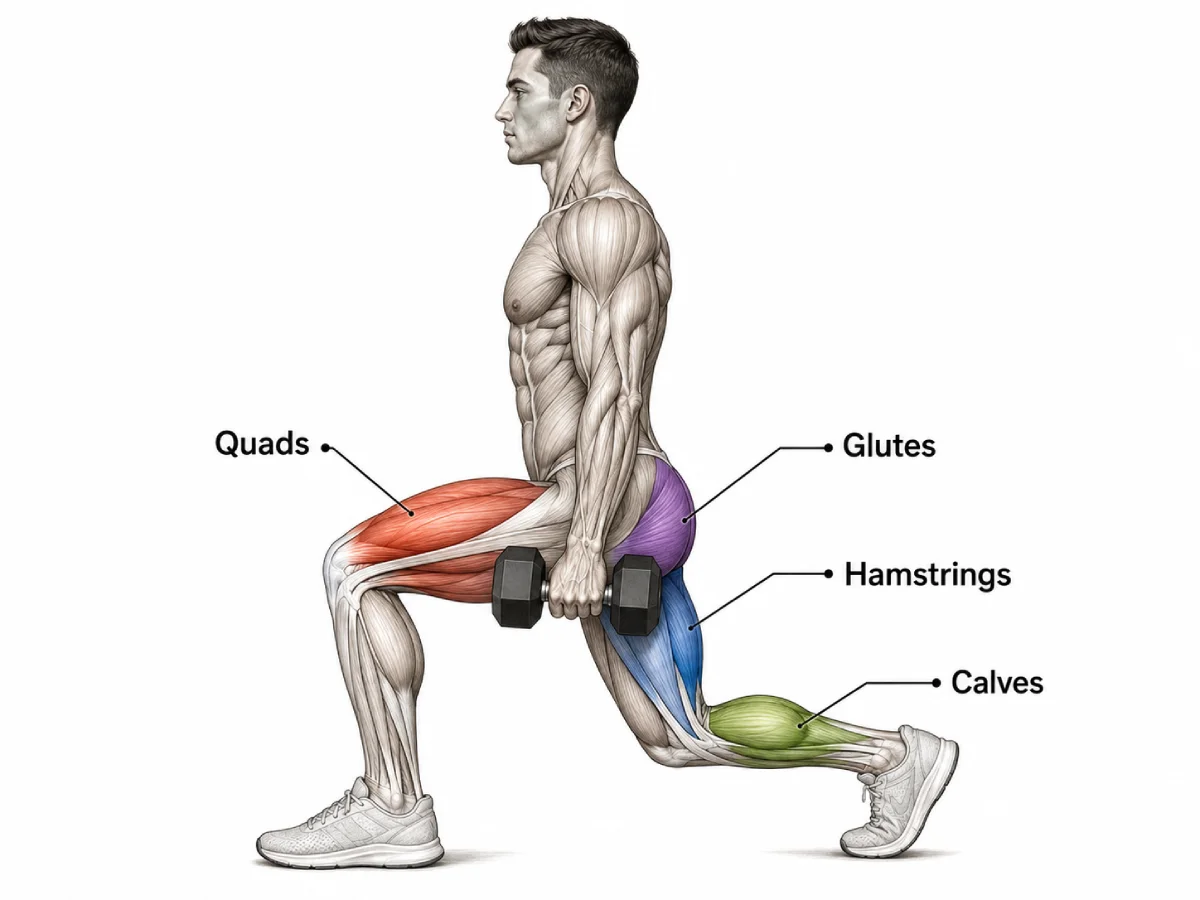
The dumbbell lunge is mainly a quad and glute exercise, but it also trains several stabilizer muscles because each leg works independently.
Primary Muscles
Muscle | Role During Dumbbell Lunges |
|---|---|
Quadriceps | Extend the knee and help you push back up |
Gluteus maximus | Helps extend the hip, especially when rising from the bottom |
Gluteus medius | Supports hip stability and helps prevent the knee from collapsing inward |
Secondary Muscles
Muscle | Role |
|---|---|
Hamstrings | Assist hip extension and stabilize the knee |
Adductors | Help control the inner thigh and hip position |
Calves | Support ankle stability and balance |
Core muscles | Help maintain posture and prevent side-to-side wobbling |
A EMG study comparing forward lunges with other unilateral exercises found high involvement from the vastus lateralis, vastus medialis, gluteus medius, gluteus maximus, biceps femoris, and rectus femoris during forward lunges.
Benefits of Dumbbell Lunges
1. Builds Stronger Legs
Dumbbell lunges train the quads, glutes, and hamstrings through a large range of motion. This makes them useful for lower-body strength and muscle development.
For best results, use a weight that challenges you while still allowing clean form. If your knees cave inward, your balance breaks down, or your torso folds forward, the weight is too heavy.
2. Improves Balance and Stability
Because one leg works harder at a time, dumbbell lunges challenge balance more than many two-leg exercises. Your hips, ankles, and core must work together to keep your body stable.
This makes lunges valuable for sports, running, climbing stairs, and everyday movement.
3. Helps Correct Strength Imbalances
Most people have one stronger leg. Bilateral exercises like squats can sometimes hide that imbalance because both legs work together. Dumbbell lunges make each leg contribute separately, which helps expose and improve side-to-side differences.
4. Trains Functional Movement
Lunges are similar to real-life movements such as stepping, climbing, decelerating, and changing direction. That makes them more functional than many isolated machine exercises.
5. Easy to Add to Home or Gym Workouts
Dumbbell lunges do not require a large machine. You can perform them in a gym, studio, or compact home training area.
If you’re planning a dedicated training space at home, explore LIFE FIT’s home gym setup service for equipment planning, layout support, and installation guidance.
Dumbbell Lunge Form: Short Step vs Long Step
Your step length changes how the exercise feels.
Lunge Style | Muscle Emphasis | Best For |
|---|---|---|
Shorter step | More quad-focused | Beginners, quad training, controlled reps |
Longer step | More glute and hamstring involvement | Glute focus, athletic training, deeper range |
Slight forward torso lean | More hip extensor demand | Glute-focused lunges |
Upright torso | More balanced quad/glute work | General strength training |
A study on trunk position found that performing a forward lunge with the trunk leaning forward increased hip extensor demand and gluteus maximus and biceps femoris activity compared with a normal upright lunge.
This does not mean you should round your back. A slight forward lean from the hips can be useful, but your spine should stay neutral.
Common Dumbbell Lunge Mistakes
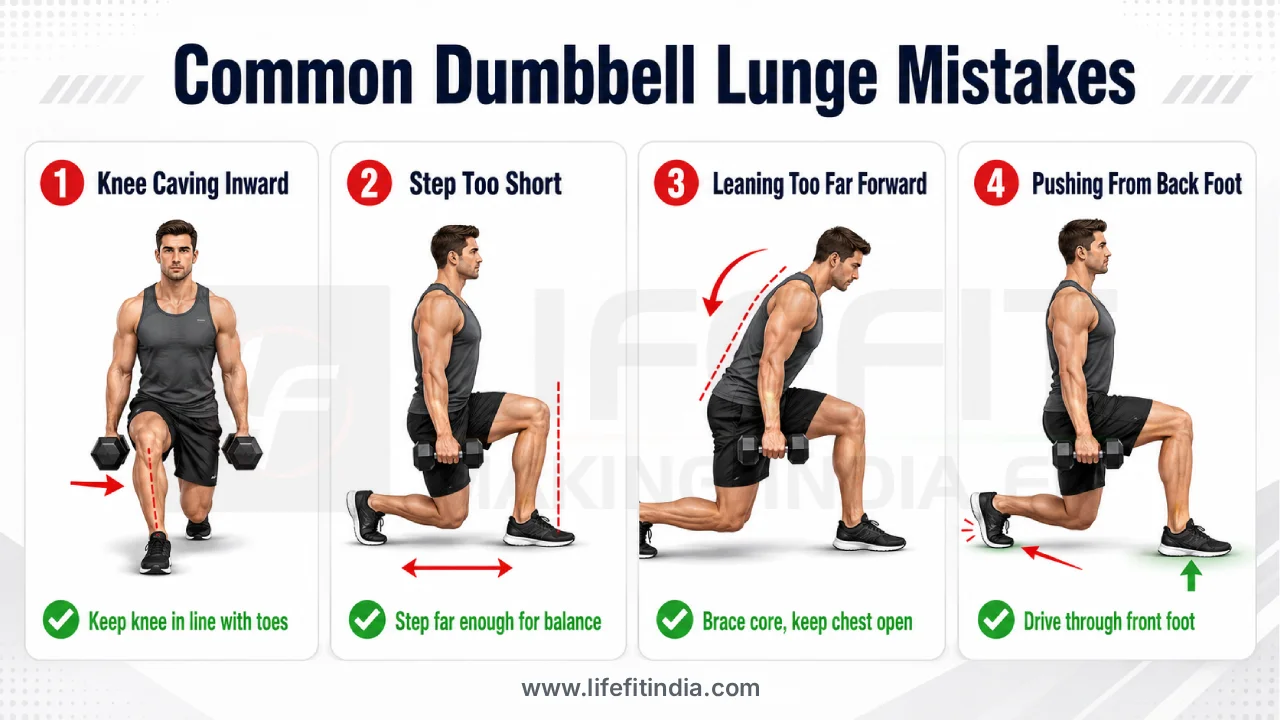
1. Front Knee Caving Inward
This is one of the most common mistakes. When the front knee collapses inward, it can reduce control and place unnecessary stress on the knee.
Fix: Keep your knee tracking in line with your second or third toe. Reduce the weight if needed.
2. Taking Too Short a Step
A very short step can make the movement feel cramped and may push too much pressure into the front knee.
Fix: Step far enough that your front foot stays flat and both knees can bend naturally.
3. Leaning Too Far Forward
A small forward lean is fine, especially for glute emphasis. But folding forward or rounding your back is not.
Fix: Brace your core, keep your chest open, and hinge slightly from the hips instead of collapsing through the spine.
4. Pushing Off the Back Foot Too Much
The front leg should do most of the work. If you push hard from the back leg, you reduce the training effect on the target leg.
Fix: Think “drive through the front foot.”
5. Using Dumbbells That Are Too Heavy
Heavy dumbbells are useful only if you can control the movement. If the weights swing, your balance breaks, or your depth changes every rep, go lighter.
Fix: Start with moderate dumbbells and progress slowly.
Dumbbell Lunge Variations
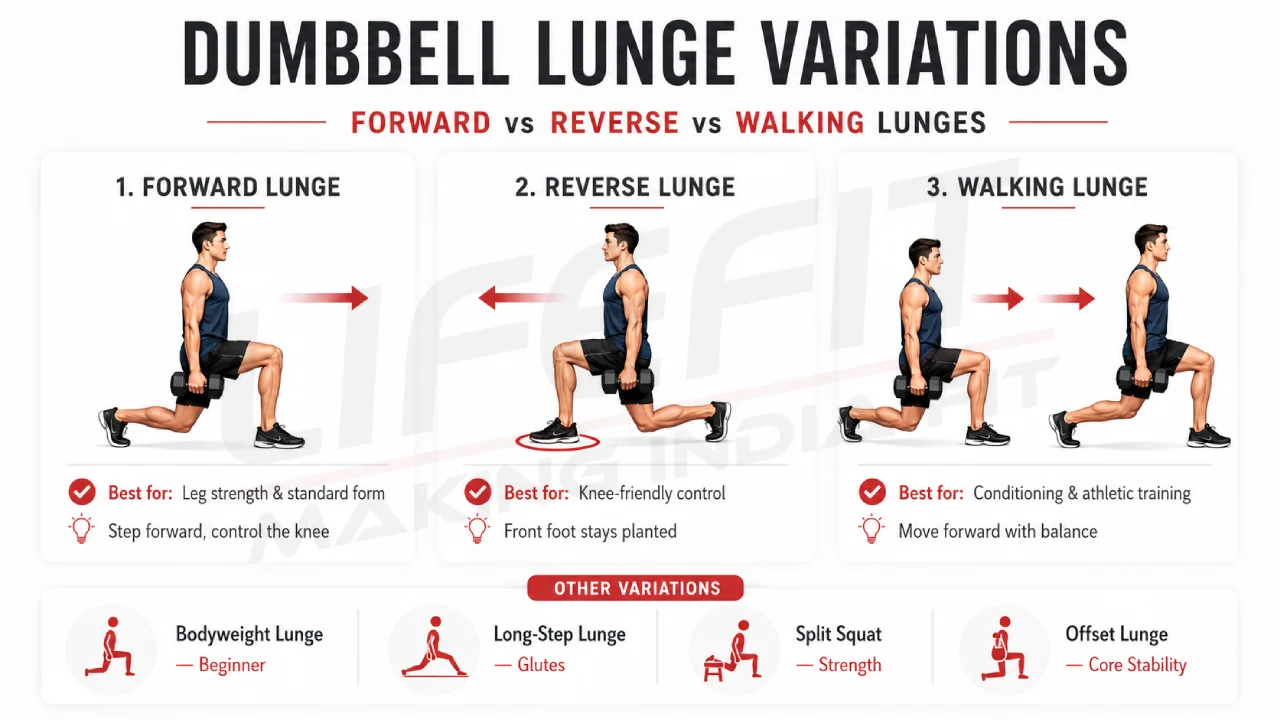
Once you understand the standard dumbbell lunge, you can use variations to target different goals.
Variation | Best For | Difficulty |
|---|---|---|
Bodyweight lunge | Learning form | Beginner |
Dumbbell reverse lunge | Knee-friendly variation, balance control | Beginner to intermediate |
Dumbbell walking lunge | Conditioning, athletic training | Intermediate |
Long-step dumbbell lunge | Glute emphasis | Intermediate |
Dumbbell split squat | Strength and hypertrophy with less stepping | Beginner to intermediate |
Offset dumbbell lunge | Core and hip stability | Intermediate |
Dumbbell Reverse Lunge
In a reverse lunge, you step backward instead of forward. Many lifters find this easier to control because the front foot stays planted.
Use this variation if forward lunges feel unstable or uncomfortable.
Dumbbell Walking Lunge
Walking lunges are better for conditioning and athletic training because you continue moving forward. They require more space and more balance than stationary lunges.
Dumbbell Split Squat
The split squat keeps your feet in place for the whole set. It is a good option if you want the benefits of a lunge pattern without stepping forward and backward each rep.
Research comparing standard and suspended lunge variations found that more demanding variations can increase recruitment of hip muscles such as the gluteus medius and gluteus maximus, so progressions should be added gradually.
How Many Sets and Reps Should You Do?
Your sets and reps depend on your goal.
Goal | Sets | Reps | Rest |
|---|---|---|---|
Beginner form practice | 2–3 | 8–10 per leg | 60–90 sec |
Muscle growth | 3–4 | 8–12 per leg | 90–120 sec |
Strength | 3–5 | 5–8 per leg | 2–3 min |
Conditioning | 2–4 | 12–20 per leg | 30–60 sec |
Beginner Recommendation
Start with bodyweight lunges or light dumbbells. Once your form feels stable, increase the load gradually.
A good beginner workout:
Dumbbell lunges: 3 sets of 8 reps per leg
Dumbbell goblet squat: 3 sets of 10 reps
Glute bridge or hip thrust: 3 sets of 12 reps
Plank: 2 sets of 30–45 seconds
For more lower-body training ideas, check out Life Fit’s leg exercises and dumbbell workouts.
Are Dumbbell Lunges Good for Glutes?
Yes, dumbbell lunges can be very effective for the glutes, especially when you use a slightly longer step and controlled depth. A small forward torso lean can also increase hip extensor involvement, but your back should remain neutral.
For more lower-body training ideas, check out leg exercises and dumbbell workouts.
Are Dumbbell Lunges Good for Quads?
Yes. Dumbbell lunges strongly involve the quadriceps, especially when you use a moderate step length and keep the torso more upright. The front leg works hard to control the lowering phase and push the body back up.
To make your leg day more quad-focused, pair dumbbell lunges with movements like the leg press and leg extension, or explore more ideas in Life Fit’s quad exercises.
Dumbbell Lunge vs Squat: Which Is Better?
Neither is “better” for everyone. They solve different problems.
Exercise | Best For | Main Difference |
|---|---|---|
Dumbbell lunge | Balance, unilateral strength, glutes, quads | Trains one leg at a time |
Squat | Heavy loading, total lower-body strength | Trains both legs together |
Goblet squat | Beginner-friendly squat pattern | Easier to learn and control |
Hack squat | Machine-based quad training | More stable, less balance demand |
A smart leg workout can include both squats and lunges. For example, use a squat variation as your main strength exercise, then use dumbbell lunges as an accessory exercise.
Example:
Barbell back squat: 4 sets of 5–8 reps
Dumbbell lunge: 3 sets of 8–10 reps per leg
Leg curl: 3 sets of 10–12 reps
Calf raise: 3 sets of 12–15 reps
Safety Tips for Dumbbell Lunges
Dumbbell lunges are effective, but they require control. Use these safety tips:
Warm up before heavy sets.
Start light if you are new to lunges.
Keep your front foot fully planted.
Do not let the front knee collapse inward.
Avoid bouncing at the bottom.
Stop if you feel sharp knee, hip, or ankle pain.
Use a stable surface with enough space.
Keep dumbbells close to your body.
If you have current knee pain, hip pain, balance problems, or a history of injury, speak with a qualified fitness coach or physiotherapist before adding heavy lunges.
Best Equipment for Dumbbell Lunges
For dumbbell lunges, you need a pair of dumbbells that are easy to grip and stable in your hands. Rubber hex dumbbells are a practical option because they do not roll easily when placed on the floor.
Recommended equipment:
Flat bench for related exercises
For gym owners, placing dumbbells near open floor space makes lunges, walking lunges, step-ups, and loaded carries easier to perform safely.
Dumbbell Lunge FAQs
Choose a weight that allows full control for every rep. Beginners can start with light dumbbells or bodyweight. Intermediate lifters can use heavier dumbbells once balance, knee tracking, and depth are consistent.
A slight forward knee movement is not automatically bad. The key is control. Your front heel should stay down, your knee should track with your toes, and you should not feel sharp pain.
Forward lunges are useful for strength, balance, and athletic control. Reverse lunges are often easier to control and may feel more comfortable for some people. Use the version that matches your goal and feels best on your joints.
Yes. Dumbbell lunges can build muscle in the quads, glutes, and hamstrings when performed with enough load, control, volume, and progressive overload.
Yes, but beginners should master bodyweight lunges first. Add dumbbells only when you can control your balance and knee position.
Yes. Dumbbell lunges are one of the best lower-body exercises for home workouts because they require minimal equipment and limited space.
Final Takeaway
The dumbbell lunge exercise is a powerful lower-body movement for building stronger quads, glutes, hamstrings, and stabilizer muscles. It improves balance, trains each leg independently, and fits well into both gym and home workout routines.
For best results, start with clean form, use a controlled range of motion, and increase weight gradually. Pair dumbbell lunges with squat patterns, hip thrusts, leg presses, and other lower-body exercises to build a complete leg training program.
0 Comments
Loading comment form…
Loading comments…