


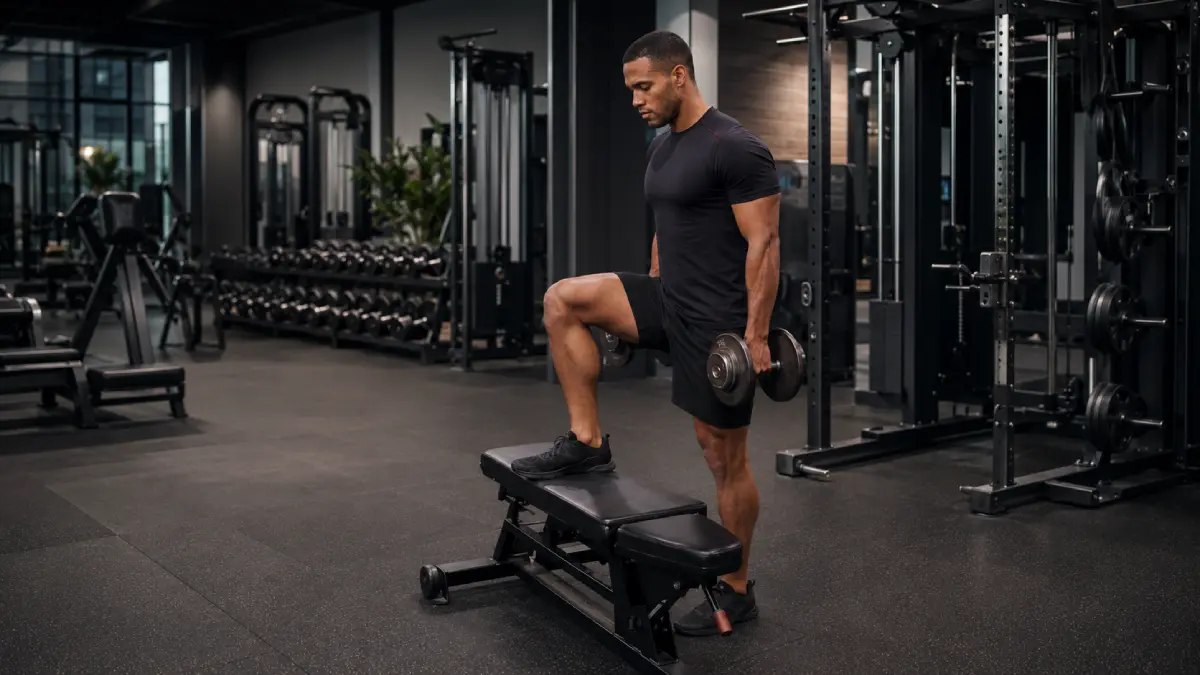
The dumbbell step up exercise is a lower-body strength movement where you step onto a raised platform while holding dumbbells. It looks simple but when done correctly, it trains your quads, glutes, hamstrings, calves, core, balance and single-leg control in one clean movement.
This exercise is useful for beginners, home gym users, athletes, and lifters who want stronger legs without relying only on squats or machines. Because each leg works separately, the dumbbell step up can also help you spot strength differences between your left and right side.
Use it as a main dumbbell leg exercise, a single-leg accessory after squats or a practical movement for building strength that carries over to stairs, running, sports, and daily life.
Dumbbell Step Up Exercise Overview
Detail | Recommendation |
|---|---|
Exercise type | Strength, unilateral lower-body exercise |
Main muscles worked | Quadriceps and glutes |
Secondary muscles | Hamstrings, calves, adductors, core |
Equipment needed | Dumbbells and a stable box, step, or bench |
Difficulty level | Beginner to intermediate |
Best rep range | 8–12 reps per leg |
Best for | Leg strength, glute training, balance, functional fitness |
Good alternatives | Dumbbell lunge, goblet squat, Bulgarian split squat, leg press |
For more lower-body training ideas, explore LIFE FIT’s quad exercises, leg exercises, and dumbbell exercises sections.
What Is a Dumbbell Step Up?
A dumbbell step up is a weighted step-up variation. You hold dumbbells at your sides, place one foot on a box or bench, and use that front leg to lift your body onto the platform.
The goal is not just to “step up.” The goal is to make the working leg do the lift with control.
When performed well, the dumbbell step up trains:
Knee extension through the quadriceps
Hip extension through the glutes and hamstrings
Ankle stability through the calves
Core control as your body balances on one leg
Hip and knee alignment during single-leg movement
This makes it different from a standard squat, where both legs work together. In the step up, each leg has to control the movement more independently.
Muscles Worked During the Dumbbell Step Up
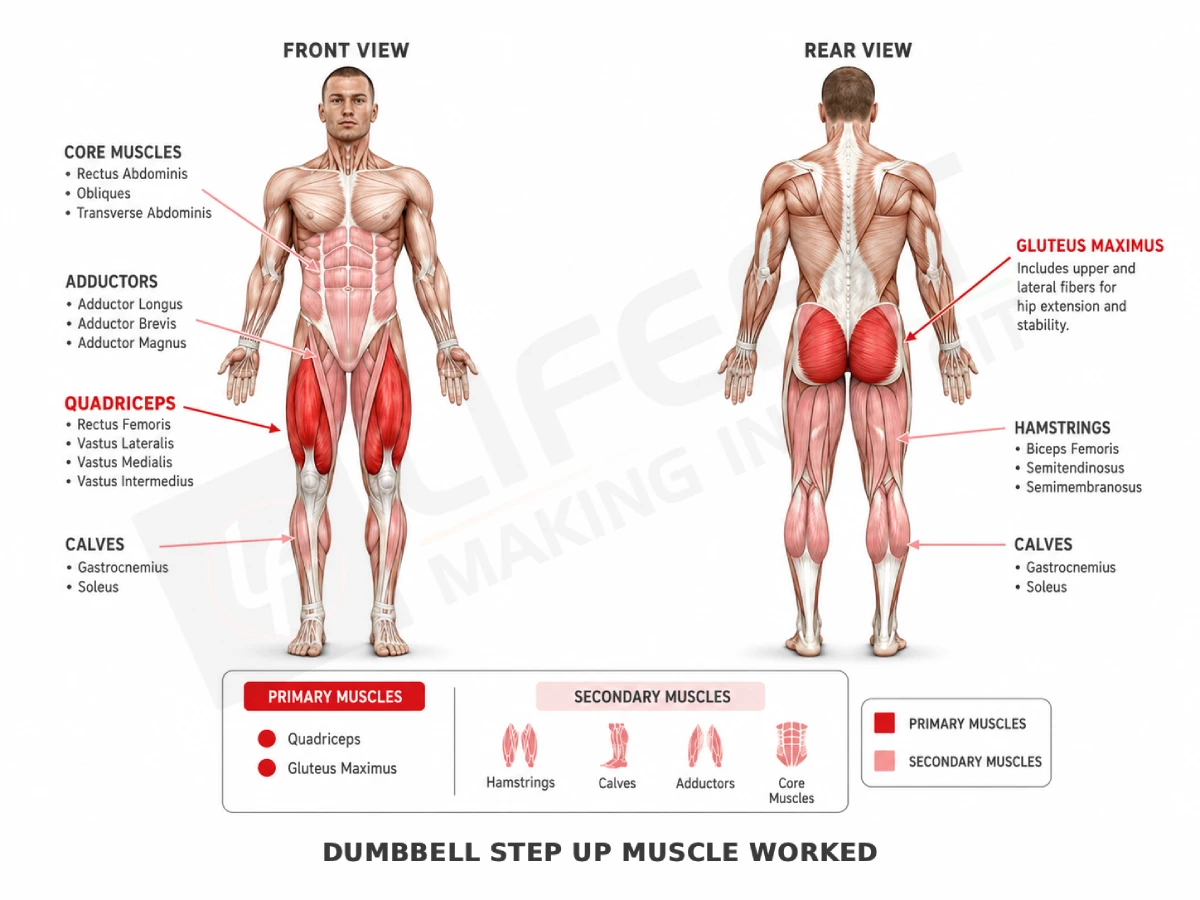
The dumbbell step up mainly targets the quadriceps and glutes, but it is not an isolation exercise. Several supporting muscles help you stay balanced and controlled.
Primary Muscles
Quadriceps
The quadriceps are the muscles on the front of your thigh. They work hard as you straighten the knee and lift your body onto the platform.
You will usually feel more quad involvement when you use a moderate step height, keep your torso fairly upright, and control the lowering phase.
Glutes
The glutes extend the hip as you drive upward. A slightly higher step, a small forward lean from the hips, and a strong heel/midfoot drive can make the movement more glute-focused.
A systematic review in the journal of sports science and medicine found that step-up variations can produce high levels of gluteus maximus activation compared with several common strength exercises.
Secondary Muscles
Hamstrings
The hamstrings assist the glutes during hip extension and help control your body as you step down.
Calves
The calves stabilize the ankle and help keep the foot steady on the platform.
Adductors
The inner-thigh muscles help control the hip and prevent the working leg from drifting out of position.
Core
Your core keeps your torso stable while your body moves on one leg. This becomes more noticeable when the dumbbells get heavier.
For glute-focused training, you can also explore glute exercises collection of movements and workout ideas.
Dumbbell Step Up Benefits
1. Builds Real Single-Leg Strength
Many lower-body exercises allow your stronger leg to take over. The dumbbell step up makes each leg work separately, which helps you build more balanced strength.
This is useful for sports, running, climbing stairs, jumping, and general lower-body performance.
2. Trains Quads and Glutes Together
The step up combines knee extension and hip extension. That means your quads and glutes work together instead of in isolation.
For balanced leg development, it pairs well with exercises like the dumbbell goblet squat, dumbbell lunge, barbell back squat, and leg Press.
3. Improves Balance and Body Control
Because one leg drives the movement, your hips, knees, ankles, and core must stay organized. This improves balance and movement control.
That is one reason step-ups are useful beyond bodybuilding. They also fit athletic training, functional workouts, and general fitness plans.
4. Works Well for Home and Gym Training
You do not need a large machine to perform dumbbell step ups. A pair of dumbbells and a stable platform are enough.
For home training, a pair of dumbbells and a sturdy gym bench are often all you need to perform step ups effectively. If you are building a compact workout space, explore the home gym setup page for equipment options and setup ideas.
5. Adds Variety to Leg Day
If your leg routine is built only around squats and leg presses, step ups add a different challenge. They train the same major lower-body muscles but with more balance and single-leg control.
This makes them useful as an accessory exercise after heavy compound lifts.
Equipment Needed
You need:
One pair of dumbbells
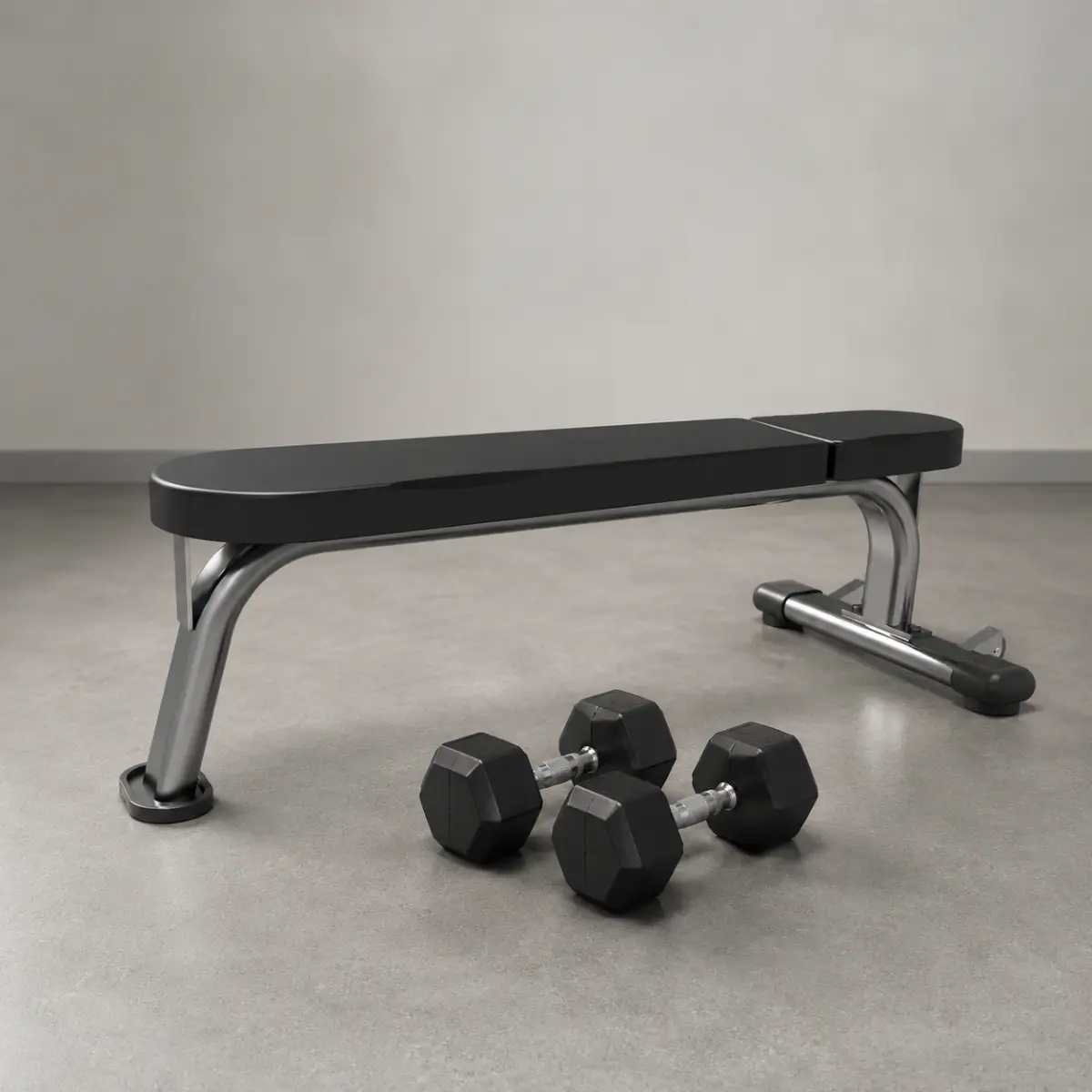
A stable box, step, or flat bench
Enough clear space around you
Shoes with good grip
Avoid using unstable chairs, soft surfaces, or platforms that move when you step on them.
For best safety, choose a strong gym bench, plyo box, or dedicated step platform.
Train Step Ups with the Right Equipment
A stable platform and properly matched dumbbells make every step-up rep safer, smoother, and easier to progress.
Explore LIFE FIT dumbbells and gym benches for home workouts, personal training studios, and commercial fitness facilities.
How to Do the Dumbbell Step Up Correctly
Starting Position
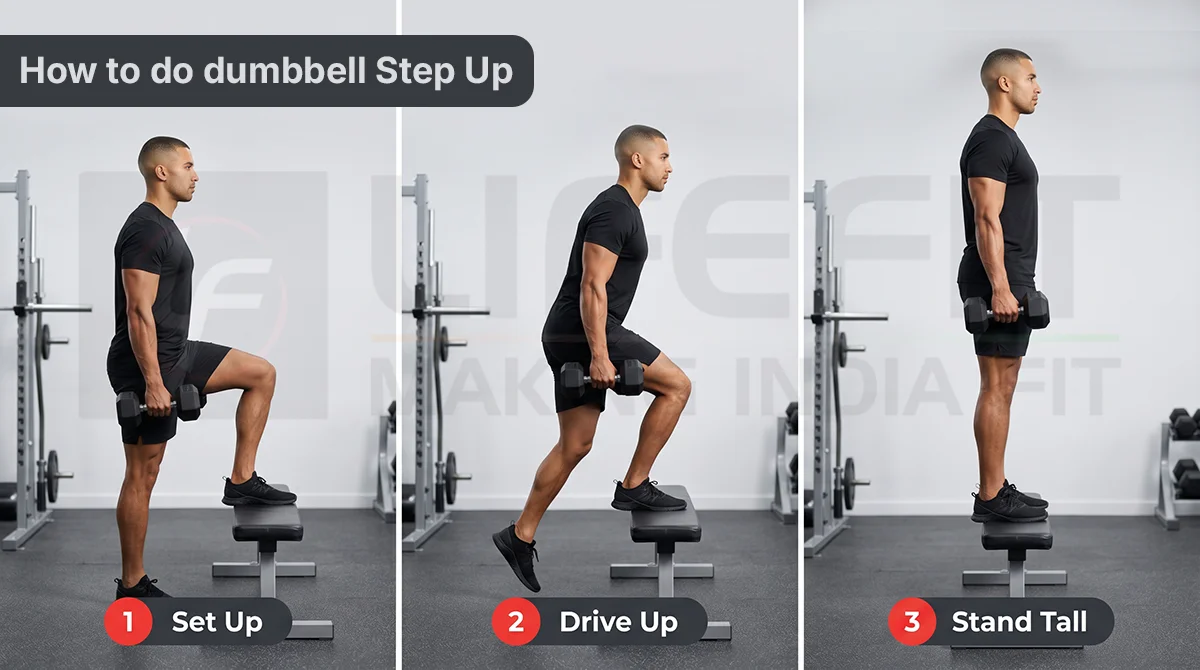
Stand facing a stable box, step, or bench. Hold one dumbbell in each hand with your arms relaxed at your sides.
Place one foot fully on the platform. Your heel should not hang off the edge. Keep your chest tall, shoulders relaxed, and core lightly braced.
Step-by-Step Instructions
Place your right foot firmly on the box or bench.
Keep the full foot planted, especially the heel and midfoot.
Brace your core and keep your torso controlled.
Push through the front foot to lift your body upward.
Let the working leg do the job instead of jumping from the back foot.
Stand tall at the top with both feet on the platform.
Step down slowly with control.
Complete the desired reps on one leg, then switch sides.
Form Cues That Make a Big Difference
Drive through your front heel and midfoot.
Keep your knee tracking in line with your toes.
Keep the back foot light.
Do not bounce off the floor.
Keep the dumbbells steady.
Lower yourself slowly instead of dropping down.
Use a step height you can control.
A clean rep should feel smooth, stable, and deliberate.
Best Box Height for Dumbbell Step Ups
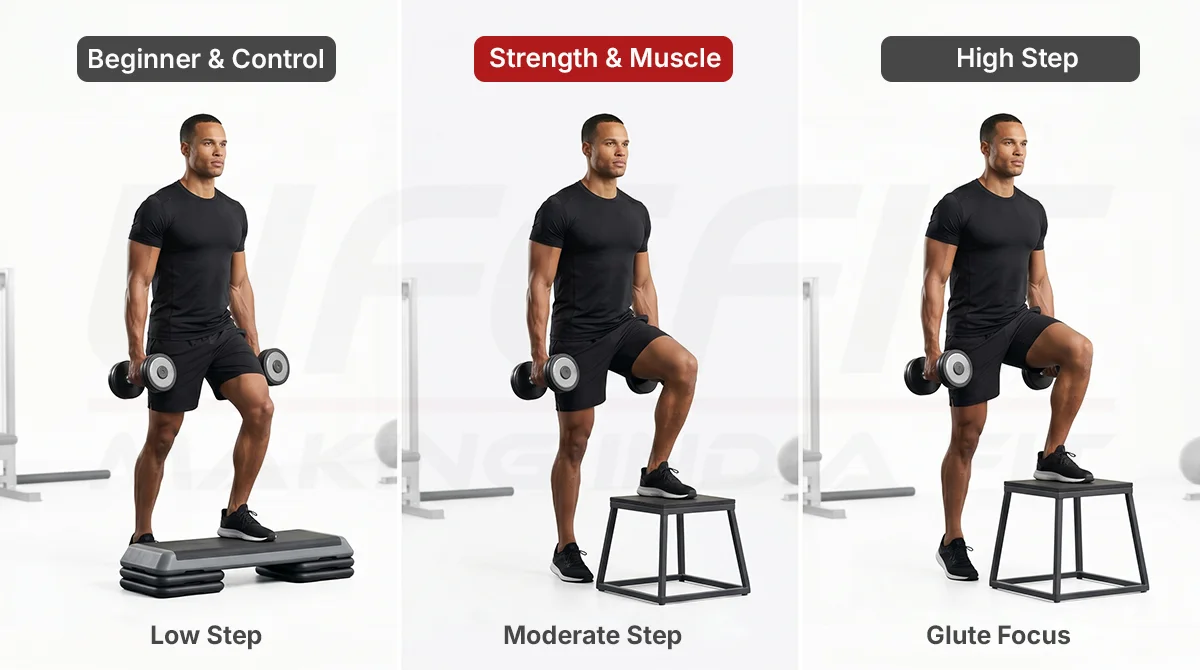
Box height changes the difficulty and muscle emphasis of the exercise.
A higher box is not always better. If the step is too high, you may twist your hips, round your lower back, or push too much from the back leg.
Box Height | Best For | How It Feels |
|---|---|---|
Low step | Beginners, warm-ups, knee-sensitive users | Easier to control |
Knee height or slightly lower | General strength and muscle building | Best option for most people |
Slightly above knee height | Advanced glute focus | Harder and more mobility-demanding |
Very high box | Advanced users only | Easy to cheat if mobility or strength is limited |
A practical rule: when your foot is on the platform, your front knee should be around hip height or slightly lower. If your knee is much higher than your hip, the box may be too tall for clean reps.
Common Dumbbell Step Up Mistakes
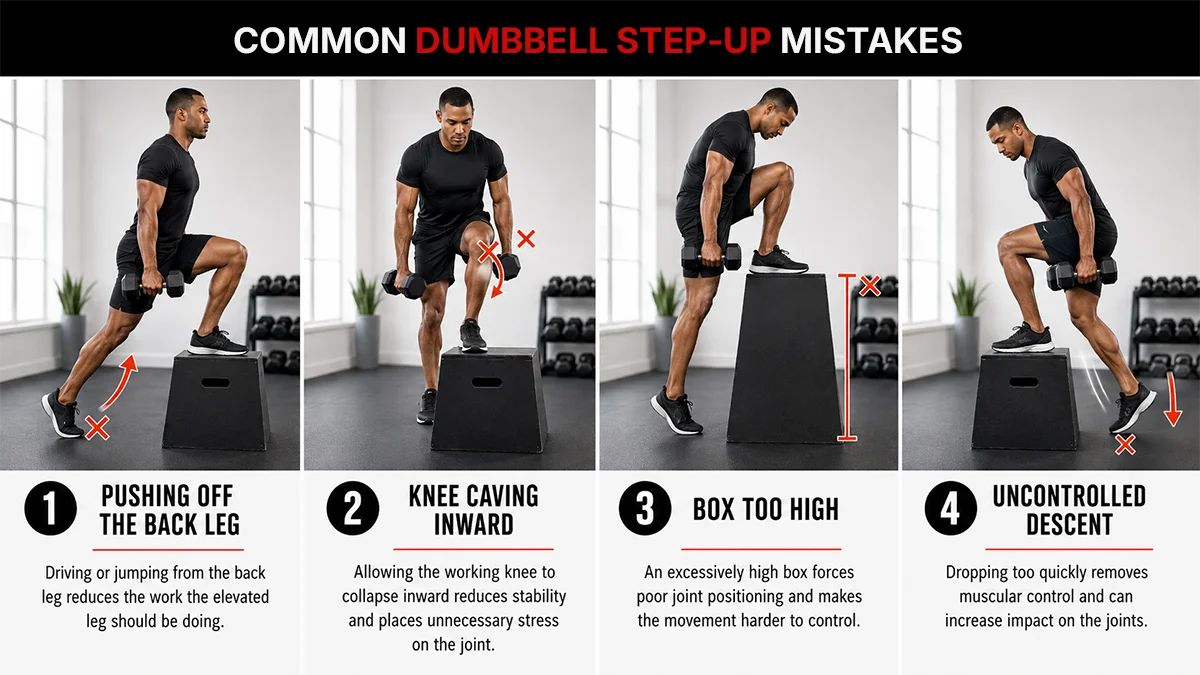
1. Pushing Off the Back Leg
This turns the exercise into a jump instead of a controlled single-leg lift.
Fix: Keep the back foot light and think, “front leg lifts the body.”
2. Using a Box That Is Too High
A high box can force poor hip position, back rounding, or excessive knee stress.
Fix: Start lower. Increase height only when your form stays clean.
3. Letting the Knee Cave Inward
Your knee should stay in line with your toes. If it drops inward, your hip and knee control need work.
Fix: Use lighter dumbbells and keep the knee tracking over the second or third toe.
4. Dropping Down Too Fast
The lowering phase builds strength and control. Dropping quickly reduces the benefit and increases impact.
Fix: Take 2–3 seconds to step down.
5. Leaning Too Far Forward
A slight forward lean is fine, especially for glute emphasis. But collapsing your chest or rounding your back is not.
Fix: Keep your chest open, core braced, and movement controlled from the hips.
6. Letting the Heel Hang Off the Platform
A partial foot position reduces stability and makes the movement harder to control.
Fix: Place your full foot on the box before every rep.
Dumbbell Step Up Sets and Reps
Choose your sets and reps based on your goal.
Goal | Sets | Reps | Load |
|---|---|---|---|
Learning form | 2–3 | 8–10 per leg | Bodyweight or light dumbbells |
Muscle building | 3–4 | 8–12 per leg | Moderate dumbbells |
Strength | 3–5 | 5–8 per leg | Heavier dumbbells |
Fat-loss circuit | 2–4 | 10–15 per leg | Light to moderate dumbbells |
Balance and control | 2–3 | 8–12 per leg | Light load with slow tempo |
For most lifters, 3 sets of 8–12 reps per leg is a strong starting point.
How to Add Dumbbell Step Ups to Your Workout
Lower-Body Strength Workout
Barbell Back Squat – 3 sets of 5–8 reps
Dumbbell Step Up – 3 sets of 8–10 reps per leg
Leg Press – 3 sets of 10–12 reps
Leg Curl or Leg Extension – 3 sets of 10–15 reps
Calf Raise – 3 sets of 12–15 reps
This works well when step ups are used after your heavy main lift.
Dumbbell-Only Leg Workout
Dumbbell Goblet Squat – 3 sets of 10–12 reps
Dumbbell Step Up – 3 sets of 10 reps per leg
Dumbbell Lunge – 3 sets of 8–10 reps per leg
Dumbbell Romanian Deadlift – 3 sets of 10–12 reps
Standing Calf Raise – 3 sets of 12–15 reps
Explore dumbbell workouts for structured training plans focused on strength, muscle building, fat loss, and full-body fitness.
Home Gym Lower-Body Workout
Dumbbell Step Up – 3 sets of 10 reps per leg
Goblet Squat – 3 sets of 12 reps
Split Squat – 3 sets of 10 reps per leg
Glute Bridge – 3 sets of 12–15 reps
Plank – 3 rounds
This routine is compact, practical, and easy to perform with minimal equipment.
Get Gym Equipment Recommendations
Planning a Home or Commercial Gym?
Share your details and the LIFE FIT team will help you choose suitable dumbbells, benches, strength equipment, and gym setup options based on your space and requirements.
Dumbbell Step Up Variations
Bodyweight Step Up: Use this version first if you are new to step ups or struggle with balance.
Standard Dumbbell Step Up: Hold one dumbbell in each hand. This is the best all-round version for strength and muscle building.
Goblet Step Up: Hold one dumbbell at chest height. This can help you keep your torso more upright.
Contralateral Dumbbell Step Up: Hold one dumbbell in the opposite hand to your working leg. This increases core and hip stability demand.
Lateral Step Up: Stand sideways to the box and step up from the side. This variation adds more side-to-side hip control.
High Step Up: Use a higher platform to increase hip involvement. This is better for advanced users with good mobility and control.
Explosive Step Up: Drive up with speed while staying controlled. This variation is useful for athletic training but should not be used until your standard step up form is solid.
Dumbbell Step Up vs Lunge vs Squat
Exercise | Best For | Main Difference |
|---|---|---|
Dumbbell Step Up | Single-leg strength, glutes, balance | Uses a raised platform and emphasizes controlled upward drive |
Dumbbell Lunge | Balance, coordination, quads, glutes | More forward/backward movement and more balance challenge |
Dumbbell Goblet Squat | Beginner-friendly leg training | Both legs work together at the same time |
Barbell Back Squat | Max strength and heavy loading | Allows heavier load but needs more technique and equipment |
Leg Press | Controlled lower-body loading | Machine-supported and easier to load heavily |
The step up is not a replacement for every leg exercise. It is best used as part of a complete lower-body plan.
For example, use squats or leg press for heavier bilateral strength, then add dumbbell step ups and lunges for single-leg control.
Is the Dumbbell Step Up Good for Beginners?
Yes, but beginners should start with a low platform and light dumbbells.
Before adding weight, make sure you can:
Keep your front foot fully planted
Step up without bouncing from the back leg
Keep your knee aligned with your toes
Step down slowly
Complete equal reps on both legs
Once you can do that, gradually increase the dumbbell weight.
Is the Dumbbell Step Up Good for Glutes?
Yes. The dumbbell step up can be very effective for the glutes, especially when you use a controlled tempo and avoid pushing from the back leg.
To make it more glute-focused:
Use a moderate-to-high platform you can control
Drive through the heel and midfoot
Lean slightly forward from the hips
Step down slowly
Keep the working leg under tension
Do not increase the box height if it causes twisting or poor form.
Is the Dumbbell Step Up Good for Quads?
Yes. The quads work strongly as your knee extends and your body rises onto the platform.
To make it more quad-focused:
Use a moderate step height
Keep the torso more upright
Control the descent
Avoid pushing off the floor leg
Keep the knee tracking forward in line with the toes
For more movements that strengthen and develop the quadriceps, explore quad exercises collection.
Dumbbell Step Up Safety Tips
The dumbbell step up is safe for many people, but only when the platform is stable and the movement is controlled.
Follow these safety tips:
Use a platform that does not wobble.
Start with lighter dumbbells.
Keep your full foot on the box.
Step down slowly.
Do not use a box that is too high.
Stop if you feel sharp knee, hip, or back pain.
Avoid turning the exercise into a jump unless you are doing an advanced explosive variation.
If you have knee pain, hip pain, balance issues, or a recent injury, work with a qualified trainer or physiotherapist before using loaded step ups.
Expert Form Tips
Keep every rep smooth.
Match your setup on both legs.
Do not rush the eccentric phase.
Keep the dumbbells quiet and steady.
Record your form from the front to check knee tracking.
Use a lower box if you feel the movement in your lower back.
Increase load only when both legs feel equally controlled.
The best dumbbell step up reps are not the fastest reps. They are the reps where the working leg does the job cleanly.
Dumbbell Step Up FAQs
Dumbbell step ups mainly work the quadriceps and glutes. They also involve the hamstrings, calves, adductors, and core for support and stability.
They are different. Step ups are excellent for controlled single-leg strength and glute-focused training. Lunges are great for balance, coordination, and lower-body conditioning. Many lifters benefit from using both.
Most people should start with a box around knee height or slightly lower. Beginners should use a lower step until they can perform clean reps without pushing off the back leg.
Both methods work. Doing one side at a time is better for strength and focus. Alternating legs works well for conditioning circuits.
Use a weight you can control without bouncing, twisting, or losing knee alignment. If your back leg has to push hard from the floor, the dumbbells are probably too heavy.
Yes. You only need dumbbells and a stable elevated surface. For safety, use a strong bench, plyo box, or step platform instead of an unstable chair.
Step ups can strengthen the muscles that support the knee, especially the quads and glutes. But box height, load, and control matter. If the exercise causes knee pain, reduce the height, reduce the weight, or get professional guidance.
One to two times per week is enough for most people. Keep at least one recovery day between hard lower-body sessions.
Final Takeaway
The dumbbell step up exercise is one of the most practical lower-body exercises for building quads, glutes, balance, and single-leg strength.
Start with a stable platform and light dumbbells. Keep your full foot on the box, drive through the front leg, and step down slowly. Once your form is strong, progress with heavier dumbbells, a slightly higher step, or more advanced variations.
For a complete lower-body routine, pair dumbbell step ups with the dumbbell goblet squat, dumbbell lunge, leg press, or barbell back squat.
References
Neto et al. — Gluteus Maximus Activation during Common Strength and Hypertrophy Exercises
Wang et al. — Lower-Extremity Biomechanics During Forward and Lateral Stepping Activities
Appleby et al. — Kinetics and Kinematics of the Squat and Step-Up in Well-Trained Rugby Players
Kipp et al. — Muscle Forces During the Squat, Split Squat, and Step-Up
0 Comments
Loading comment form…
Loading comments…