


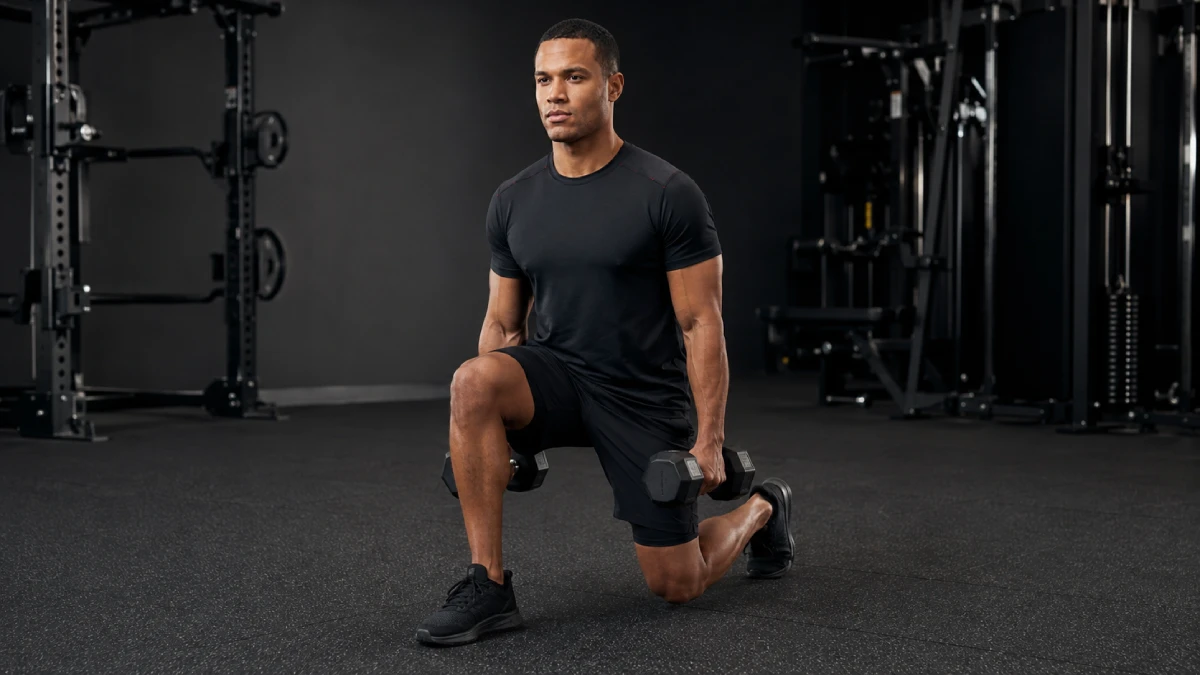
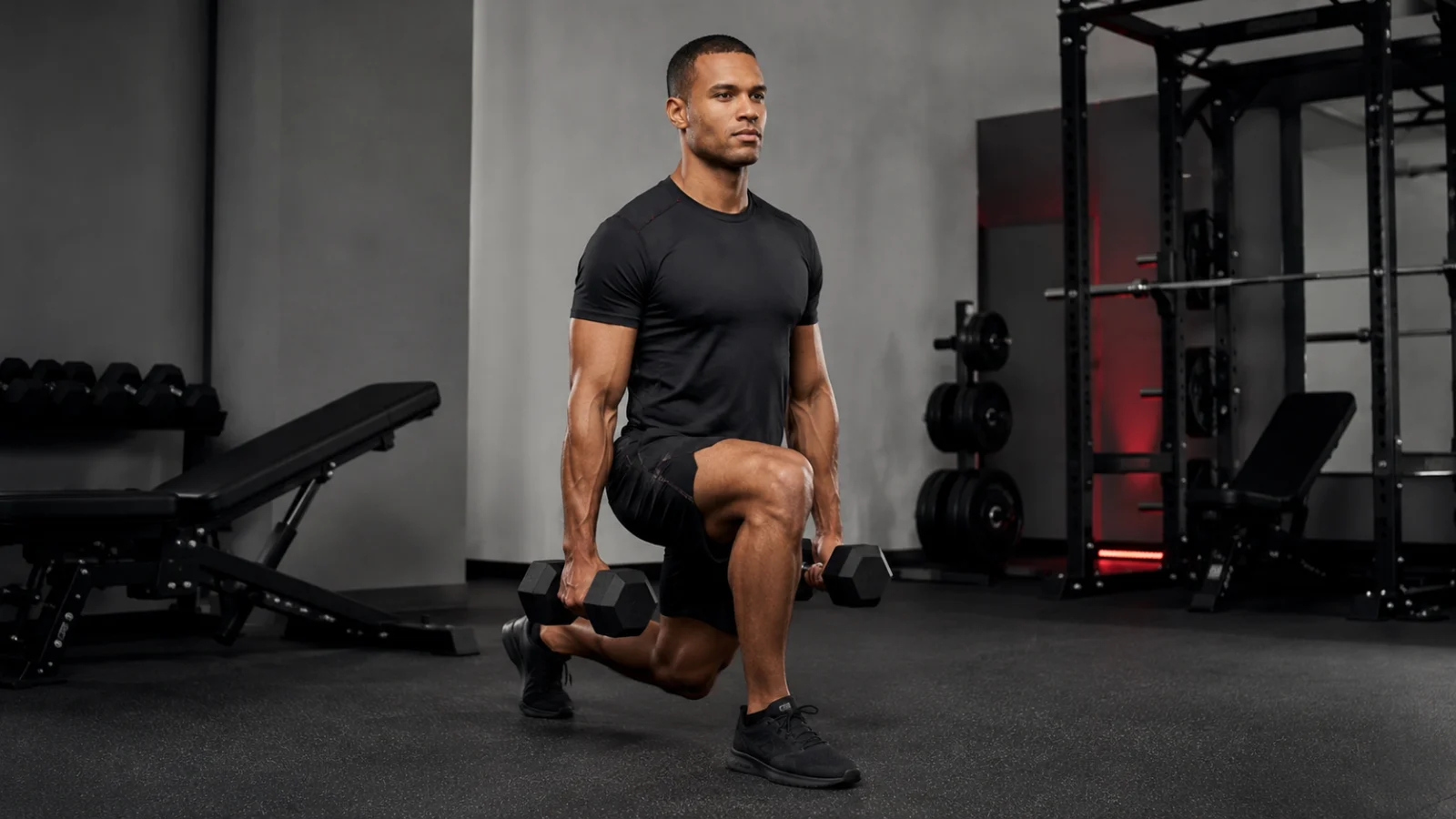
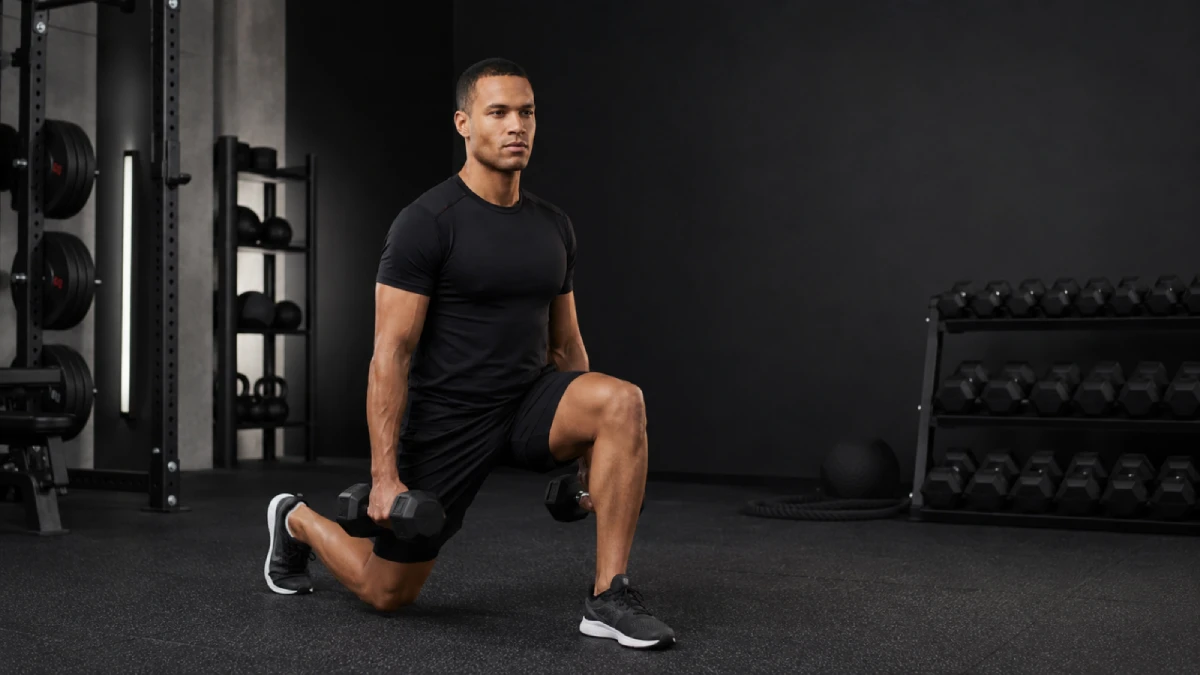
The dumbbell rear lunge, more commonly called the dumbbell reverse lunge, is a unilateral lower-body exercise performed by stepping one foot backwards while holding a dumbbell in each hand.
It strengthens the quadriceps, glutes and hamstrings while challenging balance, coordination and pelvic control. Because the front foot stays planted, many people find it easier to position and control than a forward lunge.
The movement looks simple, but its biomechanics are more nuanced than the common idea that the front leg does all the work. Both legs remain active, and small changes in stride length, torso position and weight distribution can influence how the exercise feels.
Dumbbell Rear Lunge at a Glance
Exercise detail | Information |
|---|---|
Also known as | Dumbbell reverse lunge, dumbbell backward lunge |
Primary muscles | Quadriceps and gluteus maximus |
Supporting muscles | Hamstrings, gluteus medius, adductors, calves and core |
Equipment | Pair of dumbbells |
Movement type | Unilateral lower-body exercise |
Difficulty | Beginner to intermediate |
Typical repetition range | 6–15 repetitions per leg |
Best used for | Leg strength, muscle development, balance and unilateral training |
What Is a Dumbbell Rear Lunge?
A dumbbell rear lunge is a loaded lunge variation in which you step one foot behind your body, lower both knees and then return to standing.
The terms rear lunge, reverse lunge and backward lunge generally refer to the same exercise.
Unlike a forward lunge, the front foot does not have to land and absorb forward momentum. It stays planted while the opposite leg travels backwards. This makes the foot position more predictable and may help beginners control their balance.
The movement is closely related to the standard dumbbell lunge, although changing the step direction affects momentum, joint loading and coordination.
How to Do the Dumbbell Rear Lunge
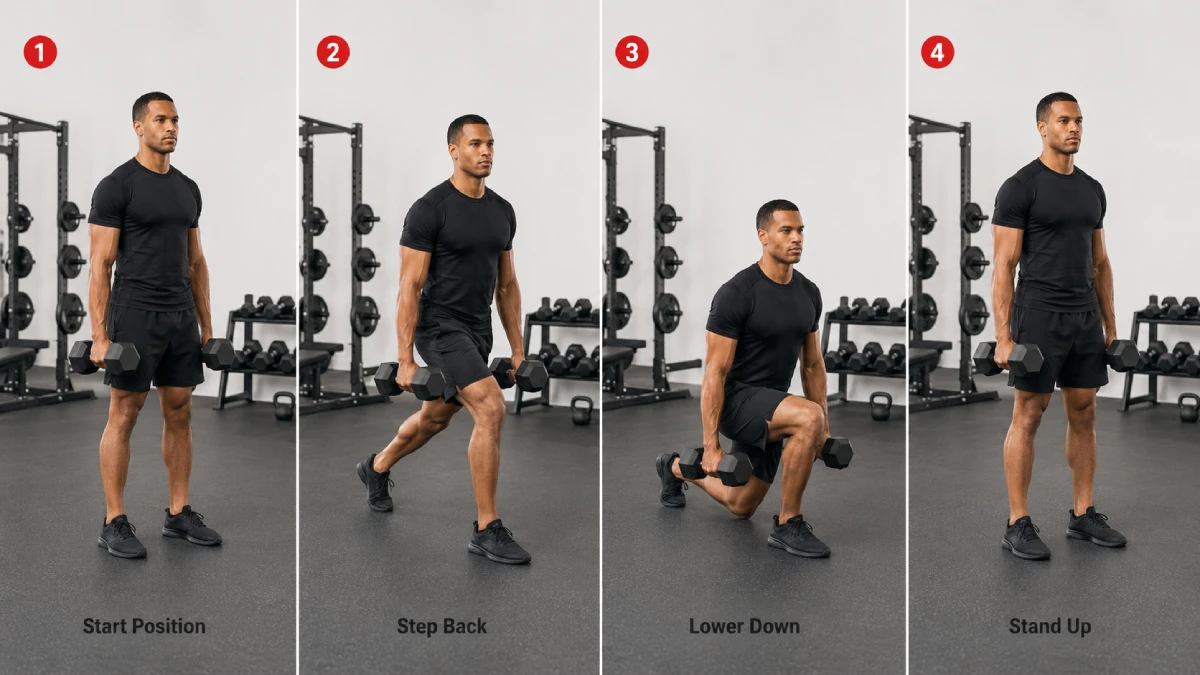
Begin with body weight or light dumbbells. The correct load is one that allows you to repeat the same stride and depth without losing balance.
1. Set Your Starting Position
Stand upright with your feet approximately hip-width apart.
Hold one dumbbell in each hand with your palms facing your thighs. Let your arms hang naturally beside your body.
Keep your ribs stacked over your pelvis, relax your shoulders and brace your core.
2. Step Backwards
Shift your weight onto one foot and take a controlled step backwards with the opposite leg.
Land on the ball of the rear foot with the heel raised. Maintain some width between your feet rather than stepping onto a straight line.
A narrow, tightrope-like stance makes balancing harder without improving the exercise.
3. Lower Under Control
Bend both knees and lower your rear knee towards the floor.
Keep the front foot firmly planted. The front knee should travel in the same general direction as the middle toes rather than collapsing inwards.
Use the deepest range you can control without lifting the front heel, twisting the pelvis or dropping onto the rear knee.
4. Return to Standing
Drive through the front foot as you extend the front knee and hip.
At the same time, bring the rear foot forwards until you return to the starting position.
The rear leg remains active, but avoid turning the movement into an aggressive push or jump from the back toes.
5. Repeat on the Other Side
Alternate sides after each repetition or complete the full set on one leg before switching.
Alternating repetitions provide a brief rest between sides. Consecutive repetitions create more continuous fatigue in the working muscles.
How to Breathe
Inhale and brace before stepping backwards.
Maintain a controlled brace during the descent, then exhale as you drive back to standing. Avoid holding your breath for extended periods, particularly when using lighter loads.
Quick Form Checklist
Keep the front foot flat.
Step backwards with some lateral width.
Lower smoothly rather than dropping.
Keep the front knee aligned with the foot.
Maintain a stable pelvis.
Return through the front leg without jumping forwards.
Stop the set when your stride becomes inconsistent.
Dumbbell Rear Lunge Muscles Worked
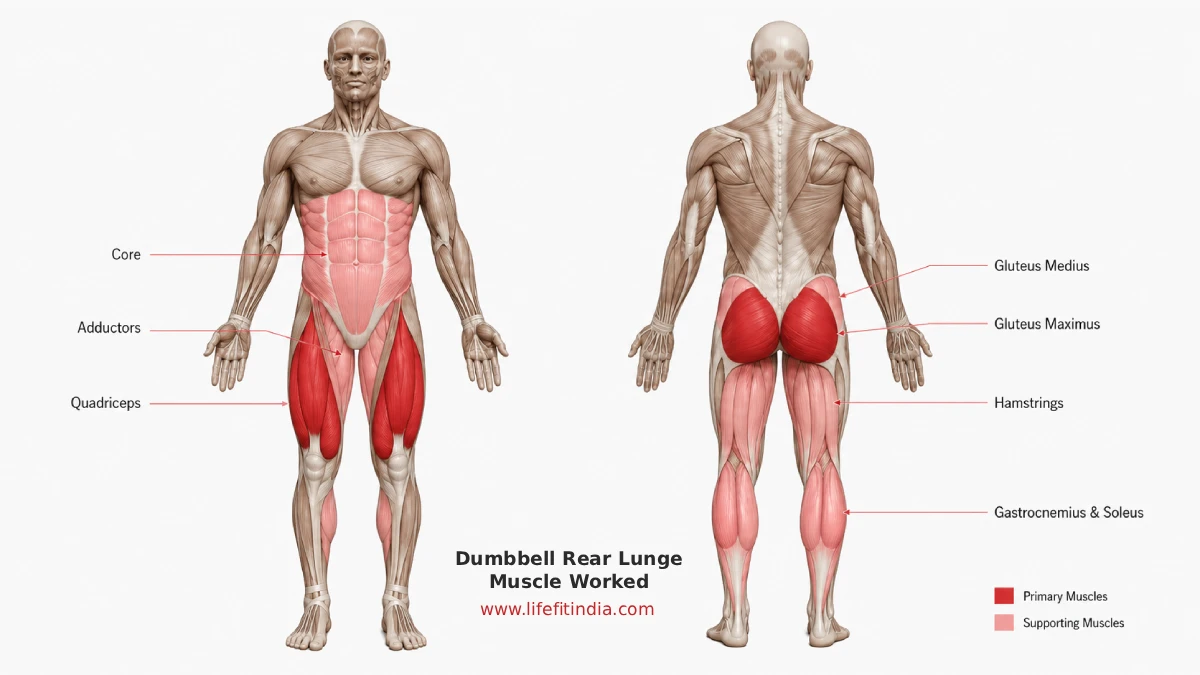
The dumbbell rear lunge trains the major muscles surrounding the hip and knee. However, the two legs do not contribute in exactly the same way.
Quadriceps
The quadriceps extend the knee and control knee flexion as you lower.
They remain active in both legs, although their contribution changes across the stepping, lowering and rising phases.
Gluteus Maximus
The gluteus maximus contributes to hip extension as you return to standing.
It also helps control the pelvis and femur while your body moves over a relatively small base of support.
Hamstrings
The hamstrings assist with hip extension, knee control and movement of the stepping leg.
They also help stabilize the knee during the transition between lowering and rising.
Gluteus Medius
The gluteus medius stabilizes the pelvis from side to side.
Its role becomes especially important when your weight shifts onto one leg and the opposite foot begins to move.
Adductors
The inner-thigh muscles help control the hip and contribute to lower-body stability.
Some of the adductors also assist with hip extension from the bottom of a deep lunge.
Calves
The calf muscles stabilize the ankle of the planted leg and help control the position of the rear foot.
Core and Upper Back
Your abdominal muscles, obliques and spinal stabilizers keep the torso controlled while the legs move independently.
Holding dumbbells also places a secondary demand on your grip, shoulders and upper back.
Which Leg Works During a Rear Lunge?
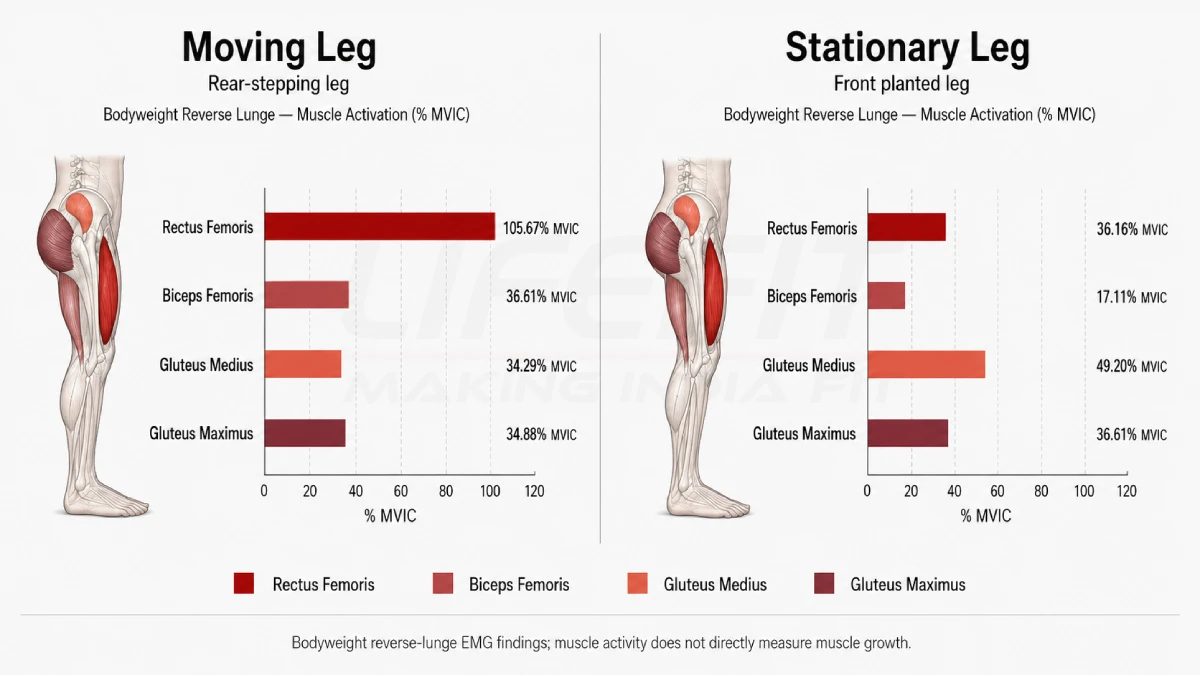
The most accurate answer is that both legs work, but they perform different tasks.
For clarity:
The stationary leg is the front leg that remains planted.
The moving leg is the leg that steps backwards and returns.
The stationary leg supports much of your body weight, controls the descent and contributes strongly as you return to standing. The moving leg must step backwards, decelerate, stabilise in the rear position and travel forwards again.
A 2024 descriptive study published in applied sciences measured the rectus femoris, biceps femoris, gluteus medius and gluteus maximus in both legs during a bodyweight reverse lunge.
The researchers recorded greater peak rectus femoris and biceps femoris activity in the moving leg. Greater peak gluteus medius and gluteus maximus values were recorded in the stationary leg.
Moving vs Stationary Leg Muscle Activation
Muscle | Moving leg peak EMG | Stationary leg peak EMG | Practical interpretation |
|---|---|---|---|
Rectus femoris | 105.67% MVIC | 36.16% MVIC | The moving-leg quadriceps was highly active while controlling and returning the stepping leg |
Biceps femoris | 36.61% MVIC | 17.11% MVIC | The moving-leg hamstrings helped control and reposition the limb |
Gluteus medius | 34.29% MVIC | 49.20% MVIC | The stationary-leg gluteus medius worked strongly to keep the pelvis level |
Gluteus maximus | 34.88% MVIC | 36.61% MVIC | Peak activity was slightly higher in the stationary leg, although the difference was small |
See the peer-reviewed reverse-lunge electromyographic study for the complete methods and results.
What the EMG Findings Do—and Do Not—Tell Us
The results provide a more detailed picture of the movement, but they require context.
The study involved 20 healthy young adults performing bodyweight reverse lunges. It did not directly test heavily loaded dumbbell lunges, long-term muscle growth or strength development.
EMG measures electrical activity within a muscle. It does not provide a complete measurement of joint force, mechanical tension or future hypertrophy.
The practical takeaway is not that one leg does everything. It is that each leg performs a different role:
The stationary leg contributes strongly to support, hip extension and pelvic stability.
The moving leg remains dynamically active while stepping backwards and returning.
Adding dumbbells or changing the technique may alter these demands.
How Torso Position Changes the Dumbbell Rear Lunge
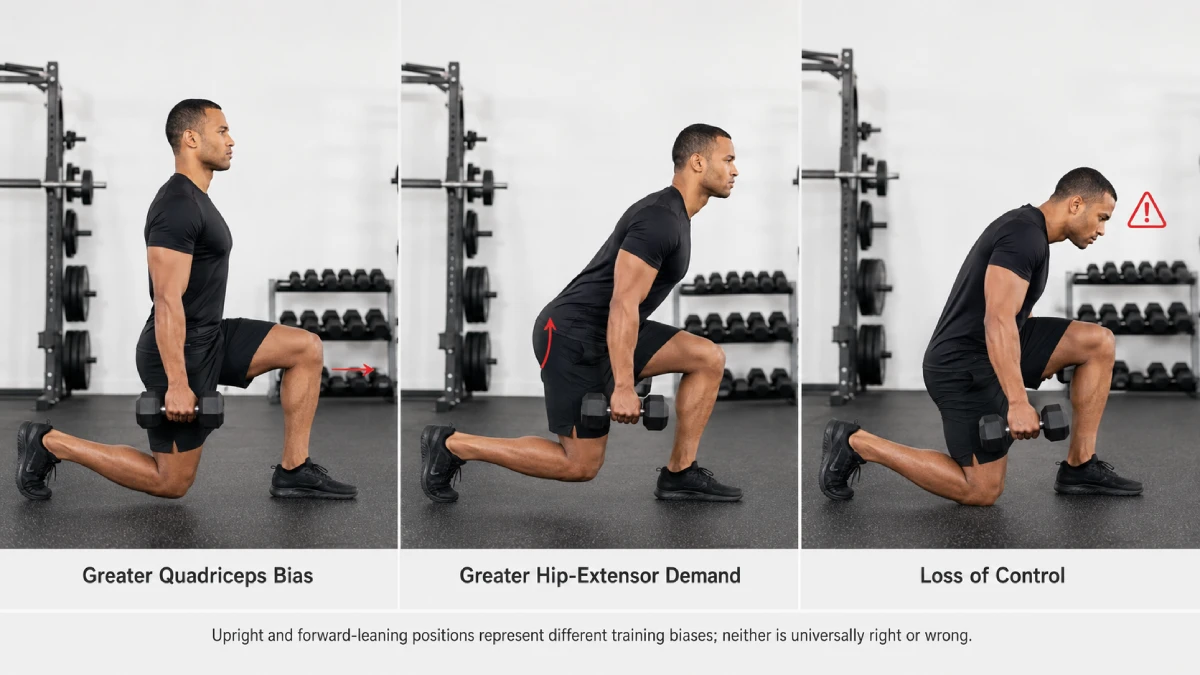
Torso position can shift the relative demand between the hip and knee. However, the effect is gradual rather than absolute.
More Upright Torso
Keeping the torso relatively upright generally maintains a larger knee-extension demand.
This can make the exercise feel more quadriceps-dominant, especially when the front knee travels forwards while the heel remains planted.
Use a more upright position when:
You want greater quadriceps emphasis.
Your ankle mobility allows comfortable forward knee travel.
You can maintain full foot contact.
The position feels stable and pain-free.
Modest Forward Torso Lean
A controlled forward lean from the hips shifts your center of mass and can increase the demand placed on the hip extensors.
This may make the glutes and hamstrings feel more involved.
Some coaches use approximately 20–30° of forward lean as a practical reference. It is not a compulsory target or a universally superior angle.
The lean should come from the hips while the spine remains controlled. Your torso should not collapse towards the front thigh.
Torso Position Comparison
Torso position | Likely mechanical bias | Main coaching cue |
|---|---|---|
More upright | Greater knee-extension and quadriceps demand | Keep the ribs stacked and allow comfortable knee travel |
Modest forward lean | Greater hip-extension demand | Hinge slightly from the hips while maintaining a stable spine |
Excessive forward collapse | Reduced balance and unnecessary spinal demand | Reduce the weight, shorten the range or improve your stance |
Biomechanical research on anterior, or forward, lunges demonstrates that changing torso and load position alters joint moments at the hip and knee. The same mechanical principle applies across the wider lunge family, including rear lunges, although the exact forces differ between variations.
A biomechanical analysis published in the Journal of Orthopaedic & Sports Physical Therapy found that load position and torso mechanics affected hip and knee demands during lunges. An EMG study in trained women also found that an inclined torso increased erector-spinae activity, while gluteus-maximus activation was influenced more clearly by the specific lunge variation.
This means torso angle should be treated as a training bias, not an on-and-off switch.
For further detail, see:
Benefits of the Dumbbell Rear Lunge
1. Develops Lower-Body Strength
The exercise trains the hips and knees through a coordinated movement.
Your quadriceps, glutes and hamstrings produce force while smaller muscles stabilize the pelvis, knee and ankle.
This makes the rear lunge useful for general strength and muscle-building programs.
2. Trains Each Side Independently
Squats and leg presses allow both legs to work together. Rear lunges require each side to control the movement independently.
This can reveal differences in:
Balance
Hip stability
Knee control
Coordination
Strength between sides
Unilateral exercises should not replace every bilateral lift, but they complement movements such as the barbell back squat by introducing a different stability and coordination challenge.
A systematic review comparing unilateral and bilateral resistance training found that both methods can improve athletic performance, with adaptations often reflecting the movement pattern being trained.
Read the systematic review of unilateral and bilateral resistance training.
3. May Be Easier to Control Than a Forward Lunge
A forward lunge requires you to step ahead, land and absorb forward momentum.
During a rear lunge, the front foot remains planted. This can make stride length, foot pressure and knee alignment easier to organize.
Research published in Physical Therapy Rehabilitation Science found lower vertical ground-reaction forces during backward lunges than forward lunges under the study conditions.
A separate study by Goulette and colleagues, published in Physical Therapy in Sport, reported lower peak patellofemoral joint loading during backward lunges than forward lunges.
These findings may help explain why some people find reverse lunges more manageable. However, they do not prove that the exercise is painless or suitable for every knee condition.
Joint comfort also depends on:
Stride length
Training load
Range of motion
Movement control
Injury history
Individual anatomy
4. Challenges Pelvic Stability
As one leg moves, the gluteus medius of the stationary leg helps prevent the pelvis from dropping or rotating excessively.
This side-to-side control contributes to more consistent hip and knee alignment.
5. Improves Balance and Coordination
The exercise requires you to:
Shift your body weight.
Place the rear foot accurately.
Control two knee joints.
Stabilize the pelvis.
Return to the same starting position.
These demands make the movement more coordinative than a fixed-path machine exercise.
6. Trains a Useful Range of Motion
Rear lunges train the front hip and knee through flexion while the rear hip moves into extension.
Use the largest range you can control comfortably. You do not need to force the rear knee onto the floor.
A systematic review published in SAGE Open Medicine found that resistance-training range of motion can influence muscular development. The practical recommendation is to use a meaningful, controlled range rather than unnecessarily shortening every repetition.
Read the systematic review on range of motion and muscle development.
7. Requires Minimal Equipment
You only need a pair of dumbbells and enough space to take one step backwards.
This makes the exercise suitable for compact workout areas. For a more complete training space, explore LIFE FIT’s home gym setup solutions.
Dumbbell Rear Lunge vs Forward Lunge
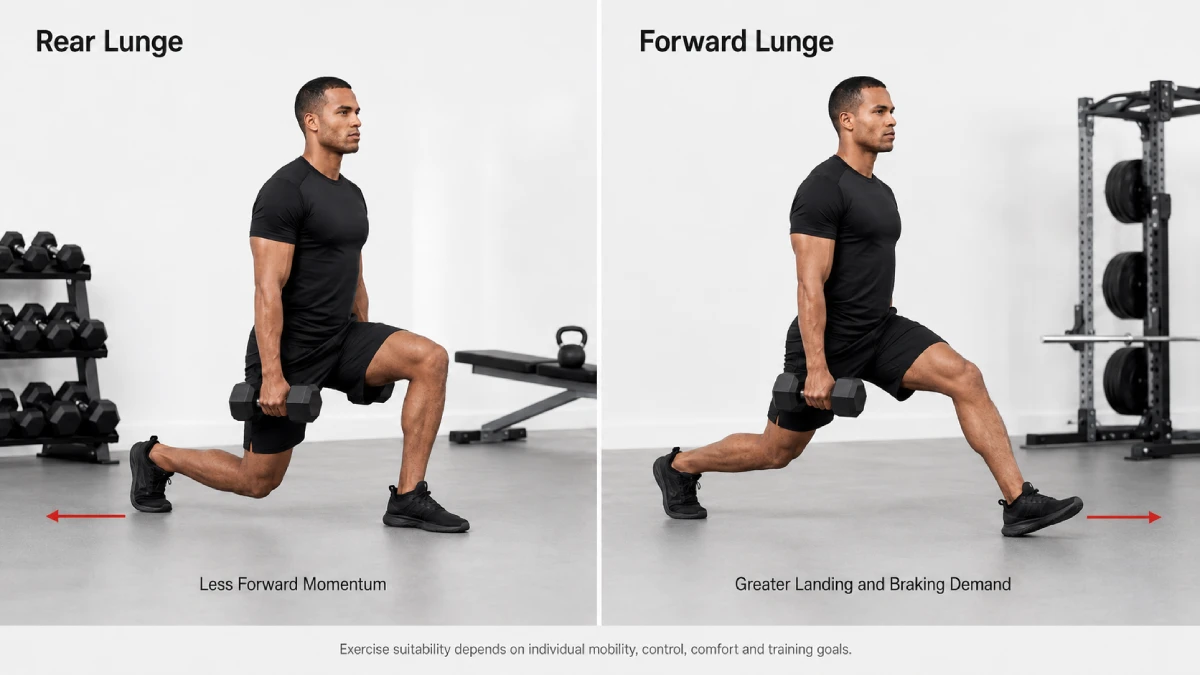
Neither variation is universally better. They emphasize different movement demands.
Factor | Dumbbell rear lunge | Dumbbell forward lunge |
|---|---|---|
Step direction | Backwards | Forwards |
Front-foot position | Remains planted | Must land ahead of the body |
Momentum | Usually easier to control | Requires greater forward deceleration |
Balance demand | Moderate | Often higher during landing |
Ground-reaction forces | May be lower under comparable conditions | Often higher during the landing phase |
Coordination focus | Backward stepping and returning | Forward landing and braking |
Typical use | Strength, hypertrophy and controlled unilateral training | Dynamic control, deceleration and athletic preparation |
Beginner suitability | Often easier to learn | May require more landing confidence |
Choose the variation that matches your goal and allows you to maintain control.
Common Dumbbell Rear Lunge Mistakes
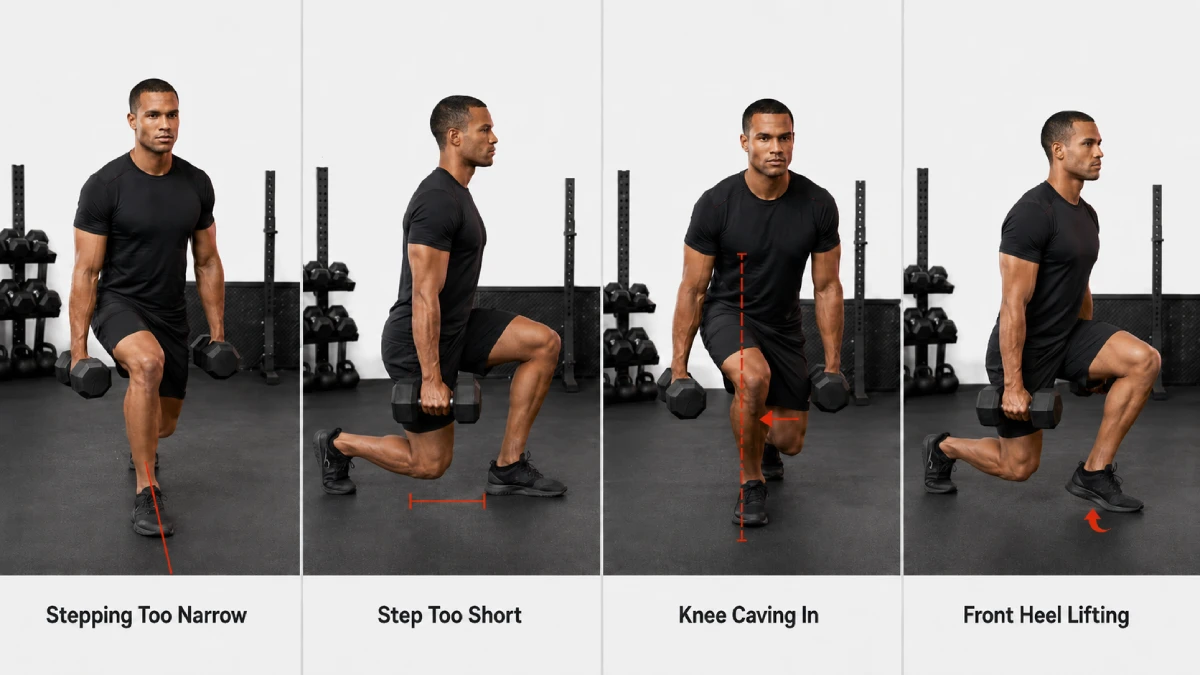
Stepping Directly Behind the Front Foot
A tightrope stance reduces your base of support and makes the movement unnecessarily unstable.
Fix: Step backwards while maintaining approximately hip-width spacing between your feet.
Taking a Step That Is Too Short
A short step can crowd the front knee and make the rear-leg position uncomfortable.
Fix: Step far enough back that both knees can bend without the front heel lifting.
Taking an Excessively Long Step
An overly long stride can pull the pelvis out of position and make it difficult to return smoothly.
Fix: Use a stride that permits a controlled descent without stretching or twisting.
Pushing Aggressively From the Rear Toes
The rear leg contributes to the movement, but excessive push-off can turn the repetition into a jump forwards.
Fix: Maintain pressure through the stationary front foot and return smoothly.
Allowing the Front Knee to Collapse Inwards
Knee collapse may occur when the stance is too narrow, the load is too heavy or hip control is insufficient.
Fix: Keep the knee moving in the same general direction as the foot. Reduce the weight when necessary.
Lifting the Front Heel
A rising heel reduces stability and may indicate limited ankle mobility, poor balance or an unsuitable stride.
Fix: Maintain pressure through the heel and both sides of the forefoot.
Dropping Onto the Rear Knee
Crashing towards the floor removes muscular control and may cause discomfort.
Fix: Slow the descent and stop just above the floor. A soft pad can be used as a depth reference.
Leaning Without Control
A small hip hinge can be intentional. A collapsing torso is not.
Fix: Brace before stepping, keep the dumbbells close to your sides and reduce the load.
Using Dumbbells That Are Too Heavy
Heavy weights often shorten the range of motion and change foot placement before the lifter notices.
Fix: Progress only when every repetition uses a consistent stance, depth and tempo.
Evidence-Informed Dumbbell Rear Lunge Progression
There is no single progression that suits everyone. A beginner learning the exercise and a patient returning from injury require different approaches.
For general strength training, use the following sequence.
Supported Split Squat: Keep both feet fixed and hold a stable support. This removes the stepping challenge and allows you to practice lowering between two legs.
Bodyweight Split Squat: Remove the hand support while maintaining the fixed stance.
Supported Rear Lunge: Hold a rack or stable support while practicing the backward step. Use only enough assistance to maintain balance.
Bodyweight Rear Lunge: Perform the complete movement without external load.
Dumbbell Rear Lunge: Hold light dumbbells beside your body. Increase the load only when both sides remain consistent.
Deficit Dumbbell Rear Lunge: Stand on a low, stable platform to increase the available range of motion. Begin with a small elevation.
Advanced Loading or Stability Variation: Progress to a front-rack, offset or contralateral dumbbell position.
A dumbbell step-up can also provide a different unilateral challenge without repeating the same lunge pattern.
A Rehabilitation Perspective
Research published in Physical Therapy in Sport has shown that joint loads differ between common single-leg exercises, reverse lunges and forward lunges.
This supports the general principle of progressing from predictable, controlled positions towards more dynamic stepping and deceleration tasks.
One possible clinician-led continuum is:
Controlled single-leg or split-stance exercise → reverse lunge → forward lunge
This is not a universal rehabilitation prescription. The correct sequence depends on the injured tissue, symptoms, training history and stage of recovery.
People returning from an injury should follow the progression recommended by their physiotherapist or healthcare professional.
Dumbbell Rear Lunge Variations
1. Alternating Dumbbell Rear Lunge
Switch legs after every repetition.
This variation is useful with moderately heavy weights because each side receives a short recovery period.
2. Consecutive Rear Lunge
Complete every repetition on one side before changing legs.
This produces more continuous local fatigue.
3. Goblet Rear Lunge
Hold one dumbbell vertically at your chest.
The central loading position is often easier for beginners to control. It also pairs well with the dumbbell goblet squat in a home workout.
4. Contralateral Dumbbell Rear Lunge
Hold one dumbbell in the hand opposite the stationary front leg.
The offset load increases the anti-rotation demand placed on the trunk and hip stabilizers.
5. Ipsilateral Dumbbell Rear Lunge
Hold the dumbbell on the same side as the stationary front leg.
This changes the lateral stability challenge and may feel different through the hip and core.
6. Front-Rack Dumbbell Rear Lunge
Hold both dumbbells at shoulder height.
This position increases trunk and upper-body demand but may be limited by shoulder or wrist comfort.
7. Deficit Rear Lunge
Elevate the stationary front foot on a low platform.
The variation increases the available depth and hip range of motion. More elevation is not automatically better.
8. Bulgarian Split Squat
The rear foot remains elevated throughout the set rather than stepping on every repetition.
This is not a direct progression for everyone, but it is an effective alternative when the goal is continuous unilateral loading.
Recommended Sets and Repetitions
Training goal | Sets | Repetitions |
|---|---|---|
Learning the movement | 2–3 | 6–8 per leg |
General strength | 3–4 | 6–10 per leg |
Muscle development | 3–4 | 8–15 per leg |
Muscular endurance | 2–4 | 12–20 per leg |
Warm-up or movement preparation | 1–2 | 5–8 per leg |
Use a load that leaves approximately one to three controlled repetitions available at the end of the set.
End the set when:
Your step becomes shorter.
The knee begins collapsing inwards.
The front heel lifts.
You cannot return without jumping forwards.
One side becomes noticeably less controlled.
Where Should Rear Lunges Go in a Workout?
Rear lunges can be performed early as a main unilateral exercise or later as an accessory movement.
Lower-Body Strength Workout
Barbell back squat: 3 sets of 5–8 repetitions
Dumbbell rear lunge: 3 sets of 8–10 repetitions per leg
Romanian deadlift: 3 sets of 8–12 repetitions
Leg curl: 3 sets of 10–15 repetitions
Calf raise: 3 sets of 12–20 repetitions
Home Dumbbell Workout
Dumbbell goblet squat: 3 sets of 8–12 repetitions
Dumbbell rear lunge: 3 sets of 8–12 repetitions per leg
Dumbbell Romanian deadlift: 3 sets of 10–12 repetitions
Dumbbell step-up: 2–3 sets of 8–10 repetitions per leg
Machine and Free-Weight Workout
Leg press: 3 sets of 8–12 repetitions
Dumbbell rear lunge: 3 sets of 10 repetitions per leg
Machine hack squat: 3 sets of 10–15 repetitions
Leg curl: 3 sets of 10–15 repetitions
Avoid combining too many balance-intensive unilateral exercises when fatigue is already affecting your technique.
Are Dumbbell Rear Lunges Suitable for Beginners?
Yes, provided the movement is introduced gradually.
Beginners should first learn to:
Keep the front foot planted.
Use a repeatable stride.
Maintain knee alignment.
Control the descent.
Return without losing balance.
Perform both sides with similar technique.
Start with a supported or bodyweight variation. Add dumbbells only when the stepping pattern feels predictable.
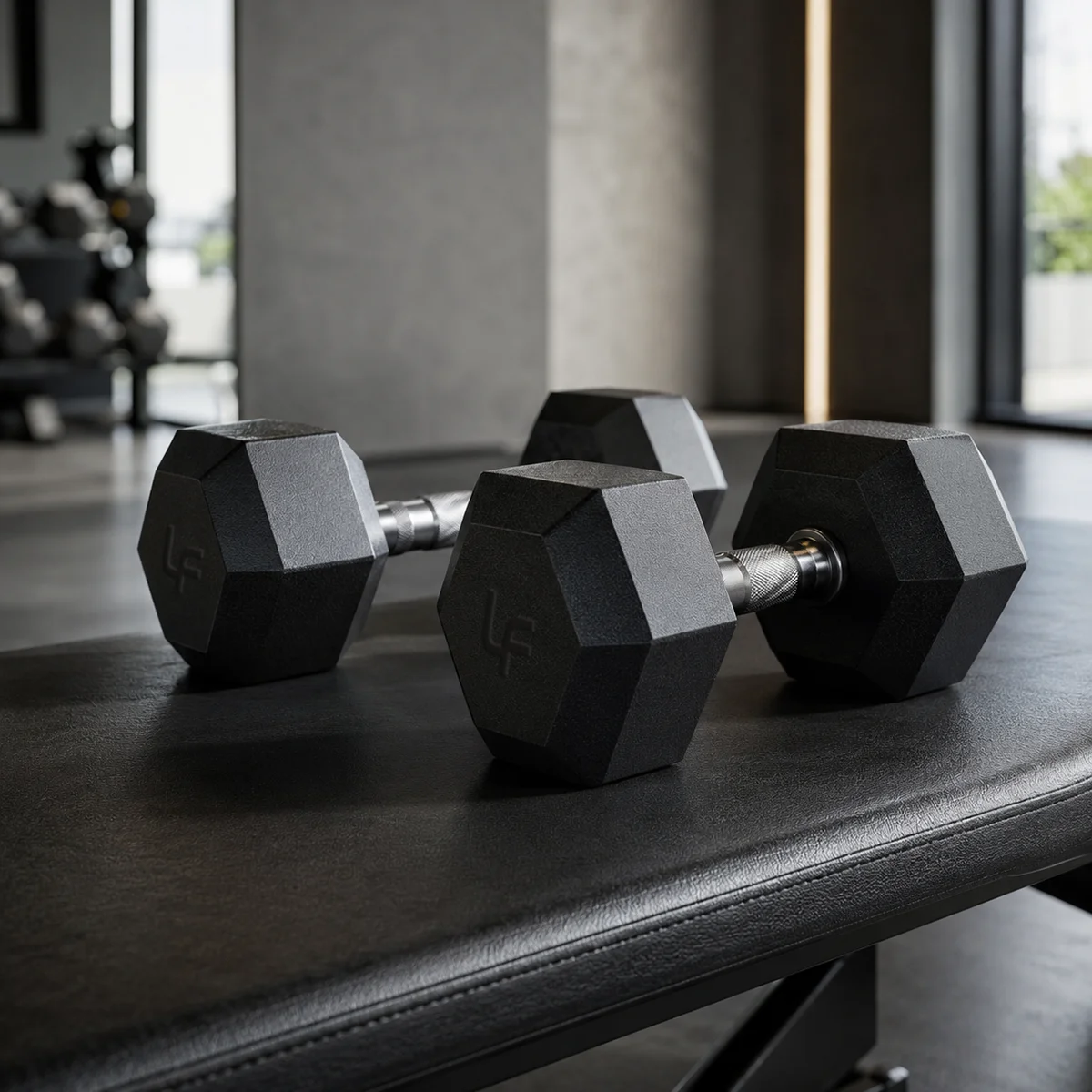
A pair of stable hex dumbbells is practical for home and gym training because the flat heads prevent the weights from rolling between sets.
Safety and Comfort Considerations
Muscular fatigue in the thighs and glutes is expected. Sharp joint pain, sudden instability or increasing discomfort is not.
Reduce the weight or range of motion when your technique changes.
People managing a current knee, hip, ankle or back injury should consult a qualified physiotherapist or healthcare professional before adding loaded lunges.
A rear lunge may produce lower loading measures than a forward lunge in certain studies, but this does not make it universally suitable for every painful condition.
Frequently Asked Questions
1. Is a rear lunge the same as a reverse lunge?
Yes. Rear lunge, reverse lunge and backward lunge are commonly used for the same backward-stepping lunge pattern.
2. Which leg should you feel during a rear lunge?
You may feel both legs working.
Bodyweight EMG research found greater gluteus medius and slightly greater gluteus maximus peak activity in the stationary leg. The moving leg showed greater rectus femoris and biceps femoris peak activity.
Where you feel the exercise can also change with your load, stride and torso position.
3. Are rear lunges better for the knees than forward lunges?
Some biomechanical studies have found lower ground-reaction forces and patellofemoral loading during backward lunges.
However, “better” depends on the individual. A movement that produces less loading in a laboratory can still be uncomfortable when performed with unsuitable depth, load or technique.
When a rear lunge causes knee discomfort, first check whether your step is too short or your descent is uncontrolled. Reduce the load and practice a bodyweight split squat with both feet fixed before reintroducing the backward step.
Persistent or sharp pain should be assessed by a qualified healthcare professional.
4. Why do I lose balance when stepping backwards?
Common causes include:
Stepping onto a straight line
Looking down at the floor
Using an inconsistent stride
Moving too quickly
Holding weights that are too heavy
Practice beside a stable support and step backwards while maintaining hip-width spacing.
Final Takeaway
The dumbbell rear lunge is more than a simple front-leg exercise.
The stationary and moving legs perform distinct roles. The stationary leg provides substantial support and pelvic stability, while the moving leg remains dynamically active throughout the backward step and return.
Use a stable stance, controlled depth and a load you can manage. Adjust your torso position according to your goal, but treat it as a subtle mechanical bias rather than a shortcut.
Once the bodyweight movement is consistent, dumbbells provide a practical way to build lower-body strength, muscle and unilateral control.
Build Your Home or Commercial Gym with LIFE FIT
Looking for durable dumbbells and strength equipment for your training space?
Explore LIFE FIT’s dumbbell collection or speak with our team for help selecting equipment based on your space, budget and training goals.
0 Comments
Loading comment form…
Loading comments…