


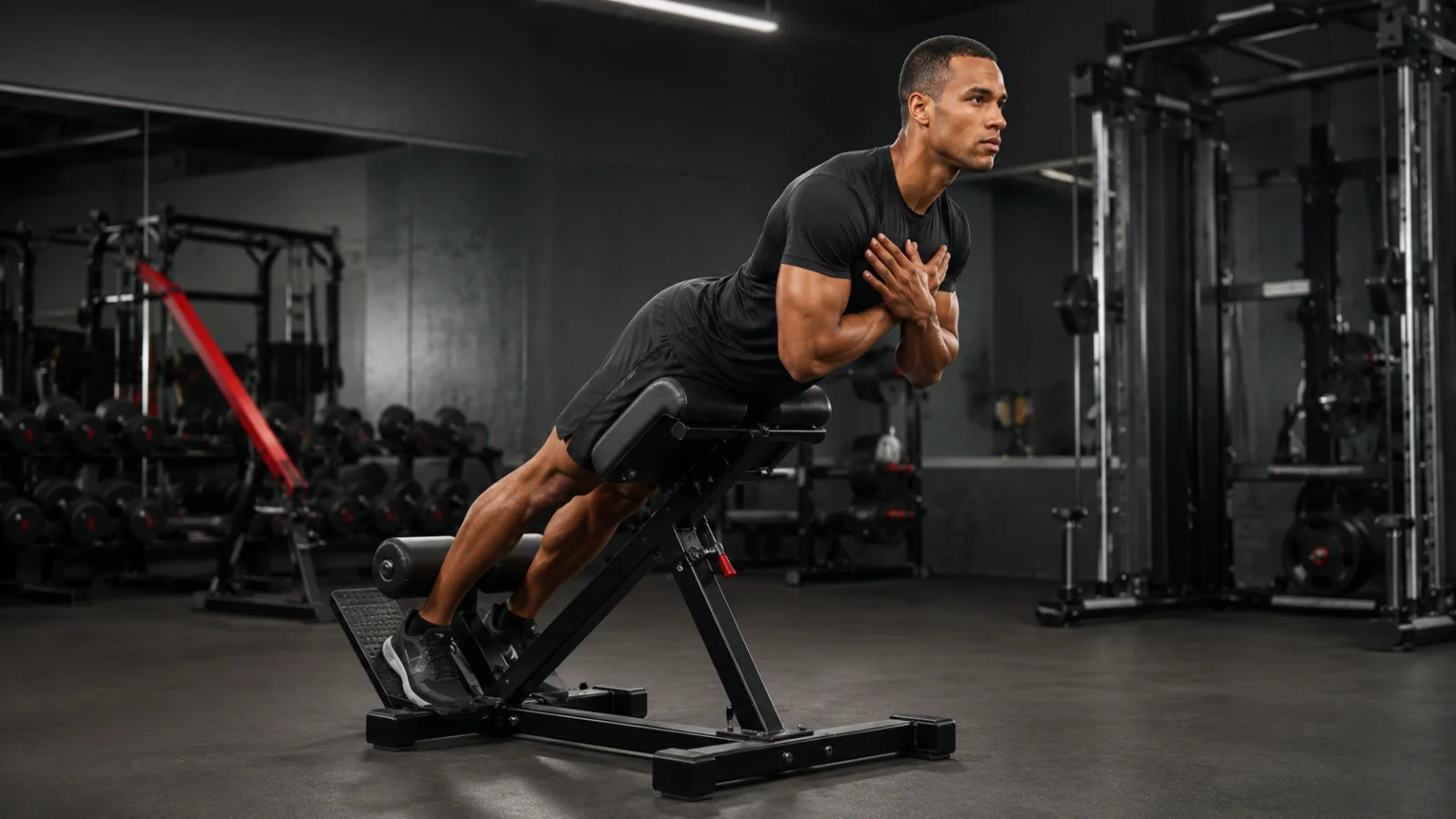
The hyperextension exercise is often described as a lower-back movement. However, its actual training effect depends heavily on how you set up the bench and perform each repetition.
A controlled, hip-driven hyperextension can train the glutes and hamstrings alongside the muscles that support the spine. A poorly controlled repetition, on the other hand, may turn into excessive lower-back arching or uncontrolled swinging.
The name itself can be misleading. Despite being called a “hyperextension,” the exercise does not require you to push your spine far beyond a neutral position. For most trainees, the repetition should finish when the shoulders, hips and ankles form a straight, controlled line.
This guide covers the gym exercise commonly called a hyperextension or back extension—not a joint hyperextension injury.
The hyperextension exercise is a supported hip-hinge movement performed on a 45-degree or horizontal back-extension bench. It trains the Erector Spinae, gluteus maximus and hamstrings while developing control through the hips and trunk.
What Is the Hyperextension Exercise?
The hyperextension is a posterior-chain exercise performed with the lower body secured against a specialised bench.
From the starting position, you lower your torso toward the floor by hinging at the hips. You then use the glutes, hamstrings and back extensors to return to an aligned position.
The exercise is commonly performed on:
A 45-degree hyperextension bench
A horizontal back-extension bench
A Roman chair
A glute-ham or posterior-chain station
The term posterior chain refers to the muscles along the back of the body, including the glutes, hamstrings and spinal extensors.
Hyperextensions are generally used as an accessory exercise rather than a replacement for major movements. They can complement compound lifts such as the barbell back squat, front squat and other hip-hinge exercises by providing additional posterior-chain training.
Hyperextension vs Back Extension
In most gyms, the terms “hyperextension” and “back extension” refer to the same general movement.
However, back extension is often the more technically accurate name. A well-controlled repetition normally involves extending from a forward-inclined position back to neutral alignment—not forcing the lumbar spine into an exaggerated arch.
Exercise Hyperextension vs Joint Hyperextension
The exercise should not be confused with a joint hyperextension injury.
Joint hyperextension occurs when a joint, such as the knee or elbow, is forced beyond its normal range. The gym exercise is a planned strength movement performed on appropriate equipment.
Hyperextension Exercise at a Glance
Attribute | Details |
|---|---|
Main movement | Hip extension with spinal stabilisation |
Primary muscles | Erector Spinae and gluteus maximus |
Supporting muscles | Hamstrings, adductors and core stabilisers |
Equipment | 45-degree bench, horizontal bench or Roman chair |
Difficulty | Beginner to intermediate |
Resistance options | Bodyweight, plate, dumbbell or resistance band |
Workout placement | Usually after compound lower-body exercises |
Main form cue | Hinge through the hips and finish in a straight line |
Hyperextension Muscles Worked
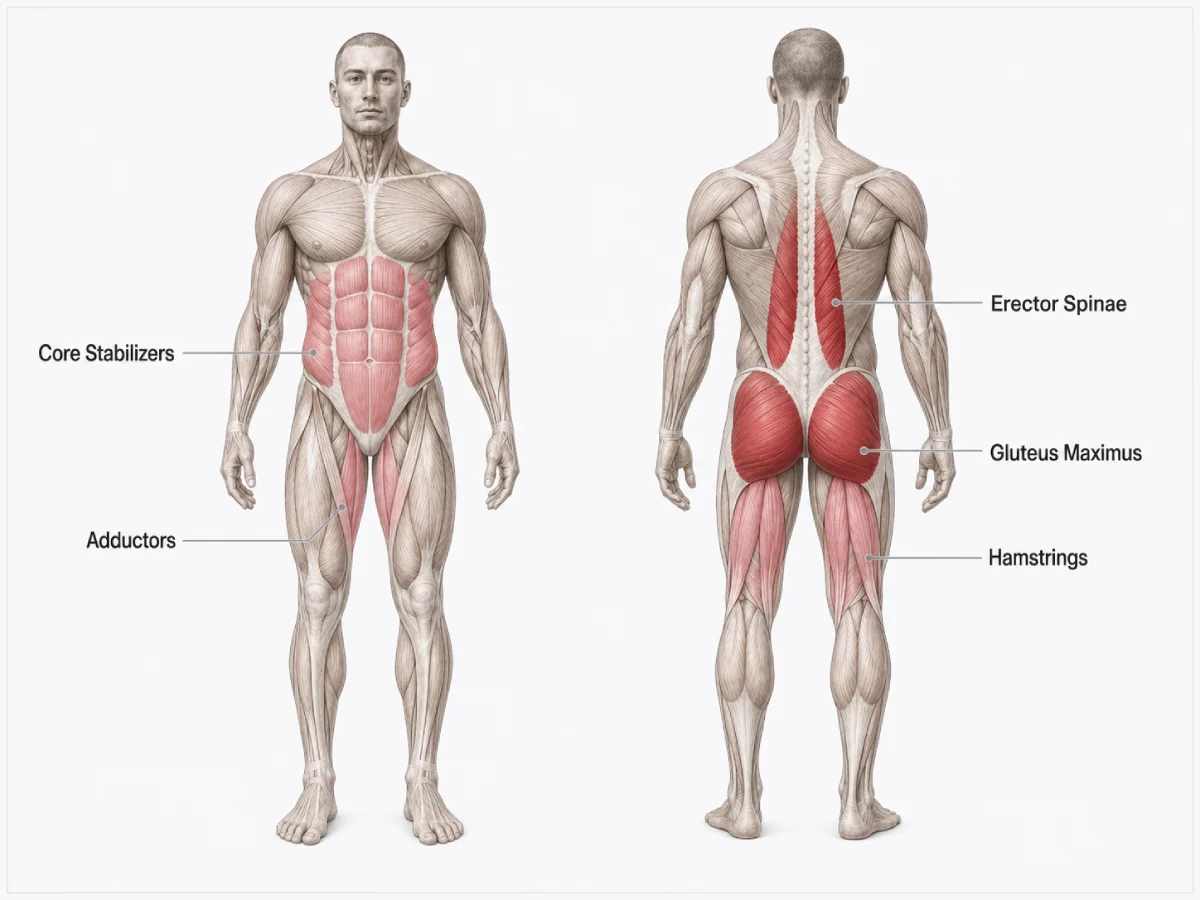
The hyperextension trains several muscles together rather than isolating one area.
Its muscular emphasis changes according to:
Bench angle
Pad height
Knee position
Spinal movement
Range of motion
Resistance used
The intention behind the repetition
For this reason, it is not completely accurate to classify every hyperextension as either a lower-back exercise or a glute exercise.
Erector Spinae
The Erector Spinae are long muscles that run along both sides of the spine.
They help extend the trunk and resist unwanted spinal flexion as the upper body moves against gravity. During a hip-dominant hyperextension, they also help maintain a stable torso while the glutes and hamstrings extend the hips.
Developing these muscles can support the torso control required during squats, deadlifts and other loaded hinges.
However, training the Erector Spinae does not require repeatedly forcing the lumbar spine into an extreme arch. Controlled loading and an appropriate range are more important than maximum extension.
Gluteus Maximus
The gluteus maximus is one of the main muscles responsible for hip extension.
It contributes as you raise the torso and bring the hips back into alignment. The glutes usually receive more practical emphasis when the movement is performed primarily as a hip hinge.
To increase glute involvement:
Position the thigh pad below the hip crease.
Allow the hips to move freely.
Keep the torso controlled.
Drive the hips into the pad as you rise.
Contract the glutes at the top.
Stop at neutral alignment.
A systematic review of gluteus maximus activation found that several hip-extension exercises can produce meaningful glute activation. Muscle activation alone, however, does not guarantee long-term muscle growth. Progressive resistance, training volume, nutrition and recovery also matter.
You can explore additional movements in the LIFE FIT glute exercise library.
Hamstrings
The hamstrings assist the glutes in extending the hips and help control the lowering phase.
Their contribution can change with knee position. Relatively straight knees lengthen the hamstrings, while slight knee flexion may reduce the stretch and make the exercise more comfortable for some users.
You do not need to lock the knees aggressively. Use a stable position that allows you to hinge smoothly without discomfort.
Supporting Muscles
Several other muscles help stabilise the body during hyperextensions, including:
Adductor magnus
Abdominals
Obliques
Smaller spinal stabilisers
Upper-back muscles
The adductor magnus can assist with hip extension, while the abdominal and oblique muscles help control the position of the pelvis and trunk.
How to Do the Hyperextension Exercise Correctly
Correct setup is essential. Before adding resistance, make sure the machine fits your body and allows your hips to move freely.
1. Adjust the Thigh Pad
Position the upper edge of the thigh pad slightly below your hip crease.
The pad should support the upper thighs without pressing heavily into the abdomen. Your hips must be able to hinge over the pad.
If the pad sits too high, it may block hip movement and encourage compensation through the lower back.
2. Secure Your Feet and Lower Legs
Place your feet firmly against the platform and position your ankles or lower legs beneath the rollers.
Check that:
Both feet are evenly placed.
The rollers hold you securely.
Your body does not slide forward.
The machine remains stable.
The setup does not create ankle or knee discomfort.
3. Establish the Starting Position
Begin with your body aligned from the head to the heels.
Cross your arms over your chest and gently brace your abdomen. Keep the shoulders relaxed and allow the head to follow the natural line of the torso.
Avoid lifting the chin or looking sharply upward.
4. Lower the Torso Under Control
Push the hips back and hinge forward over the pad.
Lower the torso only as far as you can maintain control. Your available range will depend on your mobility, limb proportions and the design of the machine.
Do not force a predetermined depth. More range is not automatically better.
Use a slow, controlled descent rather than dropping the torso toward the floor.
5. Extend Through the Hips
Contract the glutes and hamstrings to begin the upward phase.
Raise the torso smoothly while maintaining abdominal tension. Think about extending the hips instead of throwing the chest upward.
The head and torso should move together.
6. Finish in a Straight Line
Stop when the shoulders, hips and ankles form a straight line.
Do not continue lifting until the lower back is heavily arched. Excessive top-end extension is not necessary for an effective repetition.
Pause briefly, then begin the next descent under control.
Breathing and Tempo
A practical beginner tempo is:
Lowering phase: 2–3 seconds
Bottom transition: Brief and controlled
Lifting phase: 1–2 seconds
Top position: Short pause
Take a breath and brace before lowering. Maintain enough trunk tension to control the movement, then exhale gradually as you return to the top.
Hyperextension Form Checklist
Before increasing the resistance, make sure you can:
Position the pad below the hip crease
Hinge freely through the hips
Keep both feet secure
Lower without dropping
Rise without swinging
Keep the neck aligned
Finish at neutral
Perform every repetition without sharp pain
How to Target the Glutes or Lower Back More
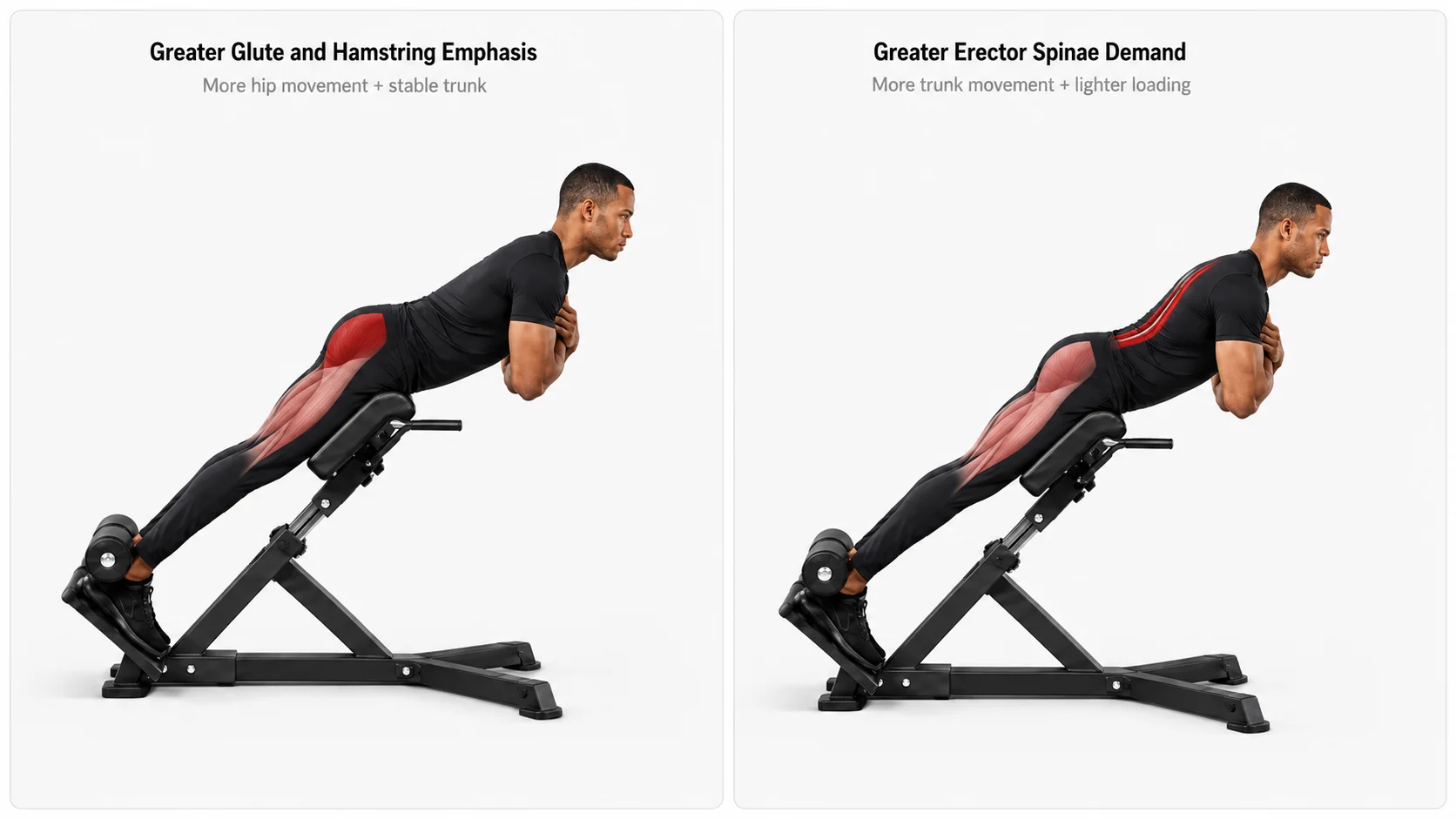
Hyperextensions always involve several muscle groups. However, technique changes can shift the relative emphasis toward the hip extensors or spinal extensors.
For Greater Glute and Hamstring Emphasis
Use a hip-dominant technique:
Keep the pad below the hip crease.
Initiate the descent through the hips.
Maintain a controlled trunk position.
Drive the hips into the pad during the ascent.
Contract the glutes as you approach the top.
Finish at neutral alignment.
The movement should resemble a supported hip hinge rather than a repeated lower-back arch.
Some advanced lifters use a slightly rounded upper-back position to create a more obvious hip-driven movement. This is not necessary for beginners, and deliberate loaded spinal rounding should not be introduced without suitable experience and control.
For Greater Erector Spinae Demand
Allowing more movement through the trunk can increase the dynamic demand on the Erector Spinae.
This approach requires greater technical control and more conservative loading. Beginners should first learn the stable hip-hinge version before experimenting with additional spinal movement.
Technique feature | Greater hip-extensor emphasis | Greater spinal-extensor demand |
|---|---|---|
Main movement | Primarily through the hips | More movement through the trunk |
Glute involvement | Relatively greater | Still active |
Erector Spinae role | Stabilisation and extension support | Greater dynamic contribution |
Loading approach | Moderate and controlled | More conservative |
Best suited for | General strength and glute training | Experienced trainees with a clear purpose |
Main risk | Using momentum | Excessive loaded spinal movement |
These differences describe relative muscular emphasis, not complete muscle isolation.
Benefits of Hyperextensions
1. Strengthen the Posterior Chain
Hyperextensions train the glutes, hamstrings and spinal extensors together.
These muscles contribute to hip extension, trunk stability and many common lifting movements. The exercise can therefore fit well within a programme that also includes free weights and machine exercises.
2. Build Back-Extensor Strength
Research on back-extension training has reported improvements in back-muscle strength and spinal range of motion following a structured training programme.
This supports the use of back extensions as a progressive strength exercise. It does not mean that the movement can cure back pain or prevent every type of spinal injury.
3. Improve Hip-Hinge Control
The exercise teaches you to move through the hips while controlling the torso.
This pattern is relevant to:
Romanian deadlifts
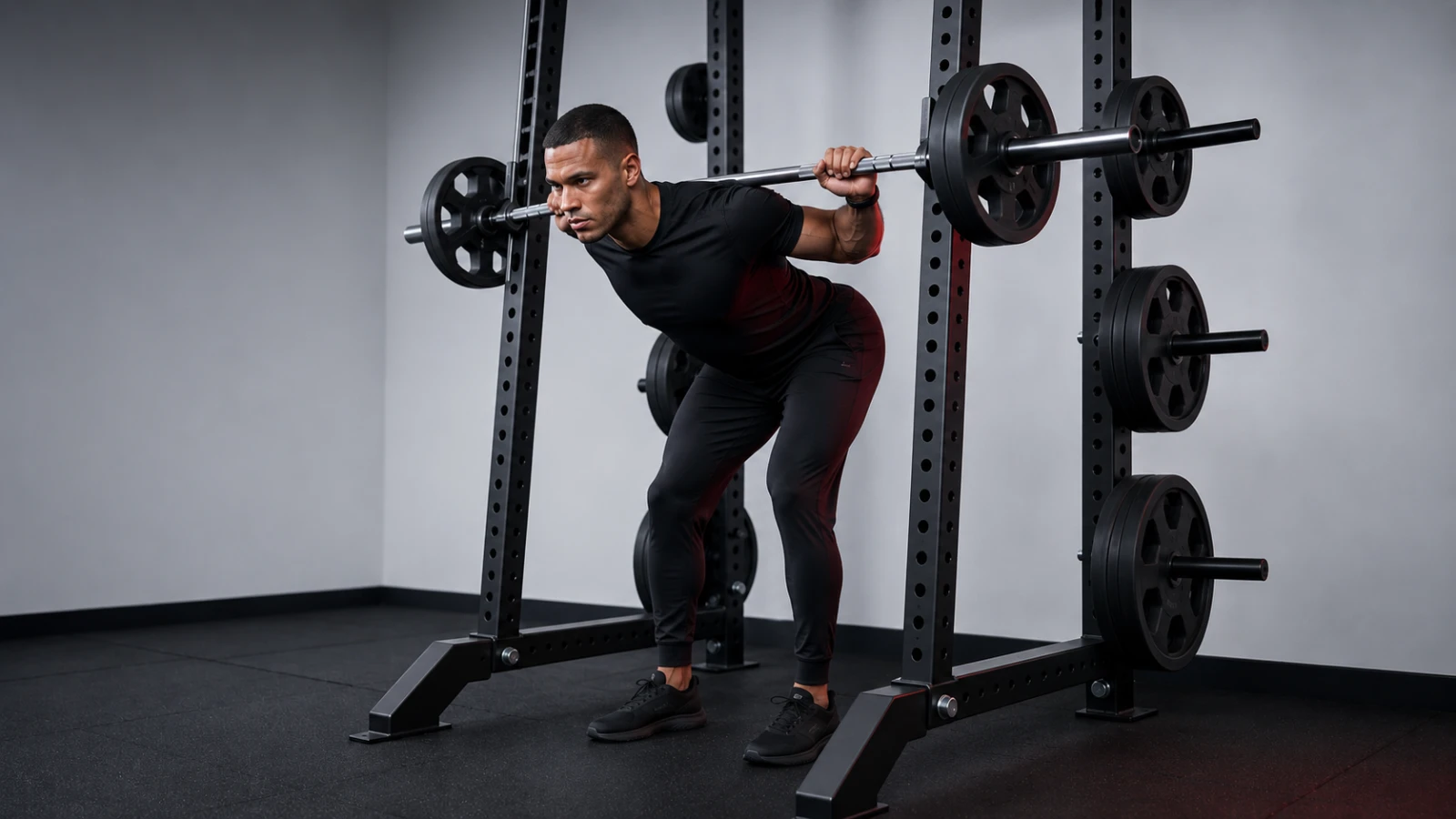
Good mornings
Kettlebell swings
Conventional deadlifts
Many athletic lifting tasks
Different hinge exercises do not create identical demands. Research comparing straight-legged hinge-pattern exercises shows that equipment, body position and loading can influence muscle recruitment.
4. Complement Squats and Deadlifts
Hyperextensions are commonly used after larger compound movements.
They can provide additional work for the muscles involved in hip extension and torso control without requiring another heavy barbell exercise.
They should be viewed as an accessory to a balanced programme—not as a complete replacement for squats, deadlifts or other major movements.
5. Offer Several Progression Options
The exercise can be made more difficult without immediately adding heavy weight.
Progression options include:
Extending the arms forward
Holding a weight plate
Holding a dumbbell
Adding a resistance band
Slowing the lowering phase
Pausing at the top
Increasing repetitions
Moving to a more demanding bench angle
6. Require Less Setup Than Heavy Barbell Hinges
Once adjusted, a hyperextension bench provides a stable and repeatable training position.
This may make it easier to perform focused posterior-chain work without lifting a barbell from the floor. However, easier setup does not mean the exercise is suitable for every individual.
Common Hyperextension Mistakes
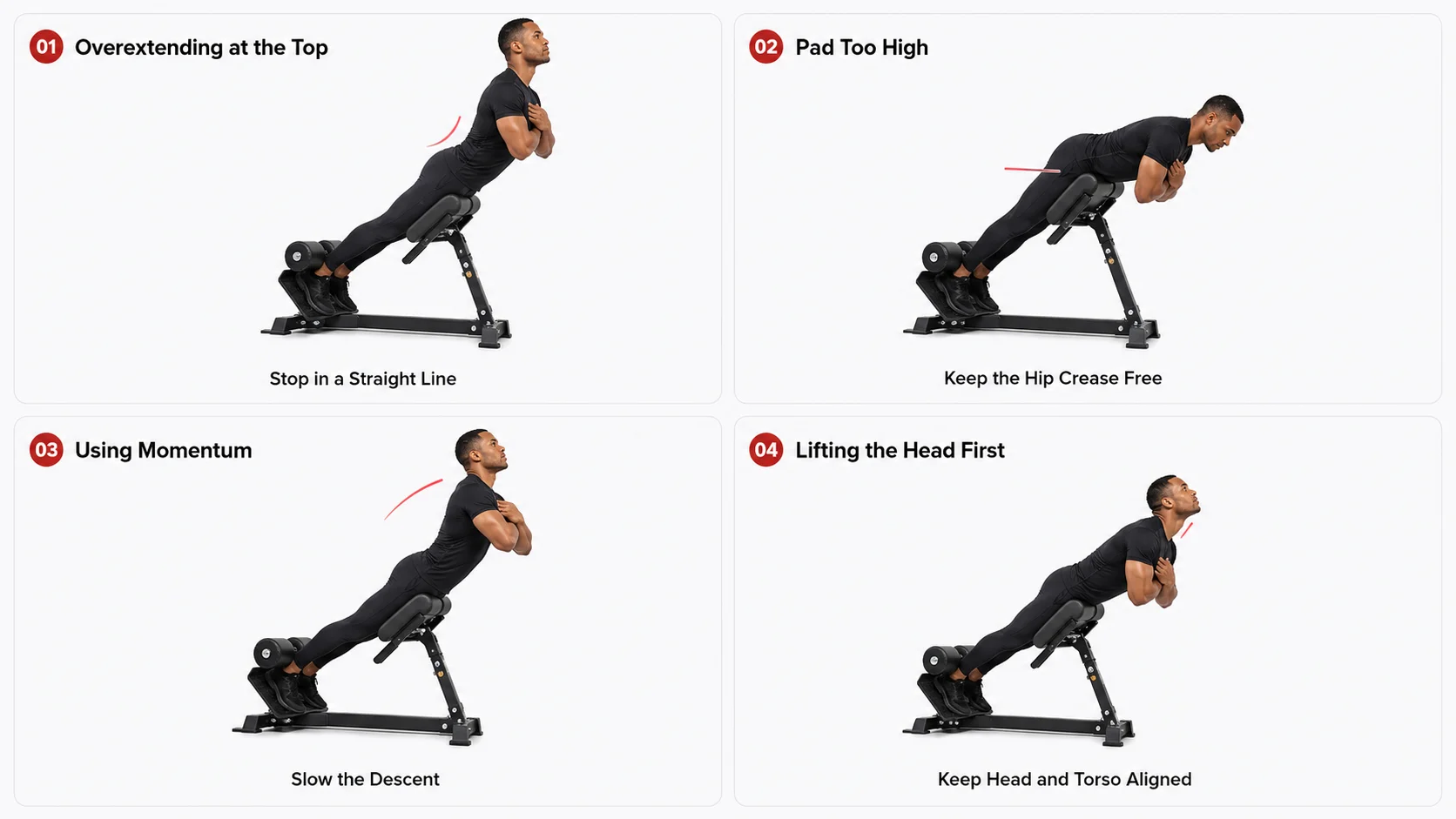
1. Extending Too Far at the Top
The problem: The chest rises above the natural body line and the lower back moves into an exaggerated arch.
Why it matters: The exercise shifts away from controlled hip extension and places more movement into the lumbar spine.
The fix: Stop when the torso and legs align. Finish by contracting the glutes rather than throwing the chest upward.
2. Positioning the Pad Too High
The problem: The pad presses into the abdomen and blocks the hip crease.
Why it matters: Restricted hip movement may cause the user to compensate through the lower back.
The fix: Lower the pad so it supports the thighs while allowing the hips to hinge freely.
3. Using Momentum
The problem: The torso drops quickly and swings back to the top.
Why it matters: Momentum reduces muscular control and makes it harder to manage the finishing position.
The fix: Slow the lowering phase and pause briefly before beginning the ascent.
4. Lifting the Head First
The problem: The head is thrown backward before the torso rises.
Why it matters: This disrupts the head-to-torso position and may encourage unnecessary spinal extension.
The fix: Keep the head aligned with the torso and allow your gaze to move naturally with the body.
5. Adding Weight Too Soon
The problem: Resistance is added before the user can control bodyweight repetitions.
Why it matters: Extra load magnifies existing setup and technique errors.
The fix: Master smooth bodyweight repetitions first. Add resistance only when every repetition looks consistent.
6. Chasing Maximum Depth
The problem: The torso is lowered beyond the range that can be controlled comfortably.
Why it matters: Range of motion becomes more important than movement quality.
The fix: Use the deepest range you can control without pain, bouncing or loss of position.
45-Degree vs 90-Degree Hyperextension Bench
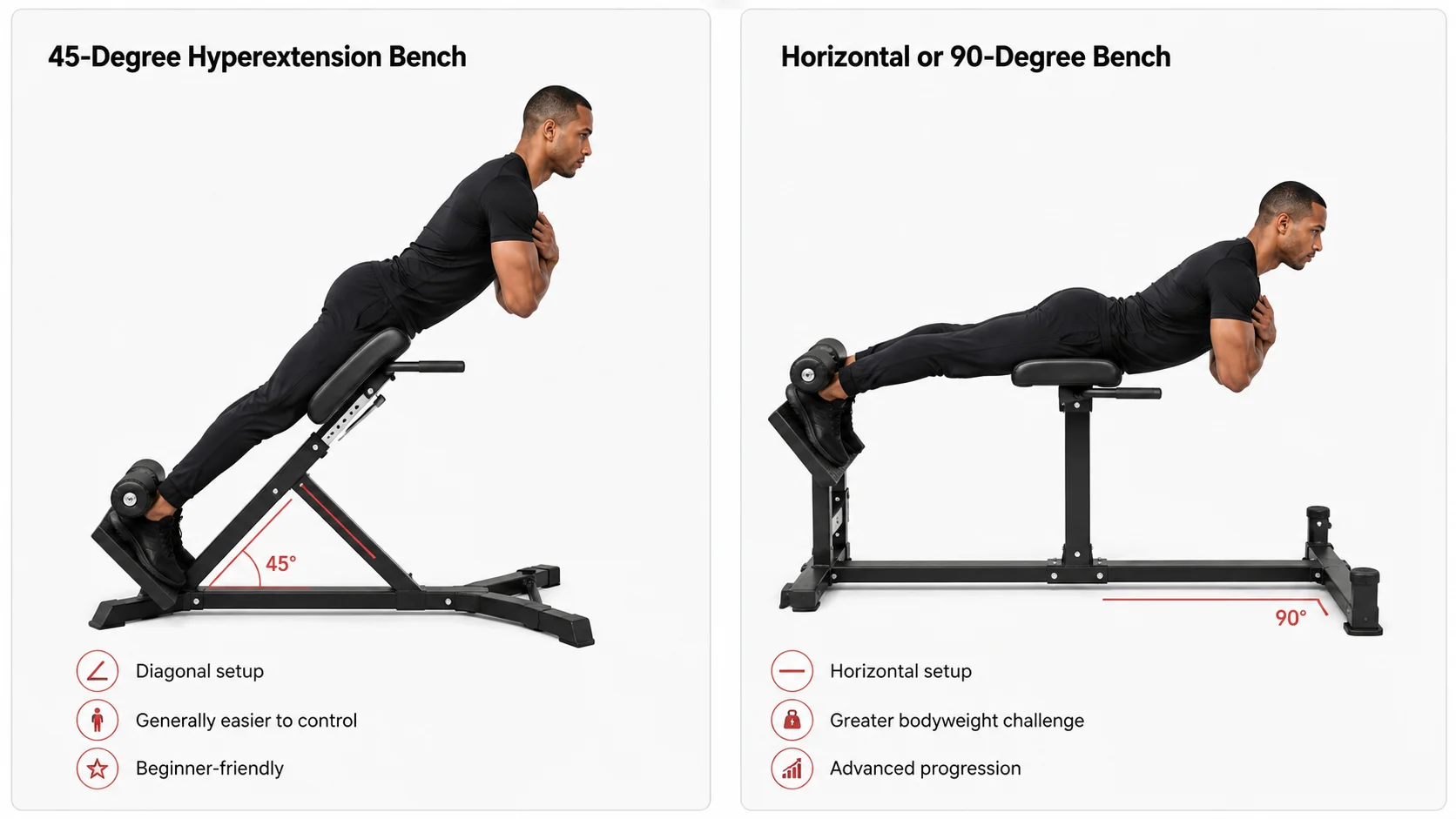
Both bench styles train the same general muscle groups, but the body angle changes how the resistance feels.
Feature | 45-degree bench | Horizontal or 90-degree bench |
|---|---|---|
Body position | Diagonal | Horizontal |
Bodyweight challenge | Usually more manageable | Usually more demanding |
Beginner suitability | Generally better | Often better for experienced users |
Training feel | More supported | Longer horizontal lever |
Space requirement | Often more compact | May require more floor space |
Best use | General training and progressive loading | Greater bodyweight challenge |
Equipment terminology is not always consistent. Some manufacturers use the term Roman chair for both angled and horizontal stations, so evaluate the actual design rather than relying on the product name alone.
A 45-degree bench does not automatically restrict users to a partial range. Hip motion also depends on:
Pad height
Machine geometry
Body proportions
Mobility
Technique
When choosing a hyperextension bench, consider:
Adjustable thigh-pad height
A stable foot platform
Secure ankle rollers
Firm, supportive upholstery
Frame stability
User-height compatibility
Rated load capacity
Available floor space
For commercial gyms, studios and serious home setups, the LIFE FIT Hyperextension Alpha provides a dedicated station for posterior-chain training. You can also compare it with other back machines when planning a complete training area.
Build a Stronger Posterior Chain with the Right Setup
A stable, correctly sized hyperextension bench makes it easier to position the hips, secure the lower body and progress the exercise consistently.
View the LIFE FIT Hyperextension Machine
Request Current Pricing
Hyperextension Variations and Progressions
Bodyweight Hyperextension
This is the best place to begin.
Cross your arms over your chest and focus on your setup, tempo and finishing position. Progress only after you can complete smooth repetitions without momentum.
Weighted Hyperextension
Hold a weight plate or dumbbell close to your chest.
Keeping the resistance near the torso is easier to control than holding it far away. Avoid placing a heavy weight behind your head, as this increases the lever length and can make it harder to maintain position.
Paused Hyperextension
Pause for one or two seconds at the top.
The pause removes momentum and increases the demand on the working muscles. Maintain neutral alignment throughout the hold.
Tempo Hyperextension
Use a slower lowering phase, such as three to five seconds.
Tempo work can make bodyweight or light resistance more challenging and is often a better first progression than adding substantial weight.
Resistance-Band Hyperextension
Attach a resistance band to a secure low anchor so that tension increases as you rise.
Confirm that the anchor cannot move and that the band does not contact a sharp surface.
Single-Leg Hyperextension
This advanced variation increases the stability requirement and may expose differences in pelvic control.
Keep the pelvis level and avoid rotating the torso. It is an optional progression, not a necessary step for every trainee.
Hyperextension vs Reverse Hyperextension
The standard and reverse hyperextension train similar muscle groups, but they use different anchored and moving body segments.
During a standard hyperextension, the lower body stays secured while the torso moves. During a reverse hyperextension, the upper body remains supported while the legs move.
Feature | Standard hyperextension | Reverse hyperextension |
|---|---|---|
Anchored segment | Lower body | Upper body |
Moving segment | Torso | Legs |
Main action | Torso rises through hip and trunk extension | Legs rise through hip extension |
Equipment | Hyperextension bench or Roman chair | Reverse-hyper machine or secure platform |
Hip motion | Moderate to substantial | Often greater |
Erector Spinae involvement | Significant | Significant |
Glute and hamstring involvement | Significant | Significant |
Equipment availability | Relatively common | Usually more specialised |
A biomechanical comparison of the two exercises found differences in hip range of motion, lumbar movement, muscle activity and lower-back moment.
These findings should be interpreted carefully.
Higher muscle activation does not automatically make one exercise better for muscle growth. Similarly, a greater spinal moment does not by itself prove that a movement is harmful.
Exercise selection should consider:
Training objective
Resistance used
Equipment design
Technique
Training experience
Individual tolerance
Neither movement is universally superior.
Hyperextension Alternatives Without a Machine
The most suitable alternative depends on what you want to train.
Alternative | Best used for | Main limitation |
|---|---|---|
Stability-ball back extension | A similar supported extension pattern | Requires a stable ball setup |
Prone trunk raise | Basic bodyweight back-extensor work | Limited progression options |
Bird dog | Low-load trunk and hip control | Not a direct strength replacement |
Romanian deadlift | Loaded hip-hinge strength | Requires more equipment and technique |
Good morning | Posterior-chain and torso strength | Loading must be managed carefully |
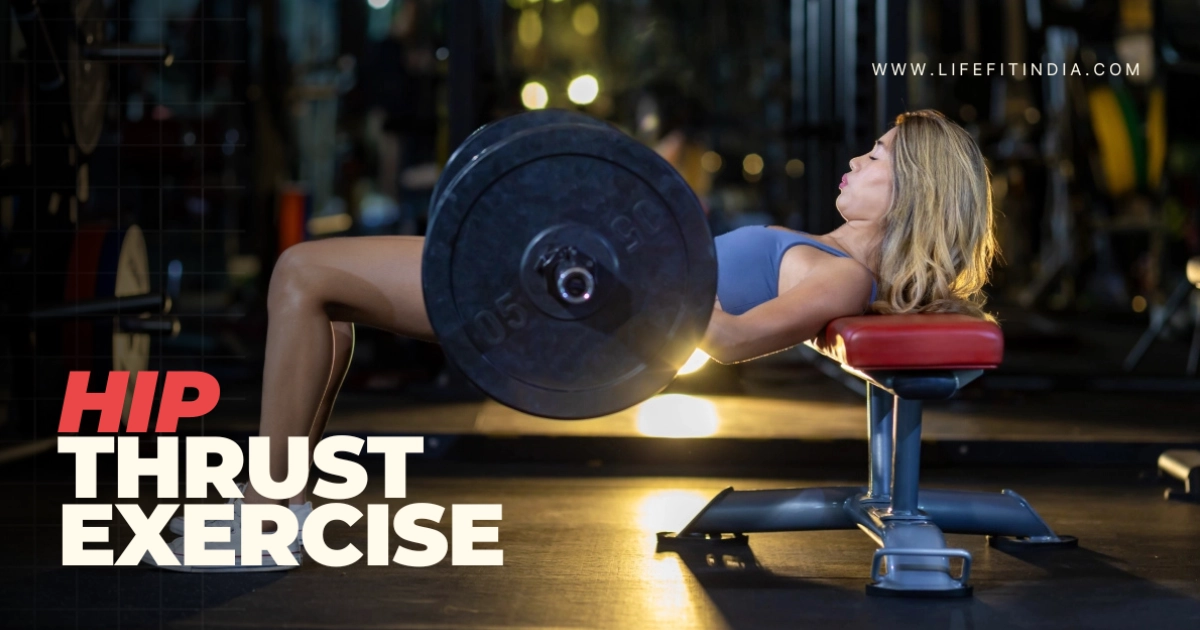
Hip thrust | Glute-focused hip extension | Less direct back-extensor demand |
Bench reverse hyperextension | Home-friendly reverse pattern | The platform must be secure |
The hip thrust exercise is a useful alternative when the main goal is glute-focused hip extension.
Romanian deadlifts and good mornings are better options when you want to train a loaded standing hip hinge.
For limited spaces, choose exercises and equipment based on your actual training needs rather than trying to recreate an unstable machine setup. The LIFE FIT home gym setup guide can help with space and equipment planning.
How Many Hyperextensions Should You Do?
Sets and repetitions should reflect your goal, training experience and ability to maintain good form.
Goal | Sets | Repetitions | Resistance |
|---|---|---|---|
Technique practice | 2–3 | 8–12 | Bodyweight |
General strength and endurance | 2–4 | 10–15 | Bodyweight or light resistance |
Muscle-building accessory work | 3–4 | 8–15 | Controlled external resistance |
Warm-up or activation | 1–2 | 10–15 | Easy bodyweight |
Tempo or endurance training | 2–3 | 12–20 | Light resistance with slow lowering |
These ranges are starting points rather than fixed prescriptions.
Where to Place Hyperextensions in Your Workout
Hyperextensions usually fit well:
After squats
After deadlifts
After Romanian deadlifts
Near the end of a lower-body session
During a posterior-chain workout
Earlier as a light technique drill
Avoid heavily fatiguing the spinal extensors before demanding compound lifts unless that order supports a specific training objective.
When to Add Resistance
Increase the difficulty only when you can:
Control the intended range
Avoid swinging
Keep the hips and feet stable
Finish at neutral
Maintain consistent repetitions
Train without sharp or worsening pain
Change one variable at a time. You might first increase repetitions, slow the tempo or add a pause before introducing more weight.
Are Hyperextensions Safe?
Hyperextensions can be appropriate for many healthy trainees when performed with suitable equipment, controlled resistance and an appropriate range of motion.
However, no exercise is suitable for everyone.
Fast repetitions, excessive range and premature loading may increase irritation. Muscular fatigue should also be distinguished from sharp, radiating or progressively worsening pain.
Stop the exercise and seek professional guidance if you experience:
Sharp or increasing lower-back pain
Pain travelling into the hip or leg
Numbness or tingling
New or unexplained weakness
Loss of movement control
Pain following a recent spinal or hip injury
People with a diagnosed spinal condition, recent injury or persistent pain should consult an appropriately qualified healthcare professional before performing loaded back extensions.
A large Cochrane review of exercise therapy for chronic lower-back pain found that exercise can benefit some people with chronic lower-back pain. However, the review examined exercise therapy broadly. It does not establish hyperextensions as the correct treatment for every person or condition.
Frequently Asked Questions
In most gym settings, yes. Both terms refer to the same general exercise. “Back extension” may be a clearer name because a controlled repetition normally finishes at neutral alignment rather than forcing the lumbar spine into excessive extension.
They train both areas, along with the hamstrings. A hip-driven hinge with a controlled torso generally places relatively greater emphasis on the glutes and hamstrings. More movement through the trunk can increase the dynamic demand on the Erector Spinae.
Most trainees do not need to. Stop when the shoulders, hips and ankles form a straight line. Extending higher by arching the lower back does not automatically make the exercise more effective.
They may be included in some professionally designed exercise programmes, but they are not a universal treatment. Lower-back pain can have many causes. Persistent, radiating or severe symptoms should be assessed by a qualified healthcare professional.
Yes, provided the machine can be adjusted correctly and the movement is comfortable. Beginners should start with bodyweight, keep the arms crossed over the chest and prioritise a slow descent and neutral finish.
Add resistance only after you can perform consistent bodyweight repetitions. Hold a plate or dumbbell close to the chest and begin with a light load that does not alter your tempo or range.
A horizontal Roman-chair-style station usually creates a longer resistance lever and makes bodyweight feel more demanding. A 45-degree bench places the body diagonally and is generally easier to control. Product naming varies, so compare the actual machine design.
Yes. Alternatives include stability-ball back extensions, prone trunk raises, bird dogs, Romanian deadlifts and hip thrusts. These exercises train related muscles but are not exact biomechanical copies.
One to three weekly sessions may suit many general strength programmes. The ideal frequency depends on resistance, volume, recovery and how much posterior-chain work is already included in the rest of your programme.
Final Takeaway
The hyperextension is most effective when treated as a controlled posterior-chain exercise—not a test of how deeply you can lower or how far you can arch your lower back.
Position the pad below the hip crease, secure your feet and move through a range you can control. Hinge through the hips, keep the repetition smooth and finish when your body reaches a straight line.
Start with bodyweight. Progress through repetitions, tempo, pauses or light external resistance before adding heavier loads.
For home gyms, studios and commercial facilities, a stable and adjustable bench can make correct positioning easier for different users. Explore the LIFE FIT Hyperextension Alpha or browse the range of commercial gym equipment for complete facility planning.
References
Lawrence MA, Chin A, Swanson BT. Biomechanical Comparison of the Reverse Hyperextension Machine and the Hyperextension Exercise. Journal of Strength and Conditioning Research. 2019.
Yaprak Y. The Effects of Back Extension Training on Back Muscle Strength and Spinal Range of Motion. Journal of Back and Musculoskeletal Rehabilitation. 2013.
Neto WK, Vieira TL, Gama EF. Gluteus Maximus Activation During Common Strength and Hypertrophy Exercises: A Systematic Review. Journal of Sports Science & Medicine. 2020.
Hayden JA, Ellis J, Ogilvie R, Malmivaara A, van Tulder MW. Exercise Therapy for Chronic Low Back Pain. Cochrane Database of Systematic Reviews. 2021.
Schellenberg F, et al. A Comparison of Muscle Recruitment Across Three Straight-Legged, Hinge-Pattern Resistance Training Exercises. 2023.
This article is intended for general fitness education and does not replace individual medical assessment, diagnosis or treatment.
0 Comments
Loading comment form…
Loading comments…