


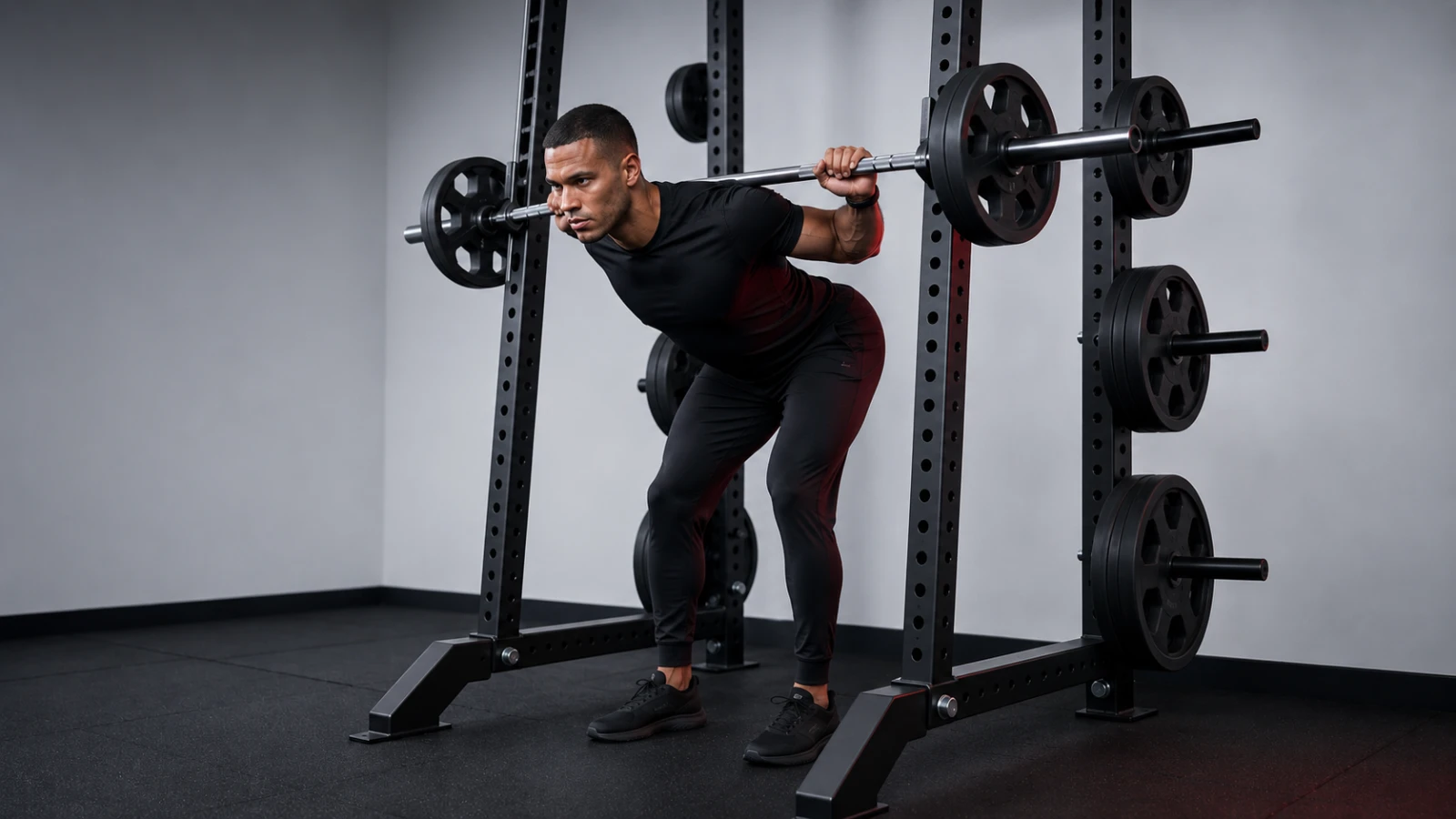
The good morning exercise is a hip-hinge movement commonly performed with a barbell across the upper back. It primarily trains the hamstrings and glutes while requiring the erector spinae and abdominal muscles to keep the torso stable.
Although the exercise looks simple, the bar’s position creates a demanding lever as your torso inclines. Beginners should therefore learn the movement with bodyweight, a dowel or a light resistance before progressing to a loaded barbell.
When performed with suitable technique, range and resistance, good mornings can develop the posterior chain, reinforce hip-hinge mechanics and complement squats, deadlifts and back extensions.
Good Morning Exercise at a Glance
Attribute | Details |
|---|---|
Movement pattern | Hip hinge |
Primary muscles | Hamstrings and gluteus maximus |
Key stabilisers | Erector spinae, abdominals, obliques and upper back |
Equipment | Bodyweight, resistance band, dumbbell, barbell or Smith machine |
Difficulty | Beginner without load; intermediate when barbell-loaded |
Best use | Posterior-chain accessory and hip-hinge practice |
Typical placement | After the main squat or deadlift |
Main caution | The load should not exceed your ability to maintain sound mechanics |
What Is the Good Morning Exercise?
The good morning is a hip-hinge exercise in which you push your hips backward while allowing your torso to incline forward. Your knees remain softly bent rather than moving into a deep squat. You then return to standing by extending your hips.
The movement resembles a formal bow, which explains its name.
In the conventional barbell version, the load rests across the upper-back musculature instead of hanging from the hands. This higher load position increases the challenge to the trunk and can make a relatively light bar feel demanding.
The exercise should not be treated as repeated bending through the lower back. Most of the visible movement should come from the hips while the torso remains stable and well organised.
How to Do the Good Morning Exercise Correctly
Start with an empty bar or a lighter regression until the movement feels stable and repeatable.
Place your feet approximately hip-to-shoulder width apart.
Support the bar securely across your upper back.
Soften your knees and brace your trunk.
Push your hips backward as your torso inclines.
Stop at the deepest position you can maintain confidently.
Drive through your feet and extend your hips to stand.
1. Set Your Stance and Bar Position
Stand with your feet approximately hip-to-shoulder width apart. A slightly wider or narrower stance may feel more natural depending on your proportions and mobility.
Maintain contact through three points of each foot:
The base of the big toe
The base of the little toe
The heel
For a barbell good morning, place the bar securely across the muscular area of your upper back. It should not rest directly on the cervical spine or the prominent bones at the base of your neck.
Use your hands to stabilise the bar and keep your wrists and elbows in a position you can maintain without shoulder discomfort.
A quality barbell and stable squat rack or power rack make unracking and reracking the load easier and safer.
2. Brace Before You Move
Take a controlled breath and tighten your trunk as though preparing to absorb a light impact. Keep your ribs positioned over your pelvis rather than allowing the lower ribs to flare forward.
The brace should make your torso feel firm without creating unnecessary tension in your jaw, neck or shoulders.
For light-to-moderate sets, you may exhale gradually during the ascent. More advanced breathing strategies should be learned under qualified supervision rather than copied from maximal-strength lifters.
3. Push Your Hips Back
Begin the movement by sending your hips behind you.
Think: Push the hips back while keeping the feet planted and the load balanced over the middle of the feet.
Allow a small amount of knee flexion, but do not continue driving the knees forward as you would during a squat. Your shins should remain relatively stable while your hips travel backward.
If you struggle to separate a hinge from a squat, practise reaching your hips toward a wall positioned a short distance behind you.
4. Lower Through a Range You Can Maintain
Continue hinging until one of the following occurs:
You feel strong tension through the hamstrings
Your pelvis begins to shift noticeably
Your trunk position becomes difficult to maintain
Your balance moves toward the toes or heels
You cannot descend further without bending the knees substantially
You do not need to lower your torso until it becomes parallel with the floor. Limb proportions, mobility, hamstring tolerance, load placement and training experience all influence an appropriate range.
A shorter, consistent repetition is more productive than a deeper repetition that changes the intended mechanics.
5. Return by Extending Your Hips
Press your feet into the floor and drive your hips forward to return to standing.
Your hips and torso should rise together. Avoid lifting your chest first while leaving your hips behind, as this can shift more demand toward the back.
Finish tall with your ribs positioned over your pelvis. Do not lean backward or force the lower back into excessive extension.
6. Use a Smooth Tempo
Lower the load steadily instead of dropping quickly into the bottom position. A two- or three-second descent can be useful while learning, although no single tempo is mandatory.
Pause only long enough to confirm that you still own the position. Then return to standing without bouncing or jerking.
Reset your breath and brace between repetitions whenever necessary.
Good Morning Exercise Muscles Worked
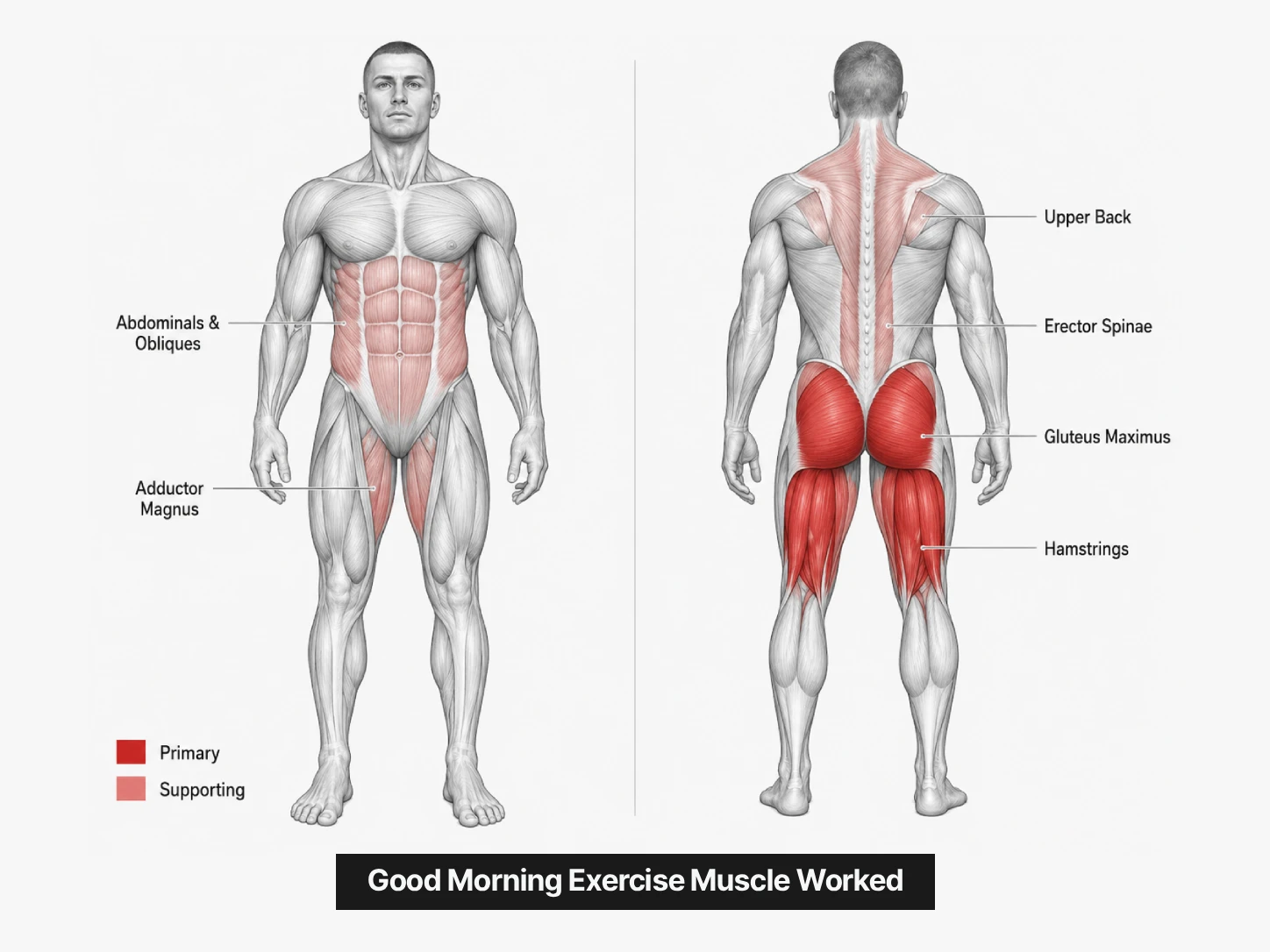
Good mornings train several posterior-chain muscles, but those muscles do not all perform the same role.
Hamstrings
The hamstrings run along the back of the thigh. Most of the group crosses both the hip and knee joints.
During the lowering phase, the hamstrings lengthen and help manage hip flexion. During the ascent, they contribute to hip extension.
Because the knees remain relatively straight compared with a squat or conventional deadlift, the hamstrings stay comparatively lengthened through much of the hinge. This is why many lifters feel substantial tension along the back of the thighs.
Gluteus Maximus
The gluteus maximus is a major hip extensor. It helps reverse the movement from the bottom and brings the hips back beneath the torso.
The glutes work alongside the hamstrings rather than taking over the exercise independently.
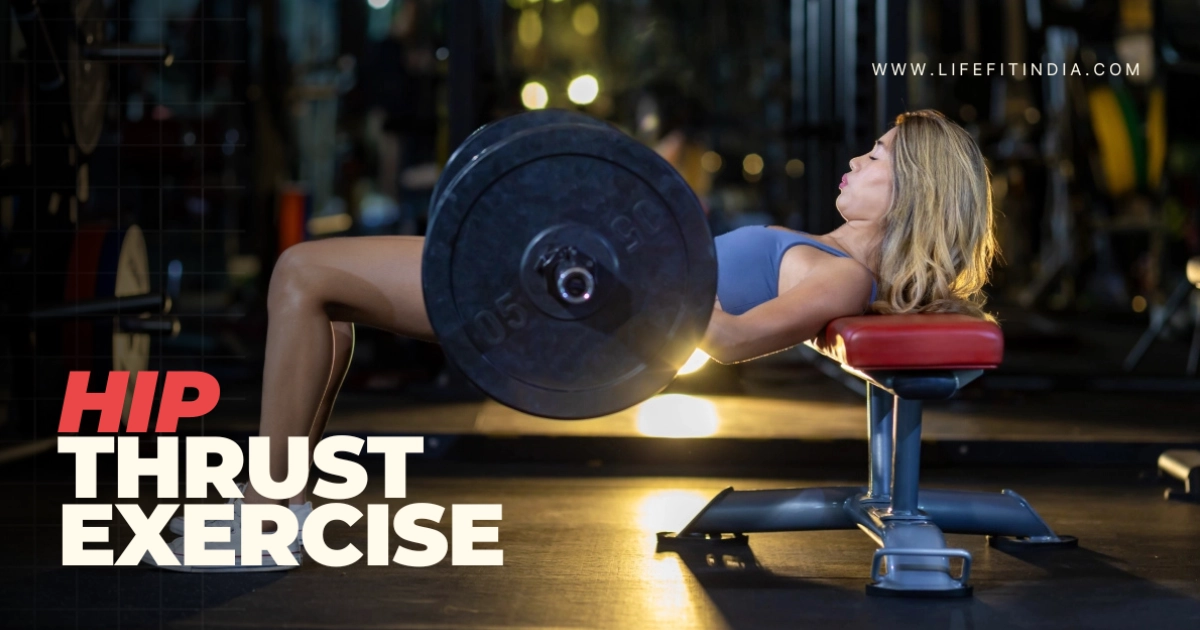
Readers looking for a movement that challenges hip extension from a different position can compare good mornings with the hip thrust exercise.
Erector Spinae
The erector spinae run along the back of the torso. During a well-executed good morning, they mainly resist unwanted spinal flexion and help preserve trunk position against the load.
This does not make the movement a lower-back isolation exercise. The spinal erectors stabilise the torso while the hips produce most of the visible movement.
Supporting and Stabilising Muscles
Other contributors include:
Adductor magnus
Abdominal wall
Internal and external obliques
Gluteus medius and smaller hip stabilisers
Trapezius and other upper-back muscles supporting the bar
These muscles assist with balance and stability, but they should not all be described as equal primary targets.
Benefits of Good Mornings
Builds Posterior-Chain Strength
The good morning trains the hamstrings, glutes and trunk together through a hip-hinge pattern.
This may make it a useful accessory for lifters who need more strength or positional consistency in exercises such as the deadlift and barbell back squat.
Carryover is not automatic. It depends on the variation, resistance, programme and the lifter’s actual limitation.
Reinforces the Hip-Hinge Pattern
Light good mornings can teach you to move through the hips without turning the exercise into a squat.
The load across the upper back also provides immediate feedback. If you lose your brace, rush the descent or shift your balance, the error often becomes obvious quickly.
Beginners should first learn the pattern without a heavy bar. The exercise is useful only when it reinforces the movement you intend to practise.
Challenges the Posterior Chain in Deeper Hip Flexion
As your torso inclines, the horizontal distance between the bar and the hips increases. The exercise therefore becomes more demanding even when the external load is modest.
The lower half of the movement can place substantial demand on the hip extensors and trunk stabilisers. This is one reason good mornings usually require less weight than many deadlift variations.
May Complement Squat and Deadlift Training
Good mornings can help lifters practise maintaining torso position while the hips travel backward.
They are usually programmed as a secondary movement rather than the main lift of the day. Moderate sets may complement squat and deadlift training without requiring the grip strength needed for Romanian deadlifts.
That does not mean every lifter needs them. Exercise selection should address a specific training need rather than simply add more fatigue.
Supports Balanced Hamstring Training
The hamstrings contribute to both hip extension and knee flexion. Good mornings train their hip-extension function, while exercises such as the seated leg curl train knee flexion more directly.
A balanced programme can include both movement types.
A 2009 electromyography study reported differences in hamstring-to-quadriceps activation ratios between men and women across the exercises examined. That finding may support purposeful hamstring training, but it does not show that good mornings alone correct an imbalance or prevent knee injuries.
Women do not require a different good-morning technique solely because of sex.
Offers Several Equipment Options
Good mornings can be adapted to the equipment available:
Bodyweight or a dowel for learning
Resistance bands for compact home training
Dumbbells for accessible external loading
Barbells for conventional strength work
Smith machines for a fixed bar path
Safety squat bars for lifters with limited shoulder mobility
This flexibility makes the exercise suitable for commercial gyms and smaller home setups.
What Research Says About Good Morning Mechanics
Research on good mornings is limited compared with research on squats and deadlifts. Most available studies are small, examine acute biomechanics or muscle activity, and do not directly measure long-term strength, hypertrophy or injury rates.
The evidence is still useful when interpreted within those boundaries.
How Loading Changes the Exercise
A 2015 study by Vigotsky and colleagues examined good mornings at loads ranging from 50% to 90% of participants’ one-repetition maximum.
Muscle activity in the hamstrings and spinal erectors generally increased as the load rose. Knee flexion also changed with heavier resistance.
This does not mean that the heaviest load produced the best repetition. Surface EMG reflects electrical activity under the tested conditions; it does not directly measure muscle growth or establish an ideal training load.
The full methods and findings are available in the Vigotsky et al. good-morning analysis.
What this means in the gym: Increase resistance only while your balance, brace, bar position and hinge remain consistent. Heavier is not better when the movement changes substantially.
Good Mornings Use Much Less Knee Flexion Than Deadlifts
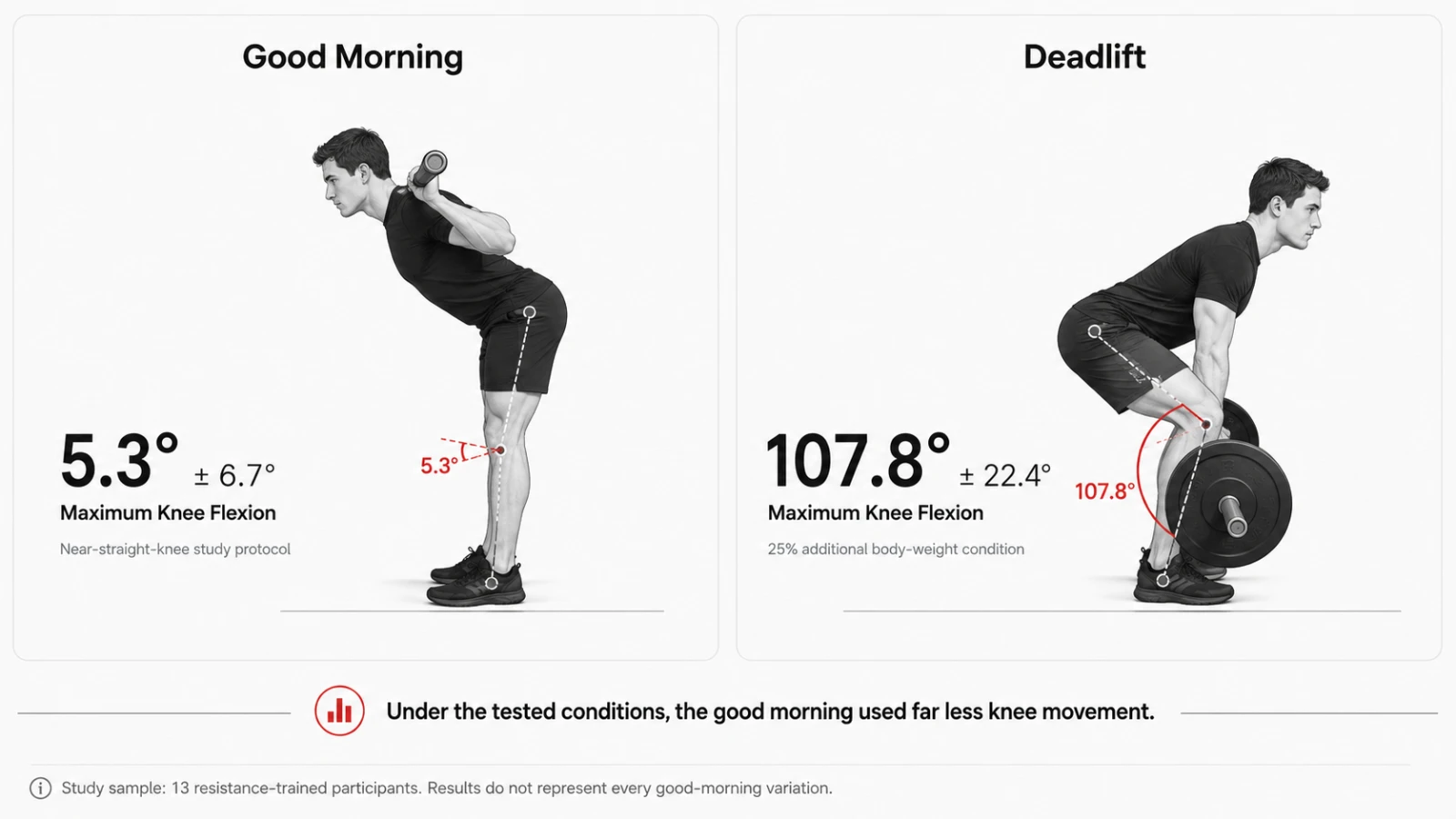
A study involving 13 resistance-trained participants compared good mornings and deadlifts using motion capture and force plates.
The good morning performed with an additional load equal to 25% of body weight produced an average maximum knee-flexion angle of 5.3° ± 6.7°.
Deadlifts performed with 25% and 50% additional body weight produced maximum knee-flexion angles of 107.8° ± 22.4° and 103.4° ± 22.6°, respectively.
The participants were specifically instructed not to bend their knees during the good morning. These values therefore describe that study’s near-straight-knee protocol, not every commonly coached variation.
The study also found different sagittal knee-moment patterns between the exercises. It did not prove that good mornings eliminate all knee loading, completely isolate the posterior chain or prevent ACL injuries.
The full experimental context can be reviewed in the Schellenberg biomechanical comparison.
What this means in the gym: Good mornings are generally more hip-dominant and use considerably less knee movement than conventional deadlifts. They should not be treated as a replacement for every deadlift or knee-dominant exercise.
Research Limitations to Keep in Mind
Current evidence has several important limitations:
Most studies use small samples
Participants are often trained or exercise-experienced
Techniques and loading methods differ across studies
Acute EMG does not measure long-term hypertrophy
Joint modelling is not the same as directly measuring internal tissue forces
Biomechanical findings do not prove injury prevention
Results from one variation may not apply to every bar, stance or machine setup
Research should improve coaching decisions, not create a false impression of certainty.
Common Good Morning Mistakes
1. Starting Too Heavy
Why it happens: The lifter assumes the good morning should use a load similar to a squat or Romanian deadlift.
Why it matters: The bar’s position creates a long lever as the torso inclines. A weight that feels light while standing may become difficult to manage at the bottom.
Correction: Begin with bodyweight, a dowel or an empty bar. Add resistance only after your depth, balance and tempo remain repeatable.
2. Rounding the Back Unintentionally
Why it happens: The lifter descends beyond their available range, loses the brace or uses excessive resistance.
Why it matters: Unplanned movement under load changes the mechanics you intended to train and may reduce your ability to complete the repetition confidently.
Correction: Reduce the weight and shorten the range. Brace before each repetition and finish the set when your position starts to deteriorate.
A small amount of normal spinal movement does not automatically equal injury. The practical objective is to avoid losing stability or being forced into a position you cannot tolerate.
3. Turning the Hinge Into a Squat
Why it happens: The knees continue moving forward while the hips drop downward.
Why it matters: The movement becomes more knee-dominant and no longer provides the same hip-hinge stimulus.
Correction: Keep your shins relatively stable and send your hips backward. Practise a wall-hinge drill before adding more weight.
4. Resting the Bar on the Neck
Why it happens: The bar is placed too high or is not supported securely by the upper back.
Why it matters: Direct pressure on the neck is uncomfortable and may make the bar unstable.
Correction: Position the bar across the upper-back musculature, maintain a secure grip and rerack it if the position begins to shift.
5. Descending Too Far
Why it happens: The lifter believes the torso must reach parallel with the floor.
Why it matters: Chasing a fixed depth may cause changes in balance, pelvic position or trunk stability.
Correction: Stop at the deepest position you can maintain with confidence. Progress the range gradually instead of forcing it.
6. Leaning Back at the Top
Why it happens: The lifter exaggerates the finish in an attempt to squeeze the glutes harder.
Why it matters: The repetition ends with excessive lumbar extension rather than a neutral standing position.
Correction: Finish tall with your ribs positioned over your pelvis. Extend the hips without pushing them far in front of your feet.
Are Good Mornings Safe?
Good mornings can be performed safely when the variation, range and resistance match the lifter’s experience and ability. They are not automatically safe or dangerous.
Important variables include:
Training history
Load selection
Technical consistency
Fatigue
Previous injuries
Current symptoms
Rack and safety-arm setup
Ability to perform an unloaded hip hinge
Perform barbell good mornings inside a rack with appropriately positioned safety arms. The arms should be low enough to permit your planned range but high enough to catch the bar if you cannot complete a repetition.
Stop the exercise and seek qualified medical guidance if you experience radiating pain, numbness, unusual weakness or symptoms that persist beyond ordinary training discomfort.
People with current back, hip or hamstring pain, recent surgery or medical restrictions should obtain individual advice before attempting loaded good mornings.
This guide provides general fitness education and is not a rehabilitation prescription.
Good Morning Variations and Progressions
Beginner Regressions
Wall Hip-Hinge Drill
Stand a short distance in front of a wall with your back facing it. Push your hips backward until they touch the wall while keeping your feet planted.
Move slightly farther from the wall as the pattern becomes easier.
Dowel Good Morning
Place a dowel across your upper back or maintain contact with it along your head, upper back and sacrum.
This allows you to practise the hinge without meaningful external resistance.
Bodyweight Good Morning
Place your hands across your chest or behind your head. Use the same stance, brace and hip movement as the loaded exercise.
Light Banded Good Morning
Stand securely on the middle of a continuous-loop band and position the band across the upper back.
Inspect the band for wear before every session and remain deliberate when stepping into or out of tension.
Home-Workout Variations for Compact Spaces
Dumbbell Good Morning
Hold one dumbbell close to your chest or two dumbbells at shoulder level. Keeping the load in front changes the balance and leverage compared with a barbell across the back.
Space-saving dumbbells can be practical for apartments and compact home gyms because they require less room than a full rack-and-barbell setup.
Resistance-Band Good Morning
Stand on a continuous-loop resistance band and position the other end securely across your shoulders.
Do not attach bands to unstable furniture, grills, ordinary door handles or uncertain structures. Only use a purpose-built anchor rated for resistance training and follow the manufacturer’s instructions.
Before training at home, check:
Ceiling and fan clearance
Floor stability
Distance from glass and furniture
Whether anyone may walk through the area
Whether moving or dropping equipment will create excessive noise
The LIFE FIT home gym setup guide can help you plan equipment around your available space.
Gym Variations
Barbell Good Morning
This is the conventional loaded variation. It allows straightforward progression but demands confident unracking, bracing and bar management.
Use considerably less resistance than you would typically use for a squat until you understand how the exercise feels.
Smith Machine Good Morning
A Smith machine guides the bar along a fixed path. This can simplify unracking, but it also limits how freely the bar can move.
Experiment with foot position using a very light load. A fixed path is not automatically safer or more suitable for every lifter.
Explore LIFE FIT’s functional trainers and Smith machines when planning a multi-purpose strength area.
Safety-Bar Good Morning
A safety squat bar may reduce the shoulder mobility required to hold a straight bar. Its handles and camber also change where the load sits and how the exercise feels.
Begin lighter when changing bar types.
Seated Good Morning
Sit on a stable bench with your feet planted and hinge forward through the hips.
This variation reduces contribution from the lower legs and creates a different stability challenge. It should still be progressed carefully because the load remains across the upper back.
Advanced Variations
Experienced lifters may use:
Staggered-stance good mornings
Pin or Anderson good mornings
Cambered-bar good mornings
These are optional tools, not mandatory progression stages. Learn them with suitable equipment and qualified coaching.
Build Your Posterior-Chain Training Setup
Explore LIFE FIT home gym equipment, dumbbells, barbells and racks for structured strength training at home or in a commercial gym.
Good Morning vs Romanian Deadlift, Back Extension and Hip Thrust
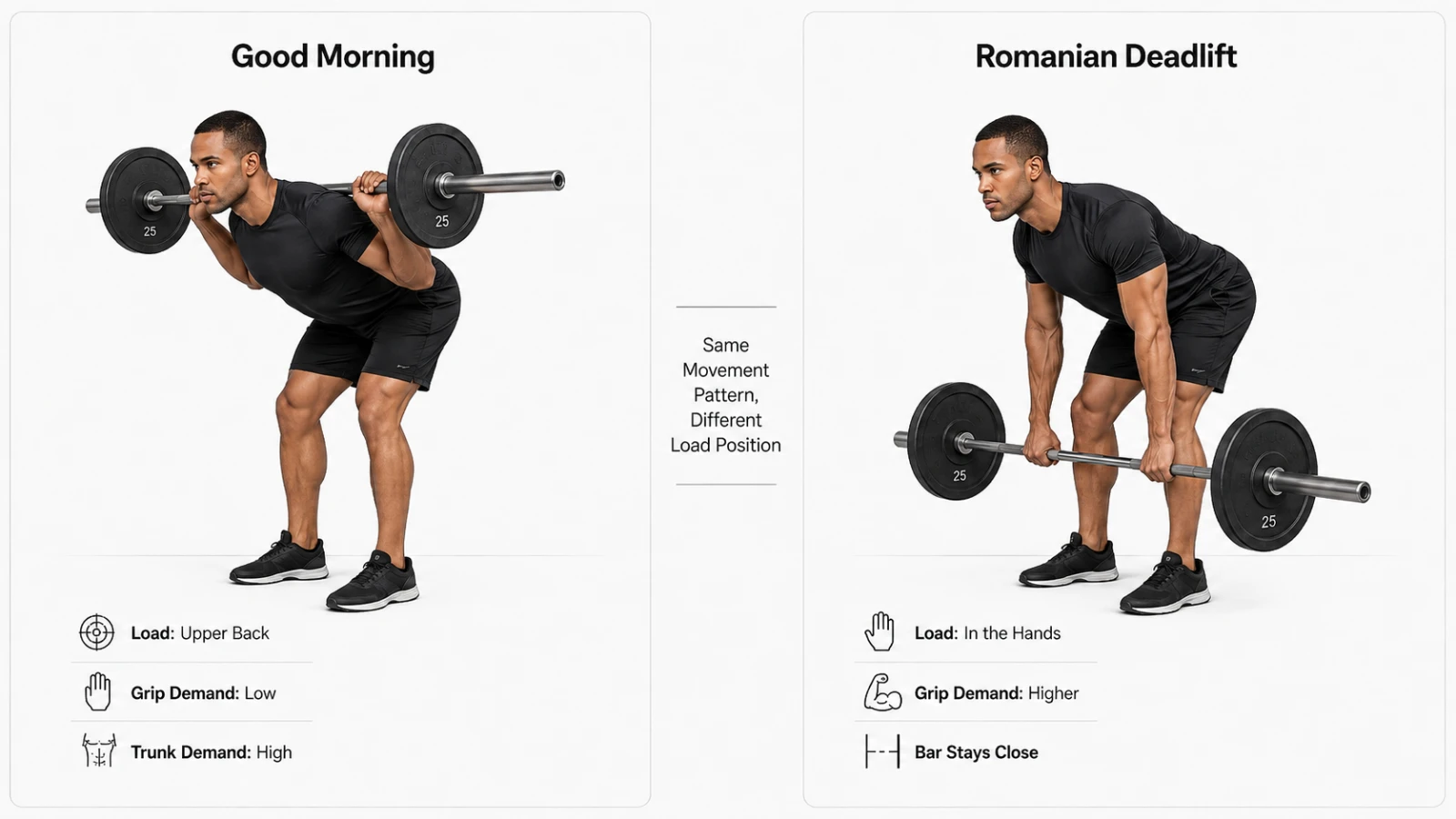
These exercises all train hip extension, but their setup and strength demands differ.
Factor | Good Morning | Romanian Deadlift | Back Extension | Hip Thrust |
|---|---|---|---|---|
Load position | Across upper back | Held in hands | Bodyweight or load near torso | Across hips |
Main pattern | Hip hinge | Hip hinge | Supported hip extension | Horizontal hip extension |
Knee movement | Low to modest | Modest | Minimal | Knees remain flexed |
External stability | Low | Moderate | High due to support | Moderate |
Trunk demand | High | High | Moderate | Lower near the top |
Grip requirement | Minimal | Can be significant | Minimal | Minimal |
Equipment | Barbell, band or alternative | Barbell or dumbbells | Extension bench | Bench and load or machine |
Best use | Hinge practice and posterior-chain assistance | General posterior-chain strength | Supported hip-extension work | Glute-focused hip extension |
Loaded beginner suitability | Low to moderate | Moderate | Moderate to high | Moderate |
Main limitation | Demanding load position | Grip and equipment requirements | Requires a dedicated bench | Setup may be inconvenient |
Good Morning vs Romanian Deadlift
Both movements are hip hinges, but the load sits in different places.
In the good morning, the bar rests across the upper back. In the Romanian deadlift, it hangs from the hands and stays close to the legs.
The RDL therefore requires more grip and lat involvement, while the good morning creates a distinctive stability demand because the resistance sits farther from the hips as the torso inclines.
The RDL is also easier to terminate by lowering the bar. A barbell good morning should be performed inside a properly configured rack.
Good Morning vs Back Extension
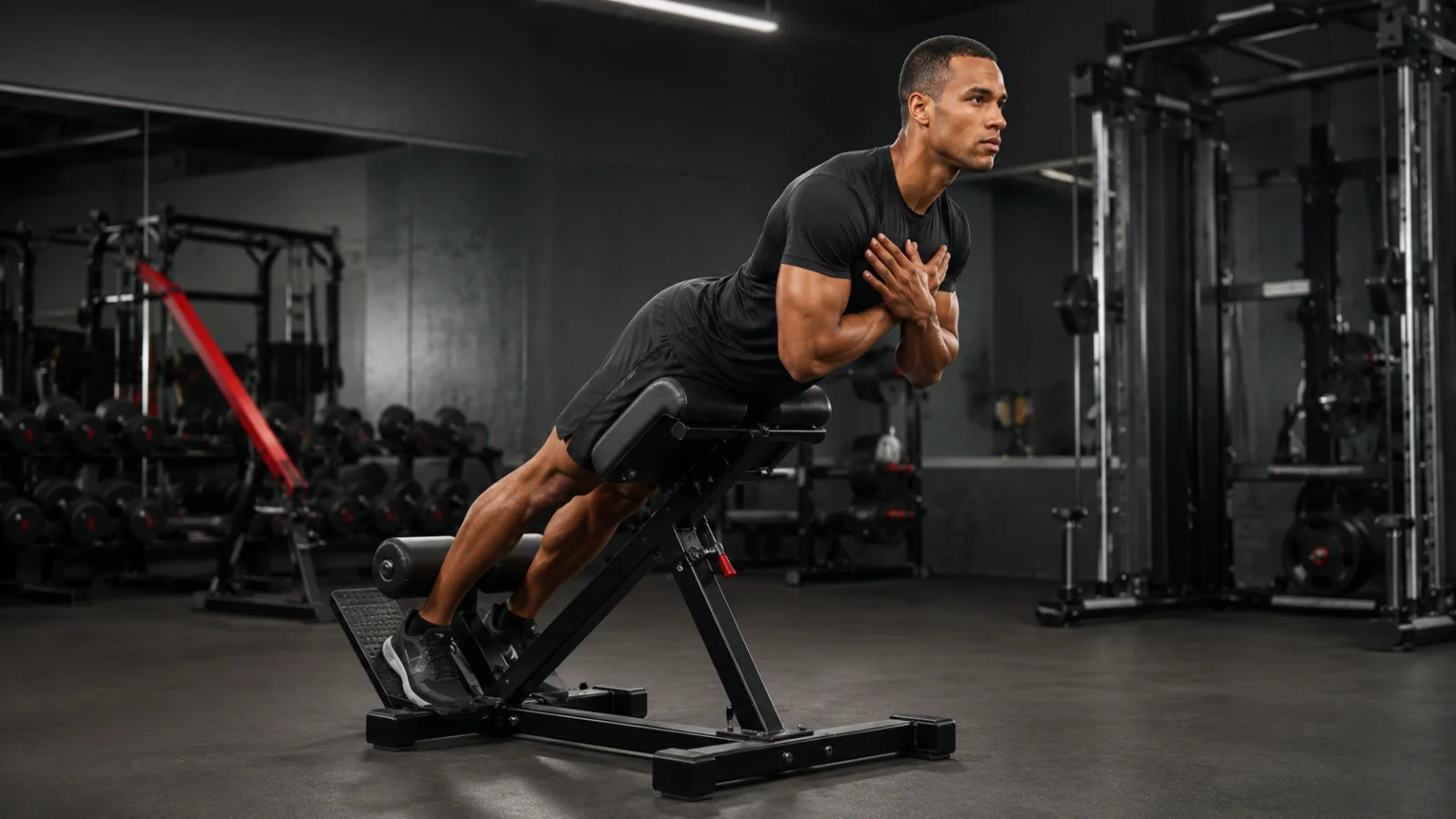
A hyperextension or back-extension exercise supports the lower body on a dedicated bench. That support reduces the balance and bar-management requirements.
Back extensions may therefore be more accessible for people who want to train hip extension without supporting a bar across the upper back.
Research comparing good mornings with Roman-chair variations suggests that the exercises can challenge the hip extensors differently across the movement. These acute findings help explain why the exercises may complement one another, but they do not establish one universal winner.
You can review the mechanical comparisons in the Contreras biomechanical analysis.
Good Morning vs Hip Thrust
The good morning becomes demanding as you hinge into deeper hip flexion. The hip thrust typically feels most challenging closer to full hip extension.
The good morning also requires more trunk and upper-back stability. The hip thrust provides greater external support but requires a bench, pad and barbell or a dedicated machine.
None of these exercises is universally superior. Choose according to your experience, equipment, comfort and desired training effect.
How to Add Good Mornings to Your Workout
For most lifters, good mornings work best as a secondary exercise.
Place them:
After your main squat or deadlift
On a lower-body or full-body day
As a moderate posterior-chain accessory
Very lightly during movement preparation
Avoid performing demanding good mornings immediately before heavy squats or deadlifts. Fatigue in the hamstrings and trunk may affect your main lift.
Suggested Starting Sets and Reps
Goal | Starting structure | Guidance |
|---|---|---|
Learn the hinge | 2–3 sets of 8–12 | Bodyweight, dowel or very light resistance |
Warm-up practice | 1–2 sets of 10–15 | Slow and non-fatiguing |
General strength | 3–4 sets of 6–10 | Moderate resistance with stable technique |
Hypertrophy accessory | 3–4 sets of 8–15 | Consistent range with repetitions in reserve |
Strength accessory | 3–5 sets of 5–8 | Experienced lifters only |
Home training | 2–4 sets of 10–20 | Dumbbell or band resistance |
These are starting frameworks rather than fixed prescriptions.
How Heavy Should Good Mornings Be?
Use a load that allows you to:
Keep the bar secure
Maintain your chosen trunk position
Lower the resistance smoothly
Reverse the movement without jerking
Complete every repetition through a similar range
Finish with approximately two technically sound repetitions still available
Your good-morning load will usually be much lighter than your squat load.
Do not determine it only as a percentage of another exercise. Your technique, proportions, bar position and chosen variation all affect what is appropriate.
When using percentage-based programming, estimate conservatively and treat the LIFE FIT one-rep max calculator as a planning aid, not as a reason to test a maximal good morning.
Progression Order
Progress in this sequence:
Improve your stance and balance.
Establish a repeatable brace.
Increase your usable range.
Make each repetition consistent.
Add repetitions within the target range.
Increase resistance gradually.
Adding weight should be the final step, not the first.
Frequently Asked Questions
Good mornings primarily train the hamstrings and gluteus maximus. The erector spinae, abdominals, obliques and upper-back muscles stabilise the torso and support the load, while the adductor magnus and smaller hip stabilisers also contribute.
No, good mornings are not inherently bad for your lower back when performed with suitable mechanics and loading. They place substantial demand on the trunk stabilisers, so the resistance, range and variation must match your experience. People with current symptoms or medical restrictions should seek individual guidance first.
Yes, you should maintain a soft, stable knee bend throughout the movement. Avoid forcefully locking the knees, but do not let them continue travelling forward as in a squat. A small amount of flexion helps keep the movement comfortable while preserving its hip-dominant character.
Lower only as far as you can maintain balance, trunk stability and the intended hip hinge. Your torso does not need to become parallel with the floor. Stop when hamstring tension, mobility or a change in position limits the movement.
Use a weight that allows every repetition to remain consistent and technically sound. Beginners should start with bodyweight, a dowel or an empty bar. More experienced lifters can progress gradually, but maximal or near-maximal loading is unnecessary for most general fitness programmes.
No—neither exercise is universally better. Good mornings remove grip as a limiting factor but create a demanding upper-back load position. Romanian deadlifts load the hands and may be easier to learn or end safely. Choose according to your programme, equipment and experience.
Yes, beginners can perform bodyweight, dowel or light banded good mornings to learn the hip hinge. A loaded barbell version is more appropriate after the lifter can brace, maintain balance and repeat the movement consistently without external resistance.
Yes, good mornings are suitable for women when the variation and resistance match the individual. Women and men can use the same fundamental technique. Differences in proportions, mobility, experience and current symptoms matter more than sex alone.
Final Takeaway
The good morning exercise is an effective but technically demanding hip hinge. It trains the hamstrings and glutes while requiring the torso to remain stable beneath a challenging load position.
Start light, push the hips backward, use only the range you can maintain and progress resistance gradually. Treat the exercise as one useful posterior-chain option, not as a test of how much weight you can place across your back.
For a broader lower-body programme, explore LIFE FIT’s leg exercise guides and combine hip-hinge training with squat, lunge and knee-flexion movements.
Need Help Choosing Strength Equipment?
Get guidance on selecting a barbell, rack, Smith machine or compact home-gym setup for your available space and training goals. Request a quotation from LIFE FIT.
References
Vigotsky AD, Harper EN, Ryan DR, Contreras B. Effects of load on good morning kinematics and EMG activity. PeerJ. 2015.
Schellenberg F, Lindorfer J, List R, Taylor WR, Lorenzetti S. Kinetic and kinematic differences between deadlifts and good mornings. BMC Sports Science, Medicine and Rehabilitation. 2013.
Ebben WP. Hamstring activation during lower-body resistance-training exercises. International Journal of Sports Physiology and Performance. 2009.
Jaeggi JS, Achermann B, Lorenzetti S. Female lower-body muscle forces: a musculoskeletal modelling comparison of back squats, split squats and good mornings. Journal of Functional Morphology and Kinesiology. 2024.
Contreras B, Vigotsky AD, Schoenfeld BJ, et al. Comparison of muscle activity in three single-joint hip-extension exercises in resistance-trained women.
0 Comments
Loading comment form…
Loading comments…