


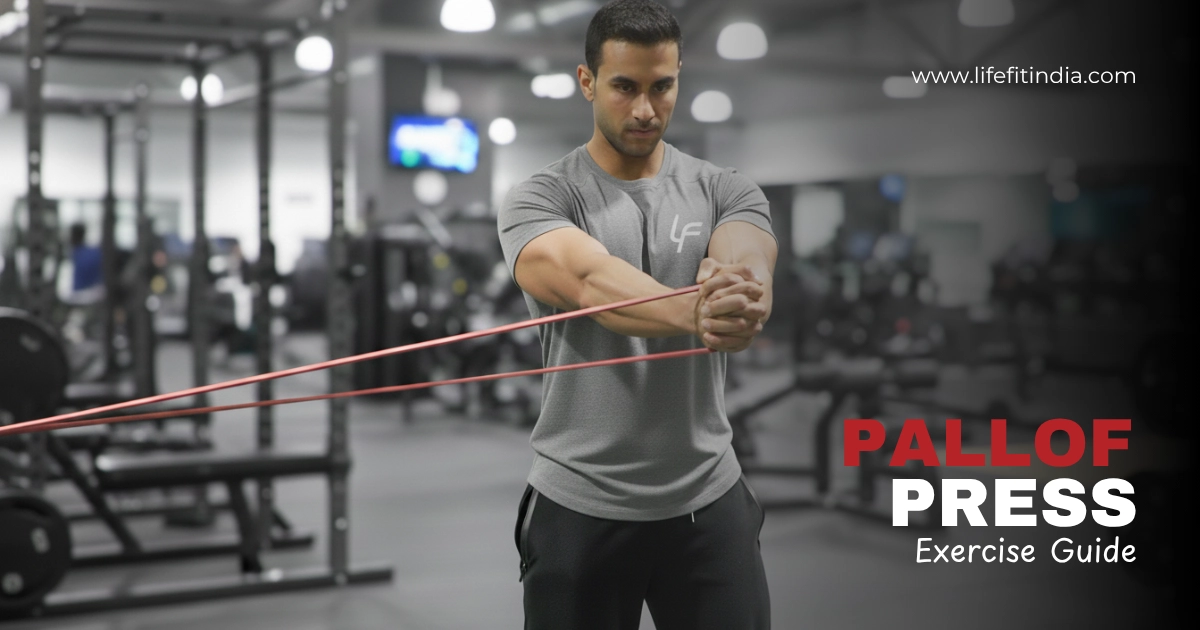
When most people think of core training, they often default to exercises that bend and flex the spine, like ab crunches or sit-ups. While these movements have their place, they miss the true primary function of your core: to resist movement and provide stabilization.
Your core is a 360-degree shield designed to protect your spine by staying rigid. The Pallof Press is arguably the most effective exercise to train this specific function.
This guide will cover everything from correct form and common mistakes to the science-backed benefits and programming of this foundational “anti-rotation” exercise.
What is the Pallof Press? A DPT Explains “Anti-Rotation”
The Pallof Press is an exercise named after physical therapist John Pallof, who popularized it as a tool for core rehabilitation and stabilization.
Its primary goal is to train “anti-rotation”.
In simple terms, anti-rotation is the ability of your core muscles, particularly the obliques and deep spinal stabilizers, to “lock down” and prevent your torso from twisting. This ability to create “core stiffness” is essential for protecting your spine from unwanted, and potentially dangerous, rotational forces under load.
How to Perform the Standard Pallof Press (Step-by-Step Guide)
To perform the Pallof Press, you need a single, consistent point of resistance.
Equipment: Cable Machine vs. Resistance Band
Cable Machine: Using a piece of equipment like a Functional Trainer or Cable Crossover is an excellent choice. It provides smooth, consistent tension throughout the entire range of motion.
Resistance Band: A heavy-duty resistance band or a Professional Suspension Trainer anchored to a squat rack is a perfect option for a home gym. A band provides accommodating resistance, meaning the tension increases the further you press it away from your body.
1. The Setup (Stance, Anchor, and Tension)
Stand perpendicular (sideways) to the anchor point. Set the cable handle or band at chest height. Grab the handle with both hands, holding it at the center of your chest. Assume an athletic stance with your feet shoulder-width apart and knees slightly bent. Step away from the anchor until you feel significant tension trying to pull you back.
2. The Brace (Set Your Core)
This is the most important step. Before you move, “set” your core. Squeeze your glutes, draw your ribs down toward your pelvis, and brace your abdominals as if you are about to be punched.
3. The Press (Extension)
While keeping your hips and shoulders locked forward, press the handle straight out from your chest until your arms are fully extended. The entire time, your body must fight the urge to rotate toward the anchor. Your belt buckle and chest should never waver.
4. The Hold and Controlled Return
Hold the fully extended position for a three- to five-second count to maximize time under tension. After the hold, slowly return the handle back to your chest with full control. Do not let the weight or band snatch you back. This completes one rep. Perform all reps on one side before switching.
Video Demonstration
5 Common Pallof Press Mistakes (And How to Fix Them)
Avoid these common faults to ensure the exercise remains safe and effective.
Rotating the Torso or Hips: This is the most common mistake. The user twists their body during the press, turning an anti-rotation exercise into a rotation exercise.
Fix: Lower the weight. Focus only on keeping your hips and chest pointing straight ahead.
Leaning Away from the Anchor: The body leans to the side to counterbalance the weight. This takes the tension off the obliques.
Fix: Keep your shoulders and hips level and square.
Rushing Repetitions: Using momentum removes the stabilization component of the exercise.
Fix: Add a mandatory 3-5 second hold at the end of every single rep.
Shrugging the Shoulders: Tension can easily creep up into the neck and traps.
Fix: Keep your shoulder blades pulled “down and back,” away from your ears.
Not Controlling the Return (Eccentric): You press out strong but then relax and let the weight pull you back.
Fix: Stay braced and fight the resistance just as hard on the way in as you did on the way out.
Muscles Worked: A Biomechanical Deep Dive
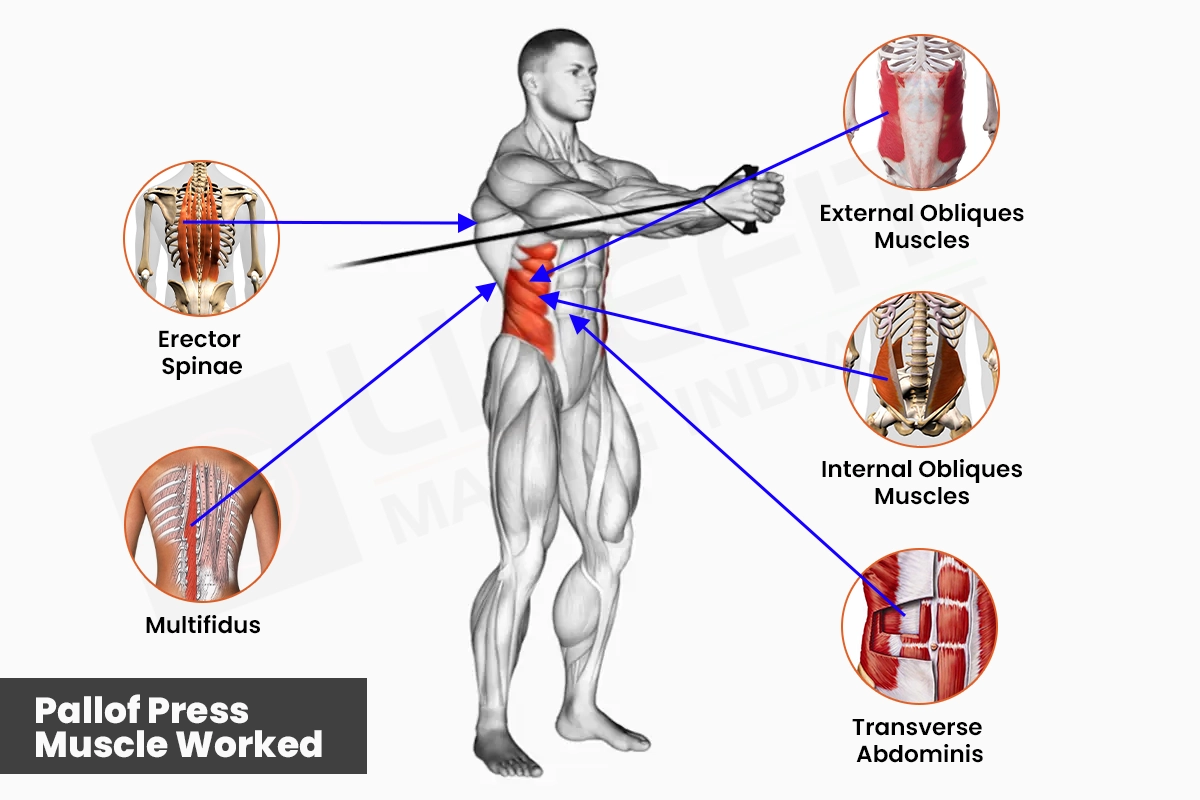 The Pallof Press is a full-body exercise, but it places specific, targeted stress on the core musculature.
Primary Stabilizers (The “Anti-Rotation” Muscles)
Internal Obliques (IO): This is the true target of the exercise. The internal obliques are deep core muscles crucial for lumbopelvic stability. A systematic review published in the International Journal of Environmental Research and Public Health found that core stability exercises (like the Pallof Press) are superior for activating these deep internal obliques compared to other exercises.
External Obliques (EO): The external obliques work with the internal obliques on the opposite side to create a “force couple” that generates rotational stiffness.
Deep Core and Spinal Stabilizers
Transverse Abdominis (TVA): This is your body’s “natural weight belt”. The bracing cue activates the TVA, which is critical for stabilizing the spine.
Erector Spinae and Multifidus: These deep muscles in your back must “co-contract” with your abdominals to hold your spine in a rigid, neutral position.
Secondary Movers
Glutes: Your glutes must stay squeezed and engaged to maintain a neutral pelvic position and prevent your hips from rotating.
Scapular Stabilizers: The muscles around your shoulder blades (rhomboids, serratus) work hard to hold your arms in the pressed position.
7 Science-Backed Benefits of the Pallof Press
This exercise is not just a “side ab” movement. It provides tangible, evidence-based benefits for your health and performance.
Forges True “Core Stiffness” and Stability: The Pallof Press trains all the muscles of the trunk to co-contract, creating the “core stiffness” needed to stabilize the spine under load. This is a foundational quality for almost all human movement.
May Reduce Risk of Low Back Pain: Many back injuries occur due to uncontrolled twisting or bending. The Pallof Press trains your core to resist those exact motions, helping to stabilize the lumbopelvic region and off-load the spinal discs. For more ideas on managing back pain, see our exercises for back pain guide.
Improves Functional Strength for Daily Life: This is the definition of functional strength. You use anti-rotation constantly, whether carrying groceries in one arm, holding a child on your hip, or pushing a heavy door.
Enhances Athletic Performance: The ability to resist rotation is the foundation for producing powerful rotation. Research has linked trunk strength and core stability to rotational power in sports like MMA, tennis, baseball, and golf.
Can Help Prevent Lower-Body Injury: This is a key benefit many miss. Research shows that core training, including anti-rotation, improves lower-body biomechanics. It can help reduce “knee valgus” (knees caving in), a primary risk factor for ACL injuries. It is also used as a key therapeutic exercise for athletic groin pain.
Alleviates Fatigue from Prolonged Sitting: This is a perfect exercise for office workers. A 2025 scoping review in Medicine found that core exercises are effective in alleviating the trunk muscular fatigue and imbalances caused by prolonged sitting.
Teaches Bracing for Heavy Lifts: The skill of “bracing” learned in the Pallof Press translates directly to staying tight and stable under a heavy barbell during a barbell bench press or squat.
Pallof Press vs. Other Core Exercises
How does the Pallof Press stack up against other common core movements?
Pallof Press vs. Side Plank
They are partners, not competitors.
The Side Plank trains the frontal plane. It is an anti-lateral flexion exercise, meaning it resists side-bending.
The Pallof Press trains the transverse plane. It is an anti-rotation exercise, meaning it resists twisting.
Conclusion: A complete core program needs both.
Pallof Press vs. Russian Twist
This is the key comparison: anti-rotation vs. rotation.
A 2025 randomized trial comparing the two exercises found that both were effective at improving core muscle strength and endurance in athletes.
However, they train different qualities. The Pallof Press (anti-rotation) is superior for building foundational stability and preferentially targets the deep internal obliques.
The Russian Twist (rotation) is a power-based exercise that preferentially targets the more superficial external obliques.
Conclusion: The Pallof Press builds the stable foundation required to safely perform rotational power exercises like the Russian Twist.
10 Pallof Press Variations for Progression
Once you have mastered the standard press, you can use progressive overload. The best way to make the Pallof Press harder is not just by adding weight, but by reducing your stability.
Changing Stance
Tall-Kneeling Pallof Press: Kneel on both knees. This removes your lower legs from the equation, forcing more direct hip and core control.
Half-Kneeling Pallof Press: This is a go-to variation. Kneel on one knee (the one closer to the anchor). It is highly stable and excellent for teaching hip control.
Split-Stance Pallof Press: Stand in a “lunge” or “split squat” position. This challenges your stability in a common athletic stance.
Tandem Stance Pallof Press: Stand with one foot directly in front of the other (heel-to-toe). Research published in Medicina (2025) found that this stance produces higher lumbopelvic acceleration compared to other variations, making it objectively more challenging.
Adding Instability
Pallof Press on Foam Pad: Perform the standing or kneeling version on an unstable foam pad.
Pallof Press on BOSU Ball: The same 2025 study found that performing the press on an unstable hemisphere ball (like a BOSU) significantly increases the exercise difficulty and muscle activation.
Changing Plane of Motion
Vertical Pallof Press: Anchor the band high or low. Press vertically (overhead or down) to fight spinal extension, not just rotation.
Angled Pallof Press (Chops/Lifts): Perform the press on a diagonal (high-to-low or low-to-high). This combines anti-rotation with anti-flexion or anti-extension.
Pallof Press with Rotation: A hybrid move. Press out and hold (anti-rotation), then add a small, controlled rotation, then return to center.
Pallof Press Walk-Out: Press the handle out and hold the extended position. While holding, take 2-3 small side-steps away from the anchor (increasing tension), then 2-3 steps back.
How to Program the Pallof Press
You can integrate this exercise into your routine in several ways.
General Guidelines (Sets/Reps/Tempo)
For Endurance/Technique: Focus on holds or higher reps. Aim for 2-3 sets of 10-15 reps per side with a 3-5 second hold on each rep. You can also do 2-3 sets of 30-60 second isometric holds.
For Core Strength: Focus on a heavier load. Aim for 3-4 sets of 8-10 reps per side, ensuring your form remains perfect.
Sample Protocols
As a Movement Prep / Warm-up
Goal: “Prime” the core and glutes before a heavy lifting session.
Protocol: Perform 2 sets of 10 reps (with a 3-second hold) per side immediately before Squats or Deadlifts.
As a Superset Pairing
Goal: Increase training density and reinforce stability during a primary lift.
Protocol:
A1: Dumbbell Split Squats (8-10 reps/leg) using Hex Dumbbells.
A2: Half-Kneeling Pallof Press (10 reps/side).
Rest 90 seconds and repeat for 3 sets.
For Low Back Pain / Rehab
Goal: Re-train core stiffness and lumbopelvic control.
Protocol: Start with the most stable variation (Tall-Kneeling or Standing). Focus on isometric holds with a light band. Perform 3 sets of 30-second holds per side, emphasizing breathing during the brace.
For Athletes (Performance)
Goal: Challenge stability and translation to sport.
Protocol: Use advanced progressions. Perform 3 sets of 8 reps per side of the Pallof Press on a BOSU ball or Pallof Press Walk-Outs.
Frequently Asked Questions (FAQ)
Yes. A resistance band is a perfect tool, especially for strength training. Anchor it to a sturdy object like a squat rack or a secure door anchor at chest height.
Key Takeaways
The Pallof Press is a foundational, science-backed exercise for building core stability, preventing injury, and enhancing athletic performance.
True core strength is not just about crunches; it is about building a 360-degree shield that can stabilize your spine against any force. The Pallof Press is one of the most effective and direct ways to build that functional stiffness.
We encourage you to add this movement to your routine, either as a warm-up to prime your core or as a dedicated exercise in your main workout.

0 Comments
Loading comment form…
Loading comments…