
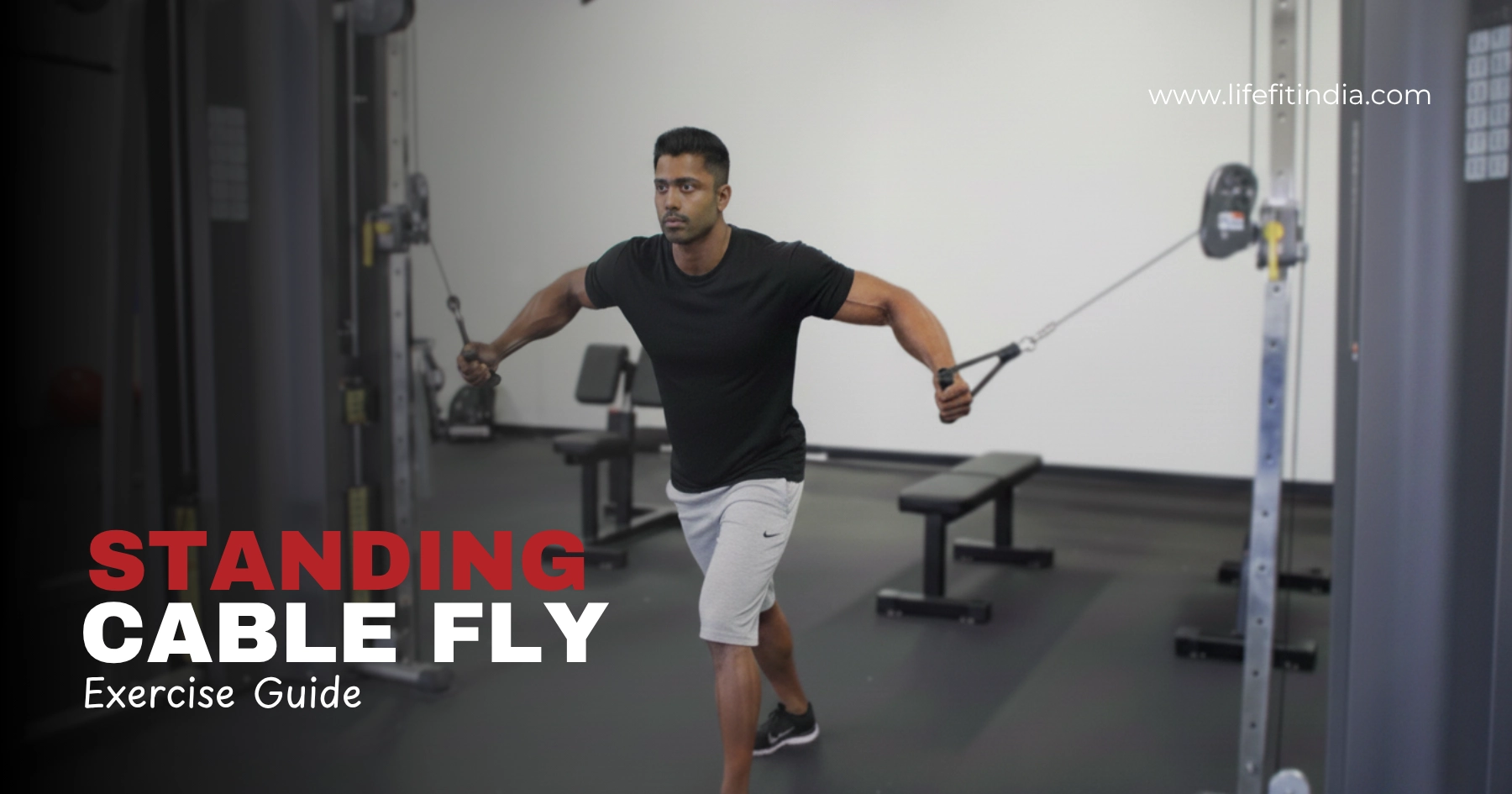
Building a sculpted chest takes more than pressing heavy weights. The Standing Cable Fly isolates and defines the chest muscles with constant tension throughout the movement. Unlike a bench press that shifts load to supporting muscles, the cable fly keeps the chest engaged from start to finish.
This guide breaks down everything you need to know about performing the Standing Cable Fly safely and effectively, backed by scientific research and expert insights from strength training professionals.
What Is the Standing Cable Fly
The Standing Cable Fly is an isolation exercise that primarily targets the pectoralis major, the large chest muscle responsible for bringing the arms together in front of the body. Using a dual pulley cable system, the movement provides continuous resistance through the full range of motion.
Many confuse the cable fly with the cable crossover. While both are similar, the fly focuses on maintaining a fixed bend in the elbows, moving only at the shoulders, whereas the crossover allows the hands to cross at the end of the movement.
If your gym is equipped with a Cable Crossover Machine or a Functional Trainer, you already have the perfect setup for performing this exercise effectively.
Muscles Worked in the Standing Cable Fly
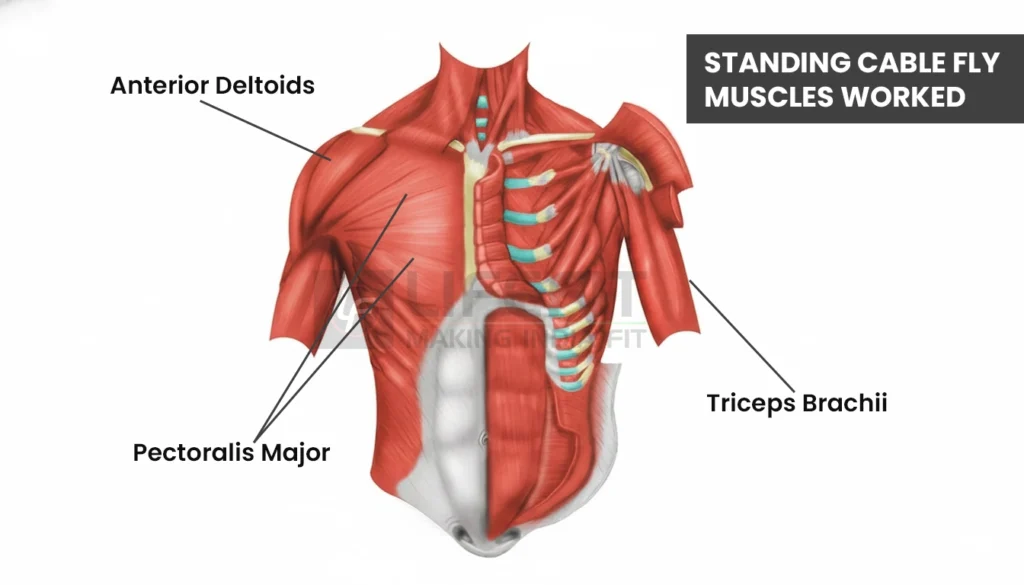
The Standing Cable Fly works multiple areas of the chest while engaging several supporting muscles.
Primary Muscle: Pectoralis Major
The pectoralis major has three distinct regions:
- Clavicular head (upper chest)
- Sternal head (middle chest)
- Costal head (lower chest)
Adjusting cable height changes which region is emphasized. Research published in the Journal of Strength and Conditioning Research (Lauver et al., 2020) showed that exercises performed at a 30-degree incline increase activation of the upper, or clavicular, portion of the chest. Performing a low-to-high cable fly mimics this angle effectively.
Secondary Muscles: Anterior Deltoids and Triceps Brachii
These assist in the adduction and stabilization of the arms during the movement. Keeping them active but not dominant ensures chest isolation.
Stabilizers: Core and Obliques
Standing movements demand balance. The rectus abdominis and obliques engage to maintain posture and prevent sway. A study by Santana et al., 2007 confirmed that standing cable presses and fly variations require significant neuromuscular coordination of the core muscles, making this not only a chest exercise but also a functional stability movement.
Science-Backed Benefits of the Standing Cable Fly
- Constant Tension Across the Range of Motion
Unlike dumbbells, which lose tension at the top of the lift, cables provide resistance through the entire arc. According to ACE-sponsored EMG research, cable movements activate up to 93 percent of the pectoralis major compared to a one-rep max barbell bench press. - Joint-Friendly Resistance
Cable systems allow natural shoulder rotation and minimize joint stress. This makes them suitable for people recovering from shoulder discomfort or looking for a safer isolation alternative to the Barbell Bench Press. - Improved Mind-Muscle Connection
The fly’s slow, controlled nature allows better focus on contracting the chest, building both size and muscle awareness. - Enhanced Core Engagement
Because the movement is performed standing, the core works to stabilize the torso. This translates to better posture and improved overall strength transfer. - Adaptable for All Fitness Levels
Beginners can use light resistance for mastering form, while advanced lifters can increase load or use single-arm variations for added challenge.
How to Perform the Standing Cable Fly
Setup
- Set both pulleys on the cable machine to shoulder height.
- Select a moderate weight that allows 10-15 controlled repetitions.
- Grab each handle and step forward into a staggered stance for balance.
Execution
- Maintain a slight bend in the elbows and keep your core braced.
- Bring your arms together in a wide arc, feeling the stretch in your chest.
- Squeeze the chest at the center before slowly returning to the start position.
- Avoid letting the weights crash; control the motion on the way back.
A useful visual comparison of correct and incorrect form can be found in our Dumbbell Fly Exercise Guide, which follows similar motion patterns.
Coach’s Tip
To reduce sway, imagine your feet rooted firmly to the floor. Engage your glutes and abdominals to create stability. This technique ensures the chest, not the lower back or shoulders, drives the movement.
Standing Cable Fly Video Demonstration
If you prefer working out at home, the Smith Machine with Dual Pulley offers similar functionality to a commercial cable setup.
Common Mistakes and How to Fix Them
- Turning the Fly into a Press – Avoid bending and extending the elbows. Keep the arm angle fixed.
- Overstretching the Shoulders – Stop when you feel a gentle chest stretch, not shoulder strain.
- Using Momentum – Move under control to keep tension on the chest.
- Poor Posture – Keep the chest lifted and shoulder blades pulled back.
- Uneven Cable Height – Adjust both pulleys evenly to maintain symmetrical tension.
Standing Cable Fly Variations
- Low-to-High Cable Fly (Upper Chest Focus): Set pulleys low and move the handles upward in an arc. This targets the upper pectoral fibers, similar to an Incline Dumbbell Press.
- Mid-Pulley Fly (Overall Chest Activation): Standard cable height provides balanced engagement across the sternal portion of the pecs.
- High-to-Low Cable Fly (Lower Chest Focus): Set pulleys high and move downward. This mimics a decline press and focuses on the lower chest.
- Single-Arm Cable Fly: Using one arm at a time increases core activation to resist rotation.
For full chest development, combine this movement with the Pec Deck Fly Machine or Incline Chest and Shoulder Press Machine from LifeFit’s Strength Machines Collection.
Cable Fly vs. Dumbbell Fly: What the Science Says
A study by Solstad et al., 2020 compared muscle activation in barbell presses and dumbbell flys. It showed that fly movements produce lower overall tension at the top phase because gravity no longer pulls directly against the chest.
Cables overcome this limitation by maintaining horizontal resistance, resulting in better time under tension. In practice, this leads to greater isolation and hypertrophy benefits.
Programming Guide: Sets, Reps, and Frequency
| Training Level | Sets × Reps | Rest | Frequency |
|---|---|---|---|
| Beginner | 3 × 12–15 | 60 sec | 2 days per week |
| Intermediate | 4 × 10–12 | 75 sec | 2–3 days per week |
| Advanced | 4 × 8–10 with drop set | 90 sec | 2–3 days per week |
Place the Standing Cable Fly after compound movements such as the Incline Bench Press or Barbell Bench Press to pre-exhaust the chest and maximize pump and definition.
Safety and Injury Prevention
- Warm up with dynamic shoulder stretches before training.
- Avoid locking the elbows to prevent strain on the joints.
- Keep the motion controlled and avoid excessive weight.
- If shoulder discomfort occurs, consider switching to the Life Fit Pro Pec Deck Fly Machine, which offers guided motion for safer isolation.
Frequently Asked Questions
1. Can beginners perform the Standing Cable Fly?
Yes. Start with light resistance and focus on form. Beginners can use resistance bands if cables are not available.
2. How is it different from the Dumbbell Fly?
Dumbbell flys rely on gravity, which reduces tension at the top of the movement, while cables maintain resistance throughout.
3. How many times a week should I do it?
Two to three sessions per week are optimal, paired with compound presses for balanced chest development.
4. Is it safe for shoulder pain?
Yes, provided the range of motion is controlled. Cables are joint-friendly and adaptable.
5. Can I replace the Bench Press with Cable Flys?
For isolation and definition, yes, but for strength and size, combine both. See the Functional Trainer Machine Exercises Guide for complementary movements.
Expert-Curated Research References
- Santana, J.C. et al., 2007. Journal of Strength and Conditioning Research.
- ACE Fitness Research, 2012. Top 3 Chest Exercises.
- Lauver, J.D. et al., 2020. Electromyographic Activity of the Pectoralis Major.
- Solstad, T.E. et al., 2020. Journal of Sports Science and Medicine.
- MDPI, 2022. Chest Exercises: Movement and Loading of Shoulder and Elbow Joints.
These studies validate the biomechanical and muscular activation advantages of cable movements compared to free-weight alternatives.
Conclusion
The Standing Cable Fly is one of the most effective isolation exercises for building a well-defined chest. It enhances muscle activation, improves posture through core engagement, and provides a joint-friendly alternative to traditional presses.
For home or gym setups, explore LifeFit India’s range of functional trainers, benches and racks, and cable machines to perform this and other chest exercises effectively.
Ready to transform your chest training? Start incorporating the Standing Cable Fly into your next workout and experience a stronger, more symmetrical upper body.