

Forget complicated machines and endless gym setups. The push-up remains one of the most effective upper-body exercises ever created. It is mechanically simple, brutally honest, and endlessly scalable.
Whether you are a beginner struggling with your first rep or an advanced trainee chasing higher performance, mastering the push-up is non-negotiable. It builds chest strength, improves stamina, reinforces core stability, and teaches full-body control better than most machines ever will.
This guide breaks push-ups down the way a good coach would: how they work, how to do them correctly, why they build both strength and stamina, and how to progress them intelligently for long-term results.
Anatomy of a Push-Up: What Muscles Are Really Working?
A push-up is not just a chest exercise. It is a moving plank with a press built into it.
The primary muscle driving the movement is the pectoralis major (your main chest muscle). It is responsible for pushing your body away from the floor. Supporting that action are the triceps, which extend the elbows, and the front deltoids, which assist at the shoulder joint.
What many people overlook is the stabilizing role of the core, glutes, and upper back. Your abs and lower back keep your torso rigid, while your glutes prevent hip sag. Without this full-body tension, the push-up collapses.
Key takeaway: A proper push-up trains the chest and teaches full-body tension, which is why it carries over so well to strength and athletic performance.
Proper Push-Up Form (This Is Where Results Are Made)
If your push-ups feel easy but your chest is not growing, form is almost always the issue. This is the technical breakdown that separates real reps from wasted ones.
1. The Setup
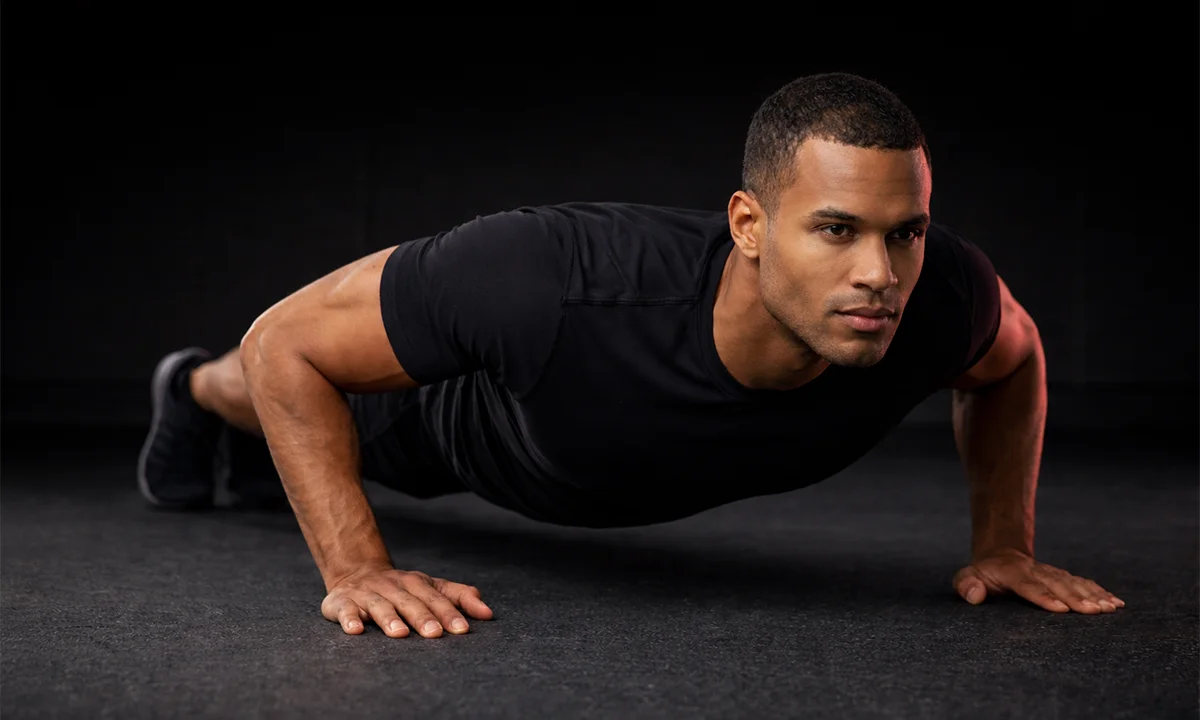
Place your hands slightly wider than shoulder-width. Think of actively screwing your palms into the floor, as if you were trying to rotate them outward without actually moving them. This creates shoulder stability and better chest engagement.
Your body should form a straight line from head to heels. Squeeze your glutes and brace your core before you even start moving.
2. The Descent
Lower yourself under control for two seconds. Inhale as you descend. Your elbows should travel at about a 30–45 degree angle from your body, forming an arrow shape, not a T. Lower until your chest is just above the floor.
3. The Press
Exhale forcefully as you push the floor away. Drive up in one strong second, maintaining full-body tension. Do not relax at the top.
Coaching cue: Think “chest down, chest up,” not “head down, head up.”
Common Push-Up Mistakes (And How to Fix Them)
Most push-up problems are instantly recognizable once you know what to look for.
The Banana Back: This happens when the hips sag toward the floor. It turns the push-up into a lower-back strain instead of a chest exercise. Fix: Tighten your glutes and abs before every rep.
The T-Shape: Elbows flaring straight out to the sides overloads the shoulders and reduces chest tension. Fix: Keep the elbows tucked into an arrow-like position.
Half Reps: If your chest never approaches the floor, you are leaving results behind. Fix: Reduce the reps, improve depth.
Rushing the Movement: Fast, uncontrolled reps rely on momentum. Fix: Slow down the lowering phase and own every inch.
Push-Up Variations: From Beginner to Advanced
Push-ups scale beautifully when you respect progression.
Beginner Variations
Incline Push-Ups: Hands placed on a bench or box. This reduces load while teaching proper mechanics.
Knee Push-Ups: Acceptable only if full-body tension is maintained (don't leave your hips behind).
Standard Push-Ups
This is your baseline. Master clean, controlled reps here before chasing numbers.
Chest-Focused Variations
Wide Push-Ups: Hands placed wider to increase chest emphasis and reduce triceps contribution.
Decline Push-Ups: Feet elevated. This shifts more load to the upper chest and shoulders.
Advanced Variations
Diamond Push-Ups: Hands close together, forming a diamond. These are triceps-dominant but excellent for elbow strength and lockout power.
Deep Push-Ups (The Hypertrophy King): Performed using push-up bars or plates. The increased range of motion places the chest under a deeper stretch, which is highly effective for muscle growth.
The Physiology: Strength, Stamina, or Cardio?
Push-ups are best described as strength-endurance training.
They build strength because you are repeatedly pushing a significant percentage of your bodyweight. They build stamina because the chest, shoulders, and arms must sustain repeated contractions over time.
Push-ups can become cardiovascular when performed in circuits, high-rep sets, or short-rest intervals. However, their primary adaptation is muscular, not aerobic.
In short: Push-ups absolutely increase stamina, while still building functional strength.
How Many Push-Ups Should You Do? (Stop Chasing Numbers)
Instead of aiming for a fixed number like 20 or 50, use Reps in Reserve (RIR).
Perform each set until you feel you could only complete one or two more perfect reps. This keeps form clean and intensity high.
For most people:
3–5 sets
Stopping at RIR 1–2
Resting 60–90 seconds
This approach scales automatically as you get stronger.
Push-Ups vs Bench Press: Which Is Better for Chest?
Neither is “better.” They serve different roles.
Bench Press: Allows heavy loading and is excellent for maximal strength and size.
Push-Ups: Develop body control, endurance, joint health, and chest activation through full ranges of motion.
The strongest chest routines use both, not one instead of the other.
Frequency, Warm-Up, and Recovery
Frequency: Push-ups can be trained 3–5 times per week if volume is managed.
Warm-Up: Before starting, spend a minute on wrist circles and light shoulder mobility. Remember, a push-up is essentially a dynamic plank, so core fatigue matters.
Recovery: If your elbows or shoulders feel irritated, reduce volume, slow the tempo, and prioritize recovery.
Conclusion: Your Challenge
Push-ups are simple, but they are not easy. When performed with intent, they build a strong chest, resilient shoulders, and real-world strength that transfers beyond the gym.
Ready to start? Drop down right now and test your clean max reps. Then use this guide to add five quality reps to that number by next week.
Consistency beats complexity. Every time.
Frequently Asked Questions
Yes. Regular push-ups significantly improve muscular endurance in the chest, shoulders, and arms.
They build chest strength and size, especially with deep and decline variations. For maximum hypertrophy, combine them with weighted presses.
They are primarily strength-endurance, with cardio benefits when performed at high intensity.
Most people can train push-ups 3–5 times per week with proper recovery.
Deep push-ups and decline push-ups provide the greatest chest stimulus.